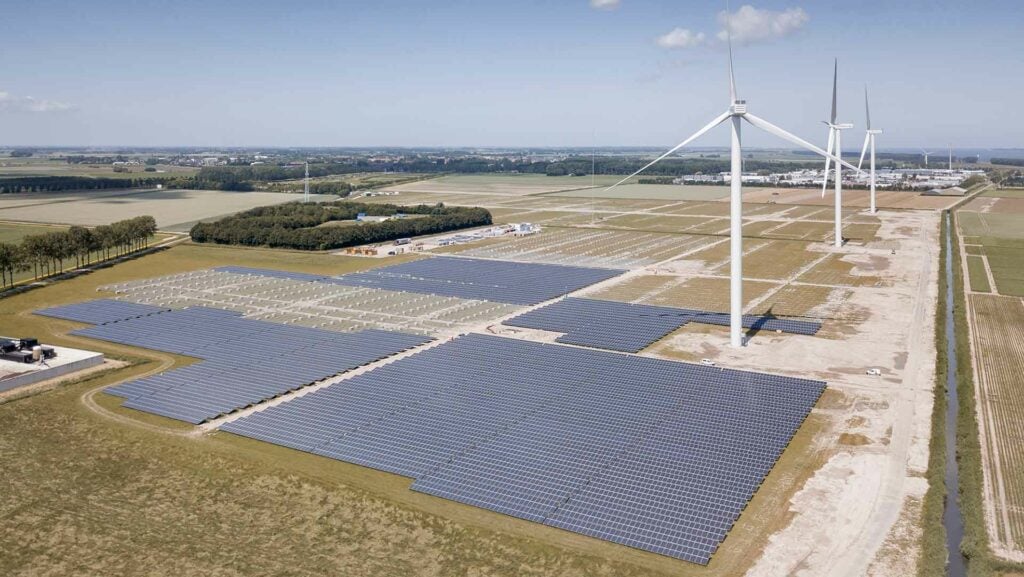
Swedish public utility Vattenfall has opened its Energypark Haringvliet in the Netherlands, which combines wind, solar and a 12MWh battery energy storage system (BESS).
The project, located 20km south of Rotterdam, features six wind turbines, 115,000 solar panels and a BESS with 12MWh of energy capacity. The 150m wind turbines have a max power output of 22MW while the solar farm can generate 38MW.
Energypark Haringvliet is a true hybrid renewable generation-plus-storage project with the BESS connected to the generating units allowing it to smooth out intermittency. The batteries will also be used for grid balancing.
Vattenfall’s announcement focused a lot on the fact that the three technologies all share the same substation, cables and most importantly grid connection. Grid congestion is a major problem in the Netherlands, according to a panellist speaking at Energy Storage Summit 2022 last month (produced by Energy-Storage.news’ parent company Solar Media).
Try Premium for just $1
- Full premium access for the first month at only $1
- Converts to an annual rate after 30 days unless cancelled
- Cancel anytime during the trial period
Premium Benefits
- Expert industry analysis and interviews
- Digital access to PV Tech Power journal
- Exclusive event discounts
Or get the full Premium subscription right away
Or continue reading this article for free
A total of €61 million (US$67 million) has been invested into Energypark Haringvliet.
BELECTRIC built the solar park while energy solutions integrator Alfen supplied the BESS, which uses 288 of the same batteries that go into BMW’s i3 electric car. Alfen has previously worked with Vattenfall using BMW batteries for a similar projects in Wales using wind.
“The opening of Haringvliet is a great step for Vattenfall’s wind and solar business, a proof point for our competence to develop and build cross technology projects in Europe,” said Claus Wattendrup, head of Solar at Vattenfall.
Pairing solar with storage is now fairly commonplace and often accounts for the majority of new storage deployment. Pairing with wind, however, is less common.
As Energy-storage.news wrote in a feature on the topic, one issue is that markets often do not have a regulatory classification for storage, let alone storage-plus-solar or storage-plus-solar-plus-wind. This, and the general complexity that comes with combining three technologies, makes it more difficult for grid operators and project developers to do the required modelling about how a project’s output will affect the grid.
Another issue for solar and wind hybrids is fairly different geographical features required for a site meaning a rare overlap. Wind turbine parks also have much longer construction times than solar and energy storage portions, making project delivery a delicate balancing act.
The Netherlands is a bit behind some other Western European countries on deploying storage but this could soon start to change according to a national sector body. One big positive has been the removal of double taxation for storing and later selling energy, removed at the start of 2022.
However, energy storage is still classified as an energy consumer and so is charged transportation costs for drawing from the grid, even though it will later re-inject that energy back in with little-to-no-loss.
Vattenfall is a Swedish multinational power company owned by the state but it also operates in Denmark, Finland, Germany, the Netherlands and the UK.
The project specifications in this article are from earlier press releases about Haringvliet – we’ve asked Vattenfall to confirm their accuracy but have yet to receive a response at the time of writing.