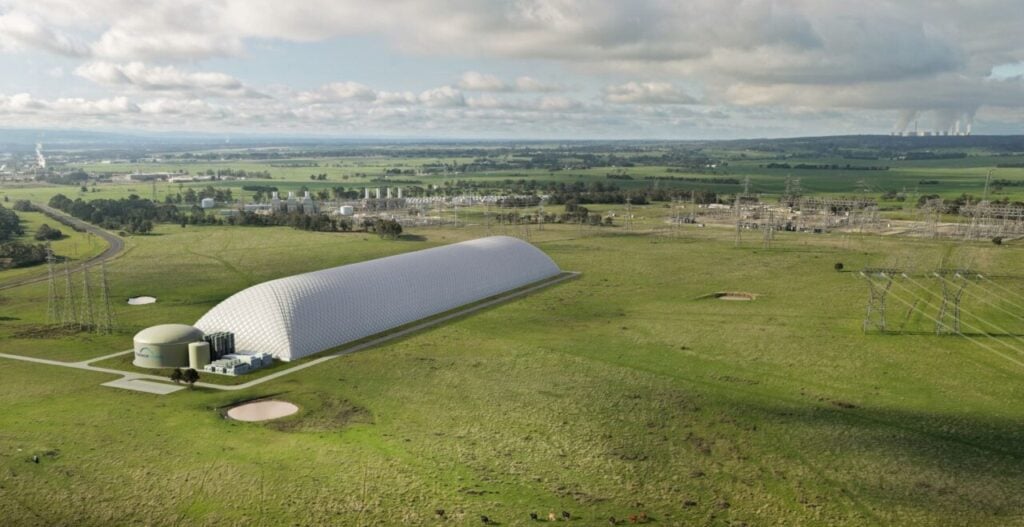
Victoria’s State Electricity Commission (SEC) and Italian clean technology company Energy Dome have announced plans to develop the state’s first long-duration energy storage (LDES) facility.
The LDES project will feature a 20MW/200MWh compressed CO2 system capable of continuously supplying electricity for 10 to 12 hours, at a new energy innovation precinct in the Latrobe Valley.
The project will be housed at SEC Energy Works, a 143-hectare site at Hazelwood North that the SEC is establishing as a space to partner with industry on new energy infrastructure and storage technologies.
It will also be Australia’s first commercial deployment of closed-loop, compressed CO2 energy storage technology.
Try Premium for just $1
- Full premium access for the first month at only $1
- Converts to an annual rate after 30 days unless cancelled
- Cancel anytime during the trial period
Premium Benefits
- Expert industry analysis and interviews
- Digital access to PV Tech Power journal
- Exclusive event discounts
Or get the full Premium subscription right away
Or continue reading this article for free
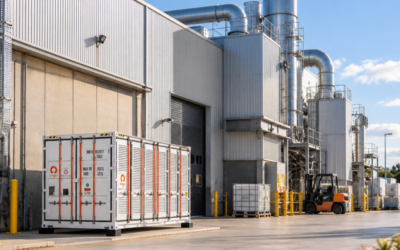
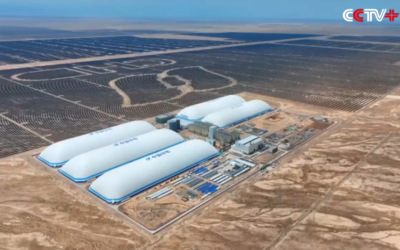
Energy Dome’s branded CO2 Battery technology stores energy by using electricity to compress carbon dioxide gas into a liquid state during charging, then releasing the stored energy by expanding the CO2 through turbines when power is needed, in a closed-loop thermodynamic process.
Unlike lithium-ion battery systems that dominate Australia’s current storage fleet, the approach relies on conventional industrial components, such as compressors and turbines, familiar to the Latrobe Valley’s existing engineering workforce.
SEC CEO, Chris Miller, said long-duration energy storage will need to play a system-level role as Victoria advances toward its 65% renewable energy target by 2030.
“As an integrated generator and retailer of 100% renewable electricity to commercial and industrial customers, we envisage long-duration energy storage will play a critical role in balancing our portfolio, enabling SEC to provide additional support to the system during multi-hour or multi-day wind or solar droughts,” Miller said.
Energy Dome founder and CEO Claudio Spadacini said the Latrobe Valley’s workforce made it a natural fit for the technology.
“Our CO2 battery delivers 10 to 12 hours of clean, dispatchable power, using proven compressor and turbine technology familiar to the Latrobe Valley workforce. This project will help support the region’s transition from coal while maintaining the engineering skills that have powered Victoria for generations,” Spadacini said.
Planning and design for the project have begun, with early stakeholder and community consultation now underway.
ESN Premium recently sat down with Energy Dome board member and COO of its energy storage-as-a-service division, Ben Potter, for an exclusive interview, which will be published next week.
Victoria’s storage fleet and the LDES gap
Victoria has seen rapid growth in short-duration battery storage in recent years. The 600MW/1.6GWh Melbourne Renewable Energy Hub was brought online at Plumpton in December 2025, jointly developed by Singapore-based Equis Australia and the SEC, and configured across three separate battery systems with two and four-hour storage durations.
The project, valued at AU$1.1 billion (US$770 million), forms part of the SEC’s broader program targeting 4.5GW of new renewable energy and storage capacity across the state.
That pattern of 2-4-hour deployments reflects the broader Australian market, where battery storage has expanded rapidly but has concentrated on shorter durations suited to smoothing morning and evening demand peaks.
Long-duration storage, generally defined as 8-hours or more, addresses a different problem: extended periods of low wind or solar output that shorter systems cannot cover.
Readers of Energy-Storage.news might be aware that Energy Dome ranked as the highest-placed non-lithium company in a new LDES supplier leaderboard published by research and consultancy firm Sightline Climate in January 2026, placed third overall behind Tesla and Chint Power.
Sightline cited Energy Dome’s two commercial projects past final investment decision, higher round-trip efficiency than other mechanical storage technologies, and competitive capital costs as the factors setting it apart from other non-lithium providers.
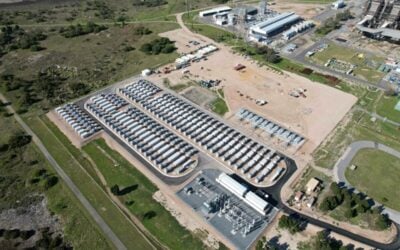
The company’s first commercial project, a 20MW/200MWh system in Sardinia, Italy, has been in operation for about a year with utility Engie as its offtaker. Energy Dome has since been expanding its commercial pipeline across multiple markets.
For instance, in June 2026, it signed its second supply contract with Google for a 23MW/200MWh project in County Offaly, Ireland, to be built, owned and operated by Energy Dome under a tolling agreement, with the project also holding a 10-year capacity market contract from the Irish grid operator. That contract was won in competition with thermal generation, hydro and battery storage.
Meanwhile, in Arizona, Energy Dome is also advancing a 19MW/190MWh project with utility Salt River Project and Google, under a 20-year tolling agreement, co-located at a former coal-fired power station site. The Arizona project is expected to come online in 2029.
Energy Dome’s Ben Potter told Energy-Storage.news that the Google projects are expected to be the first of many in a multi-gigawatt-hour global rollout, following the tech giant’s mid-2025 strategic investment in the startup that established their commercial partnership.
Our publisher, Solar Media (part of Informa Group), will host the Battery Asset Management Summit Australia 2026 on 25-26 August at Amora Hotel Jamison in Sydney. You can find out more about the Summit on the official website.