
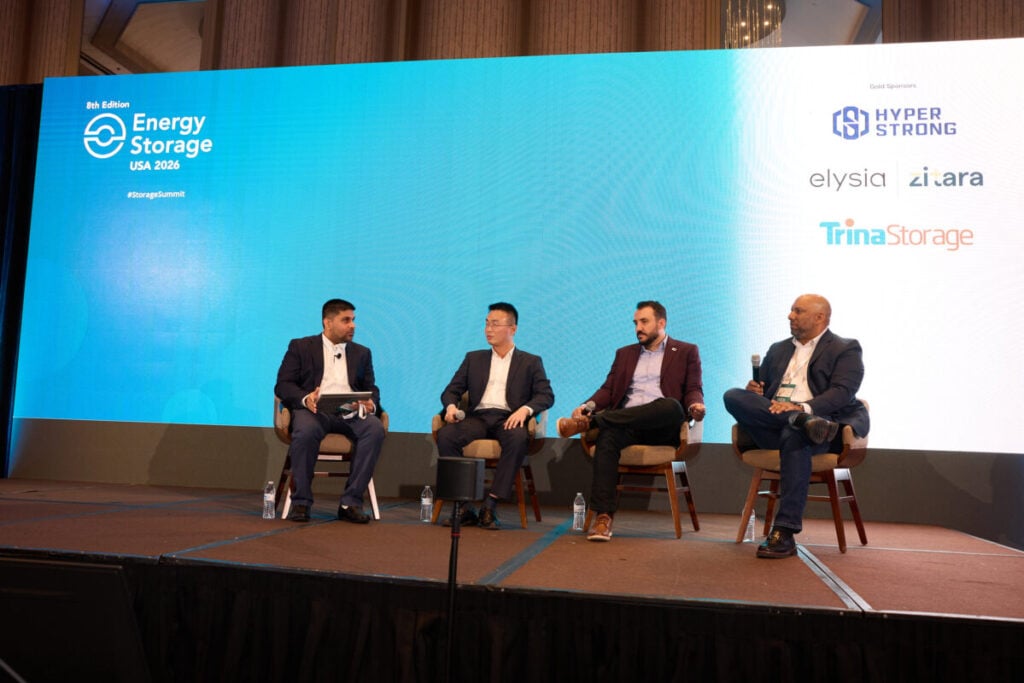
Energy-Storage.news speaks with Raafe Khan, head of energy storage at Camelot Energy Group, ahead of the upcoming Battery Asset Management Summit (BAMS) USA in Garden Grove, California.
Battery energy storage system (BESS) developers and especially long-duration energy storage (LDES) developers have increasingly been making agreements to power AI infrastructure.
CO2 Battery startup Energy Dome’s Ben Potter told ESN Premium in July that hyperscale data centres’ massive power requirements have sparked “an explosion of demand for long-duration energy storage,” especially across the US.
With LDES’ increase in popularity questions are emerging about market evolution—how will economics shift as supply scales, demand patterns change, and alternative technologies mature?
Try Premium for just $1
- Full premium access for the first month at only $1
- Converts to an annual rate after 30 days unless cancelled
- Cancel anytime during the trial period
Premium Benefits
- Expert industry analysis and interviews
- Digital access to PV Tech Power journal
- Exclusive event discounts
Or get the full Premium subscription right away
Or continue reading this article for free
Khan argues that current capacity market structures in the US are systematically undervaluing duration, creating a financial environment where doubling a battery’s discharge capability yields only marginal revenue gains.
Meanwhile, short commitment tenors and administrative price caps further compress returns, making it difficult to justify the capital intensity of long-duration projects. The result is a market that talks about the need for 8-, 10-, and 12-hour BESS but provides few economic pathways to build them at scale.
In this interview, Khan dissects the structural flaws in capacity markets, explains why data centre demand is an “accelerant” rather than a foundation for storage growth, and why vertical integration is becoming essential—not for margin expansion, but for risk management.
Energy-Storage.news: What’s the disconnect between what utilities are willing to pay for resource adequacy and what makes LDES projects financeable?
Raafe Khan: I would categorise the disconnects into three buckets. The first is accreditation—specifically the Effective Load Carrying Capability (ELCC) accreditation. Using PJM as an example, their published ELCC ratings for the latest capacity auction had a four-hour battery at 59%, a six-hour battery at 68%, and an eight-hour battery at 71%.
Doubling the duration from four to eight hours only buys you 12 points of increased unforced capacity for roughly double the energy. The accreditation metric almost discounts duration as fast as duration costs money, which is a major disconnect.
The second issue is commitment tenor. These auctions typically award capacity for a one-year or three-year block, whereas these assets are meant to be 20 to 25-year assets. This is core infrastructure, and we need commitments longer than just three years because that puts tremendous pressure on asset owners to recontract and return to the market every few years to get reaccredited for an asset that has proven performance.
The third disconnect is on the administrative side. PJM has a cap on capacity pricing that’s been hitting the upper end for the last three auctions—most recently at around US$325-per-MW-day. The cap binds when the market is short, so we’re not sending the right price signal to develop more assets at certain durations or capacities.
With data centres emerging as major battery storage customers, how does the value proposition and project structure differ when serving captive loads versus wholesale markets?
The convergence of data centres and BESS has only been spotlighted in the last 12 to 18 months at most. I really think data centres are a margin play for BESS, because what captive batteries are actually selling is not energy—it’s time, the ability to interconnect faster than the conventional process.
There was an example where Aligned Data Centres procured a battery from Calibrant Energy in the Pacific Northwest with a local utility, and that captive battery helped them move through the interconnection process faster by providing firm capacity of up to four hours during high-demand periods. The anchor is really the opportunity cost of interconnection, not purely the levelised cost of storage (LCOS).
In wholesale markets, it’s a completely different paradigm because you’re dealing with real-time power pricing, day-ahead markets, and ancillary markets. That’s where LCOS becomes much more important, and optimisation becomes critical from a revenue profile perspective.
I would add that BESS for data centres is a margin play—it’s an accelerant, but it’s not the foundation for increased interest in the battery storage market. The driver for BESS is really being able to capture peaks and troughs in the form of energy arbitrage due to intense solar and wind buildout depressing power pricing in the middle of the day. That’s a structural driver for deployment.
Do standalone BESS companies have a sustainable competitive moat, or is vertical integration becoming essential?
In my observation, upstream integration has not paid off. When you look at the data, vertically integrated cell and system companies have been losing market share in the last few years, primarily driven by prices falling and more optionality in cell architecture. Integrators like Sungrow and Hyperstrong have grown their market share.
I think vertical integration is becoming essential for reasons outside of margin. When you look at Tesla’s commitment to LG for domestic lithium iron phosphate (LFP) cells, it’s not a pure bet on cell margins—they’re riding through the tariffs and any policy insurance or schedule uncertainty, all three of which can kill projects.
Companies that do one thing really well and then slowly expand horizontally are the ones having the best outcomes. When you look at institutions that have spread themselves thin and tried to vertically integrate everything too quickly, we have examples like Powin that filed for Chapter 11.
At what project duration or use case do the economics most favour alternative technologies, particularly for LDES?
There are a few use cases where alternative technologies beat lithium-ion (Li-ion). Beyond 10 to 12 hours, when you’re cycling between 100 to 200 cycles a year and your asset is paid for availability, Li-ion’s cycle life advantage is almost worthless.
It becomes all about the cost of energy. The trade-off is you have lower round-trip efficiency (RTE) for non-lithium solutions, which only works when you’re charging at negative power prices—either you’re not paying for power or you’re getting paid to charge.
The other use case is between 8 to 12 hours, where asset life and ambient conditions become more important. Hydrostor, that does advanced compressed air. They’re looking to operate for 50 years versus a traditional Li-ion battery, which operates for 20 to 25 years at best. A 50-year life without augmentation rewrites the whole calculation for LCOS.
In the four-hour category, lithium dominates, but where lithium could be unseated is where you have the non-flammable aspect. If you have a non-flammable, non-lithium solution, you can command a premium for pricing. For example, if you’re sitting next to a multi-billion-dollar data centre, their insurer will impose stricter requirements for fire safety, and insurance costs will go up. The argument there is insurability, not purely cost.
We can’t talk about non-lithium without talking about sodium-ion (Na-ion). I think Na-ion is a hedge against lithium rather than a true long-duration play. Even though Na-ion loses on a few accounts against lithium in terms of performance, it’s all about cost hedging, not particularly duration. Companies like CATL investing heavily in Na-ion research are trying to reduce dependence on Li-ion supply chains.
Are current capacity market structures adequately valuing the resource adequacy benefits of LDES?
There are three genuine design flaws. First, the tenor issue—one to three-year commitments cannot underwrite capital-intensive, long-life assets with little to no merchant exposure.
Second is the duration issue we discussed with PJM, where there’s such a big gap between the accreditation value and cost that it almost doesn’t reward developers to think about long duration because the incremental yield is so low. CAISO is even worse because it gives no incremental credit past four hours and cannot represent anything past 12 hours.
Third are the administrative caps. The last three auctions in PJM hit the cap, which was binding during a well-documented shortage. This suppresses the signal that should drive more entry.
When I compare how capacity markets are structured here versus overseas—taking Great Britain as an example—an eight-hour battery in PJM today has an ELCC of 71%. The same battery in the UK is about 84%, a pretty sizeable spread. Where it diverges even further: in PJM your commitment tenor is one to three years, whereas in the UK it’s up to 15 years.
Khan will be speaking on a resource adequacy and LDES panel at BAMS with participants Mitchell Bauer, president at developer GCI; Jacob Steubing CCO at IPP Linea Energy; and moderated by Lukasz Cianciara, founder and operating partner at advisory and management firm Silmera. He will also be participating in a panel at the Solar & Storage Financing event, taking place at the same location.
ESN Premium subscribers will be able to read more from our interview with Khan in a feature article to be published in the coming days.
Battery Asset Management Summit USA 2026 will be held 15-16 September in Garden Grove, California, hosted by Energy-Storage.news publisher Solar Media (part of the Informa Group). The agenda emphasises addressing the roles of AI, cybersecurity, and second-life applications, broken down into two tracks: Technical Asset Management and Commercial Asset Management. This year, the conference is also co-located with Solar & Storage Finance Summit USA. Visit the official site for more details.
