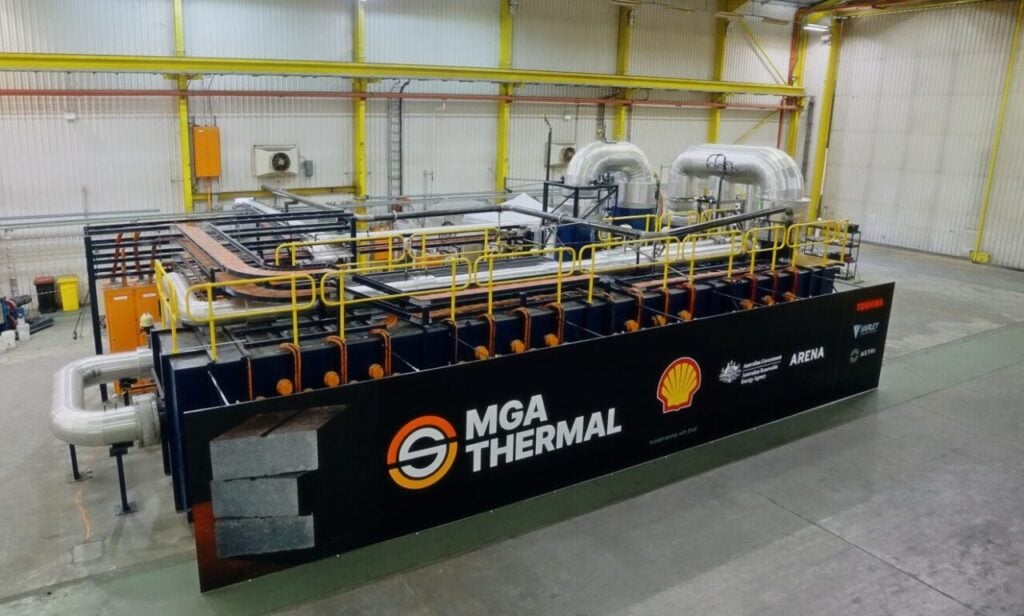
EtaPRO LLC has deployed its monitoring, digital twin and predictive analytics technology at MGA Thermal’s 5MWh thermal energy storage demonstration plant in Tomago, New South Wales, Australia.
It has been delivered in partnership with Toshiba International Corporation, EtaPRO’s parent company.
MGA Thermal is an Australian company developing long-duration thermal energy storage technology aimed at industrial process heat, one of the more difficult sectors to decarbonise, given its reliance on continuous high-temperature energy.
Its system, based on patented MGA Blocks, stores renewable energy as latent heat via a solid-to-liquid phase change in an alloy, then dispatches it on demand as high-grade process heat or steam.
Try Premium for just $1
- Full premium access for the first month at only $1
- Converts to an annual rate after 30 days unless cancelled
- Cancel anytime during the trial period
Premium Benefits
- Expert industry analysis and interviews
- Digital access to PV Tech Power journal
- Exclusive event discounts
Or get the full Premium subscription right away
Or continue reading this article for free
EtaPRO is a Toshiba Group company that provides performance monitoring, diagnostics, and digital twin software, originally developed for conventional power generation assets.
Under the partnership, EtaPRO has applied three components of its platform to the Tomago site: an Archive historian to consolidate and visualise operational data, a VirtualPlant tool to build a thermodynamic digital twin of the demonstration plant, and an APR advanced pattern recognition system designed to flag operating behaviour outside expected parameters.
Akira Sasaki, assistant CEO at EtaPRO, said digital intelligence would play a role in accelerating the adoption of new energy technologies as long-duration storage moves toward broader commercial deployment.
“As the energy industry continues to evolve, digital intelligence will play a critical role in accelerating the adoption of new technologies. We are proud to work alongside MGA Thermal and our Toshiba colleagues to bring proven monitoring, diagnostics, and digital twin capabilities to this pioneering energy storage project,” Sasaki said.
“Together, we are helping transform operational data into actionable insights that support performance, reliability, and confidence as long-duration energy storage moves toward broader commercial deployment.”
From a troubled demonstrator to a commercial pipeline
The Tomago plant has a track record predating this partnership. MGA Thermal completed what it described as the world’s first industrial steam heat energy storage demonstrator at the site in April 2025, storing 5MWh of energy across roughly 3,700 MGA Blocks and delivering continuous superheated steam for 24 hours.
That demonstration followed an overheating incident at the same site in 2023, when emergency services were called after a dangerous heat build-up was detected early in the morning, an episode the company described at the time as a reminder of the risks inherent in developing large-scale, first-of-a-kind storage technology.
MGA Thermal has since moved toward commercial deployment. The company raised AU$8.5 million (US$5.47 million) in an earlier funding round backed by investors including Shell Ventures and Belgian venture capital firm Finindus, and secured AU$3.25 million from the Australian Renewable Energy Agency (ARENA) in February 2026 to fund up to five front-end engineering design (FEED) studies for industrial customers under ARENA’s Powering the Regions programme.
One of those studies, conducted with Australian industrial solutions company Knode, is examining a 195MWh electro-thermal energy storage system for chemicals company Tronox’s Kwinana facility in Western Australia, with construction targeted for 2027 and commercial operation the following year.
The Tomago demonstration plant now holds a Technology Readiness Level of 8, according to EtaPRO, and the digital twin deployment is intended to support that pathway by allowing MGA Thermal to simulate operating scenarios and validate performance under customer-specific conditions before committing to full-scale builds.
MGA Thermal’s demonstration plant is located in Tomago, the same Hunter Region suburb as the Tomago Aluminium smelter. The Australian and New South Wales governments jointly committed AU$2.5 billion to secure a renewable energy supply for the nearby Tomago Aluminium smelter last week.
The Tomago Aluminium smelter is Australia’s largest single electricity user, and the deal highlights the scale of industrial demand that the Hunter region’s shift toward renewable energy and storage technologies is being built to support.
Industrial process heat accounts for a substantial share of global energy demand and has proven difficult to electrify directly, making long-duration thermal storage technologies, alongside alternatives such as molten salt systems and sand batteries, an area of growing investment as manufacturers look for ways to decarbonise continuous, high-temperature operations.
Never miss an Australian energy storage story. Sign up for our Australia newsletter and get the latest project announcements, policy updates and market analysis delivered directly to you.
Solar Media (part of Informa Group) will host the Battery Asset Management Summit Australia 2026 on 25-26 August at the Amora Hotel Jamison in Sydney, bringing together asset owners, operators, trading teams and optimisers to address revenue strategy, lifecycle management and operational performance across Australia’s fast-growing battery storage fleet.
Readers of Energy-Storage.news can get 20% off their tickets using the code ESN20 at checkout. Find out more about the Summit on the official website.