India’s Union government has approved the next IR145 billion (US$1.5 billion) phase of the Viability Gap Funding (VGP) policy support mechanism for energy storage capacity additions.
In addition, a Ministry of Power official has reportedly said state power companies will likely soon be required to include energy storage in new renewable energy developments.
Announced earlier this week (4 November) by the office of Prime Minister Narendra Modi and the Press Information Bureau (PIB) of India following the Union Cabinet’s approval, the VGF scheme will offer Capex support to 92GWh of new energy storage deployments.
This will include 60GWh of pumped hydro energy storage (PHES), 30GWh of battery energy storage system (BESS) capacity and 2GWh of ‘alternative energy storage technologies.’
Try Premium for just $1
- Full premium access for the first month at only $1
- Converts to an annual rate after 30 days unless cancelled
- Cancel anytime during the trial period
Premium Benefits
- Expert industry analysis and interviews
- Digital access to PV Tech Power journal
- Exclusive event discounts
Or get the full Premium subscription right away
Or continue reading this article for free
Together, the capacity will represent an estimated IR976 billion in energy storage investments, the government said. A domestic content requirement of 40% has also been introduced.
It follows the initial running of the scheme that saw the government offer support worth up to 40% of project Capex to 4GWh of projects for delivery in 2030-2031 after it was put forward in the 2023-2024 Union Budget.
It was later expanded to support 13.2GWh of new capacity, before its dramatic expansion with an additional IR54 billion to support 30GWh of battery storage was revealed in a Ministry of Power press conference in June 2025.
At the beginning of this year, the government issued a significant ruling on the VGF scheme, stipulating that developers must utilise a minimum of 20% domestic content, a requirement that has now been doubled.
Prime Minister Modi posted a tweet to X (formerly Twitter) describing the latest approval as a “massive” push to develop storage capacity, highlighting the 40% domestic content rule as a “unique feature.”
“Store More → Import Less → Power India Round the Clock!” the tweet read.
State utilities to be handed energy storage mandates, Ministry of Power secretary says
The scheme has been instrumental in supporting India’s emerging energy storage sector. As the name suggests, it is intended as a bridge to support the commercial viability of energy storage.
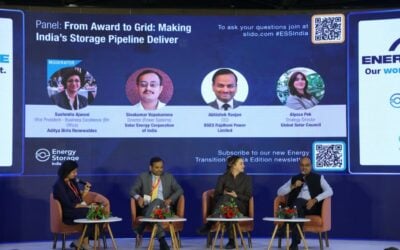
Many, including speakers at the recent Energy Storage Summit India 2026 in Greater Noida, have commented that VGF should therefore be a starting point as the industry matures, rather than a long-term crutch.
In an interview with Energy-Storage.news, Ateesh Samant, COO at independent power producer (IPP) Oyster Renewable, said that VGF “has been critical” in the early phase of the market, as was the waiver on Inter State Transmission System (ISTS) charges for co-located storage going online by mid-2028. Standalone BESS and PHES already receive waivers on those costs.
“The next step is to move from capital support to market design. That means markets that pay storage for the flexibility, capacity and grid services it provides,” Samant said, offering some recommendations such as increasing the spread between off-peak and peak electricity pricing.
At the India summit conference in October, Prashant Bhamu, deputy director of integrated resources planning at the Ministry of Power’s Central Electricity Authority (CEA) said India now has 5.3GWh of operational battery storage capacity and 185GWh under development.
CEA long-term resource adequacy planning indicates ~888GWh of energy storage capacity, including BESS and PHES, will be required by 2035-2036 across India, Bhamu said.
In other news, Ministry of Power secretary Pankaj Agarwal said recently that India will introduce mandatory energy storage capacity requirements for state utilities, Reuters news agency reported yesterday (5 November).
Speaking at the Bharat Renewable Energy Summit, the secretary also said more clean energy tenders related to energy storage will be forthcoming, although, according to Reuters, Agarwal added the situation was “fluid” regarding specific capacity addition requirements for state utilities.