Samsung SDI is on track to begin production of lithium iron phosphate (LFP) battery cells in the US in the third quarter of this year.
The South Korean battery manufacturer released its second quarter 2026 financial results last week (30 July), posting a return to operating profit for the first time in seven quarters.
Samsung SDI posted revenue of KRW3.77 trillion (US$2.59 billion) for Q2 2026, up 18.5% a year-over-year and up 5.4% quarter-on-quarter, alongside KRW203.8 billion in operating profit for the quarter.
The company had last been profitable in Q3 2024. Previously, it had seen a significant decrease in revenues in its battery business due to slowing electric vehicle (EV) battery sales. US tax incentives for consumer EV purchases ended in September 2025.
Try Premium for just $1
- Full premium access for the first month at only $1
- Converts to an annual rate after 30 days unless cancelled
- Cancel anytime during the trial period
Premium Benefits
- Expert industry analysis and interviews
- Digital access to PV Tech Power journal
- Exclusive event discounts
Or get the full Premium subscription right away
Or continue reading this article for free
Samsung SDI said in reporting its Q3 2025 results that it was putting energy storage system (ESS) sales at the heart of its turnaround strategy, particularly in the US, although in Europe it still aimed to capitalise on continued EV uptake.
This time out, the company reported a rebound in battery sales, with revenue of KRW3.52 trillion representing an 18.8% year-over-year increase and operating profit for the division of KRW159.3 billion.
The increase in battery sales came from high-power batteries for UPS applications, battery backup units (BBUs), power tools and European EV sales.
Samsung SDI reported a net profit of KRW471.6 billion, a 740.5% quarter-on-quarter increase, bringing the company back into profitability earlier than the second half of the year timeline it had previously guided.
The earnings recovery was driven by strong demand from AI data centre applications, particularly high-power products used in utility-scale battery energy storage systems (BESS), UPS and BBU systems, the company said. Profitability was achieved due to a better product mix, higher US advanced manufacturing production credit (AMPC) and favourable tariff impacts.
The earnings recovery is expected to continue through the second half of this year, Samsung SDI said, driven largely by ESS battery sales in the US and by EV battery sales in Europe, where it recently contracted to supply Mercedes-Benz. Samsung SDI is already a supplier to Germany’s two other premium car brands, BMW and Audi.
‘Reviewing options to secure additional capacity’ for US BESS cell manufacturing
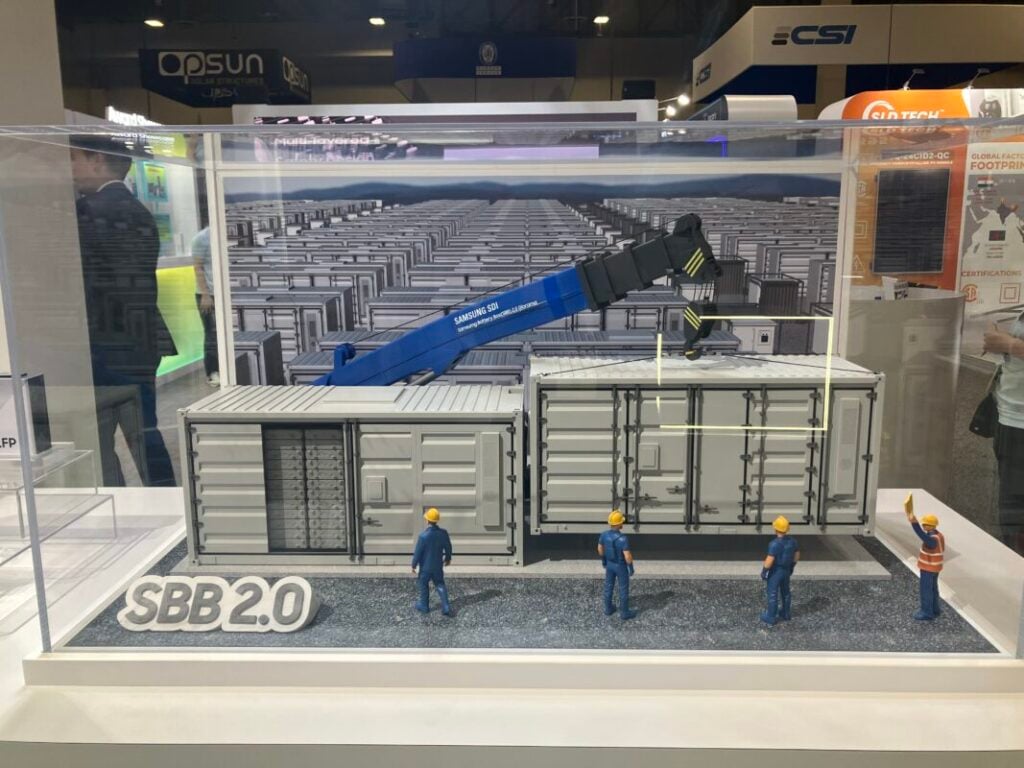
Samsung SDI announced last year that it would start producing battery cells for stationary storage applications, along with two complete BESS solutions, from US production lines. It debuted the two solutions in the Samsung Battery Box (SBB) range at the RE+ trade show in Las Vegas in September.
SBB 2.0 uses LFP cells in a 20-foot container, while SBB 1.7 uses nickel cobalt aluminium oxide (NCA) cells.
Importantly, production within the US ensures Samsung SDI receives the production tax credit (PTC) incentive, while customers can get the investment tax credit (ITC) for deploying the systems, including the 10% bonus adder for domestic content.
Since the ‘One Big Beautiful Bill Act’ (‘OBBBA’) passed last year, projects using Chinese imported cells deemed to originate from foreign entities of concern (FEOC) are ineligible for tax credits.
This has driven battery manufacturers in the US, including Samsung SDI and South Korean rivals LG Energy Solution (LG ES) and SK On, to repurpose EV cell production lines to produce BESS cells. It has also drawn new entrants into the market, such as Ford and General Motors.
Samsung SDI said in November last year that it aimed to open 30GWh of annual BESS cell production capacity in the US by the end of 2026 (ESN Premium article).
In an earnings call to explain Q2 2026 results, Samsung SDI executive VP Yonghui Cho said the US prismatic LFP cell line for ESS applications is “currently undergoing mass production quality validation.”
Cell production will begin in October, with customer deliveries of SBB 2.0 to begin before the end of this year, which Yonghui Cho said was in line with company plans. The executive VP said that establishing a supply chain for LFP materials is the key priority in preparing a non-FEOC supply chain, accounting for a significant share of product costs.
“Through a range of partnerships, primarily with Korean and US suppliers, we have secured in advance the necessary volumes of LFP cathode material. For other key components, we have also established a non-FEOC compliant supply chain through localisation of our partners,” Yonghui Cho said.
Samsung SDI is seeing “strong momentum in order intake” for its BESS segment, Cho said, with orders secured to date covering a substantial portion of capacity through 2029, and demand expected to exceed production capacity “from 2028 and onwards.”
“Against this backdrop, we are currently reviewing options to secure additional capacity and will update the market once our plans become more concrete,” Yonghui Cho said.
The company has also received orders for projects in South Korea awarded by the government in its 3rd Central Contract Market tender. It is also, like LG ES, advancing development of sodium-ion (Na-ion) batteries for data centre and large-scale BESS applications, although it did not offer timelines for commercialisation.
Samsung SDI noted that it secured long-term supply agreements with US BESS customers during the quarter. Although it did not refer to these in detail, they are thought to include a KRW1.5 trillion (US$1 billion) deal with an undisclosed customer announced in March.
Batteries covered by that agreement will include LFP and NCA cells, and be made at the StarPlus Energy plant in Indiana, operated by Samsung SDI’s joint venture (JV) with automotive OEM Stellantis.
LG ES, which is further ahead of Samsung SDI in establishing US BESS cell production lines, also recently reported a return to profitability.
US BESS adoption goes far beyond AI data centre boom, VP says
Samsung SDI leadership talked up the importance of AI data centres as a driver of battery demand in its results presentation and earnings call. However, ESS business executive VP Yonghui Cho said that even if the pace of data centre construction in the US were to slow down, the “structural growth trend in the US ESS market will remain intact.”
This is due to the continued growth of solar PV and wind generation amid rising electricity demand and “improving economies,” which are “driving steady growth in ESS demand to manage intermittency and support grid stability.”
A growing number of states are also setting ESS deployment targets and raising their planned installation capacity. Beyond renewable energy applications, ESS is increasingly being used as critical infrastructure to stabilise ageing power grids and facilitate smooth grid interconnection. Against this backdrop, ESS is set to play an increasingly critical role in the US power market,” Yonghui Cho said.
“We therefore expect any slowdown in AI data centre investment to have only a limited impact on our ESS business.”