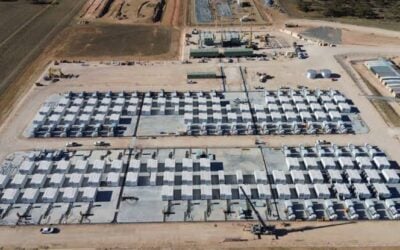
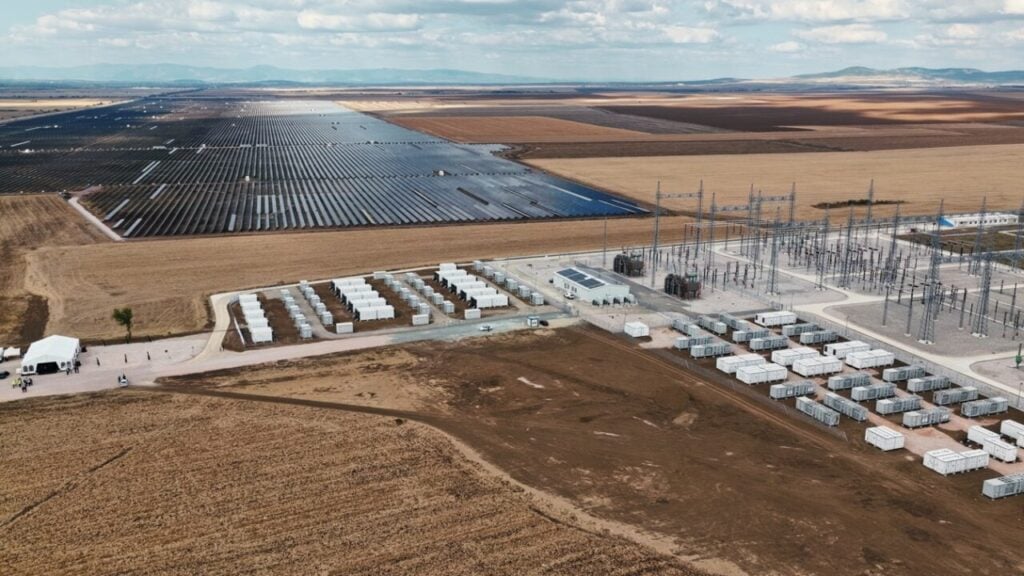
Renalfa IPP and Eurowind have brought a large-scale hybrid renewables project, featuring 242MWp of solar PV and 773MWh of battery storage, into commercial operation in Bulgaria.
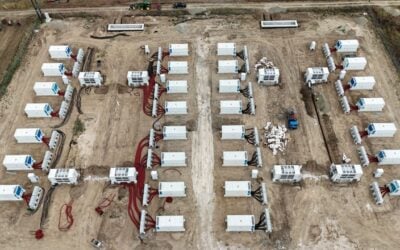
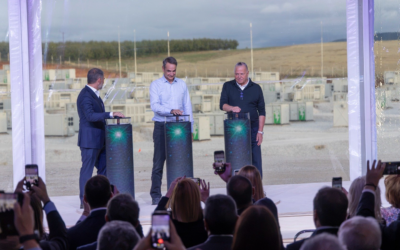
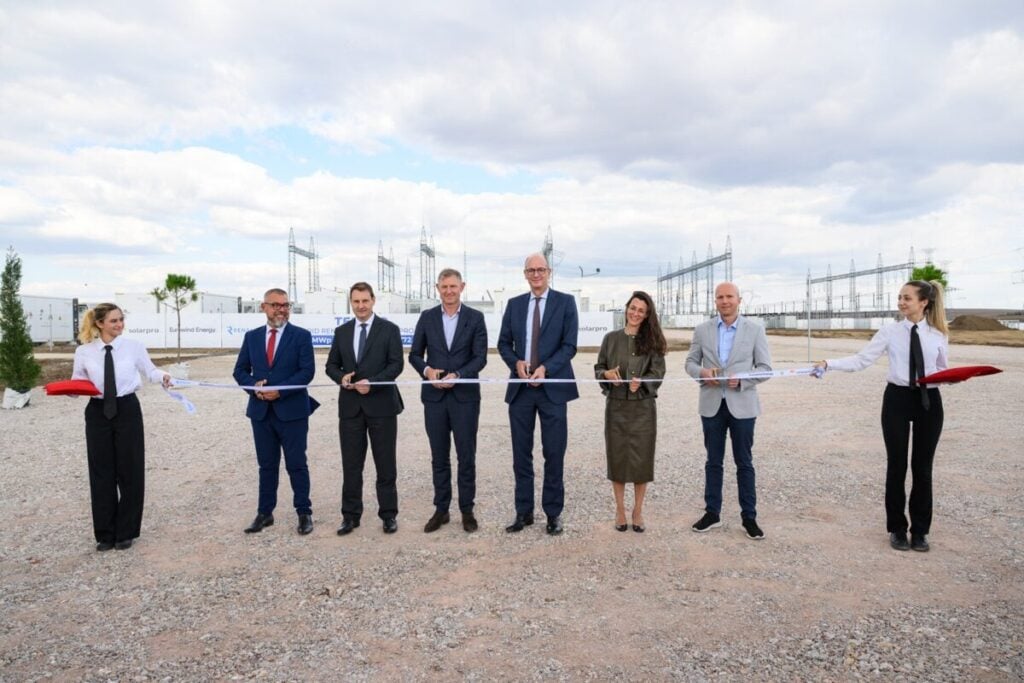
The pair announced the inauguration of Tenevo hybrid renewable energy complex in Tundzha Municipality, southeastern Bulgaria, earlier this week (30 September). Comprising a solar PV array and two co-located battery energy storage systems (BESS) totalling 311MW output,
It is jointly owned by Renalfa IPP—a joint venture (JV) between Austria’s Renalfa Solarpro Group and French investment manager RGreen Invest—and Danish developer Eurowind. Renalfa IPP and Eurowind formed a special purpose vehicle (SPV), Tenevo Solar Technologies, to develop and own the project.
The solar portion of the project was commissioned in Q1 of this year, by which time the first 65MW/260MWh BESS at the site was already in operation. Further BESS capacity was added in two subsequent phases, 144MW/300MWh and then 102MW/212.5MWh, respectively, giving Tenevo its total nameplate capacity of 311MW/772.5MWh.
Try Premium for just $1
- Full premium access for the first month at only $1
- Converts to an annual rate after 30 days unless cancelled
- Cancel anytime during the trial period
Premium Benefits
- Expert industry analysis and interviews
- Digital access to PV Tech Power journal
- Exclusive event discounts
Or get the full Premium subscription right away
Or continue reading this article for free
There are also longer-term plans to add 250MW of wind power generation at the site, although a timeline for this phase was not mentioned in this week’s announcement. The companies said the project aligns with a shared strategy of maximising the value of available grid connections through hybridisation.
“Tenevo complex is the first showcase in Europe of dispatchable renewable asset of that scale,” Renalfa Solarpro Group founder and chief executive Ivo Prokopiev said.
“Eastern Europe at the moment is changing the traditional energy transition playbook for investing and structuring of renewable projects.”
Bulgaria has the world’s most ‘battery-intensive’ power sector
Tenevo comes online as Bulgaria’s energy sector finds itself in perhaps the unlikely position of having the world’s highest share of battery storage relative to installed power capacity.
The country had around 5.4GW of operational battery storage as of the beginning of September, which is equal to 22.8% of all its installed power capacity.
Ivaylo Stanchev, editor-in-chief of Bulgarian business publisher Capital, pointed out in a recent Energy-Storage.news interview that California, the leading US BESS market, has far more installed capacity at 16GW, but this represents just 14.9% of all installed power capacity in the state.
“Bulgaria’s battery capacity relative to the size of its power system is therefore substantially higher. When we talk about absolute numbers, China is far, far away with 150GW of operating battery storage, but compared to the power system of the country, this is just 3.7%,” Stanchev told Energy-Storage.news.
“Bulgaria moved from a very small battery market to a level at which storage is already changing the daily operation of the electricity system in just two years.”
Recent research from low-carbon think tank Ember found that Bulgaria installed enough battery storage in 2025 to shift 77% of its newly installed daytime solar capacity, the highest level in the world, even above Chile’s 76%.
This has been despite political turmoil in the country. Triggers for growth have included European Union (EU) funding through the Recovery and Resilience scheme.
Through the scheme’s RESTORE programme (National Infrastructure for Storage of Electricity from Renewable Sources), Bulgaria’s Ministry of Energy selected 82 energy storage projects in April 2025 for a share of BGN1.15 billion (US$670 million at the time) in financial support.
A month after that, a 496MWh project was inaugurated, welcomed as the first step to achieving a national 10GW energy storage goal within the next year by Energy Minister Zhecho Stankov.
“Deployment is spread across the country. Some batteries have been added to existing or newly built solar parks, while many of the largest projects are standalone systems connected close to substations or existing grid infrastructure,” Capital’s Ivalyo Stanchev said.
Tenevo was also the first project to get a guarantee under the InvestEU programme. It was financed with EU50 million from the European Bank for Reconstruction and Development (EBRD) and EU53 million from Raiffeisen Bank International AG (RBI).
The two financial institutions committed their funding in November 2024, with an EBRD Sustainable Infrastructure executive noting that Tenevo is a “sizeable merchant project,” and strategically important in Bulgaria’s green energy transition, especially in the light of the ongoing conflict between Russia and Ukraine.
This came shortly after Chinese solar PV manufacturer JA Solar signed a deal with SolarPro to supply its n-type tunnel oxide passivated contact (TOPCon) DeepBlue 4.0 Pro modules to Tenevo. While BESS equipment used has not been publicly revealed, SolarPro signed a Master Supply Agreement (MSA) for 2GWh of BESS with Chinese OEM Hithium in mid-2025.
Energy Storage Summit Central & Eastern Europe 2026 takes place next week, 6-7 October 2026 at Warsaw Presidential Hotel, Poland. Energy Storage Summit Central and Eastern Europe serves as the essential meeting point for the most influential voices shaping the region’s power landscape. ESN readers can use the code ESN20 for a 20% discount on tickets at checkout. See the official website for more details.