
Bulgaria now has a world-leading amount of battery storage capacity relative to installed power capacity despite a period of political turnover, although those assets are now cannibalising the revenues that attracted investment in the first place.
That’s according to Ivaylo Stanchev, editor-in-chief of Bulgarian business publisher Capital, speaking to Energy-Storage.news. Stanchev will be among the speakers at the Energy Storage Summit Central and Eastern Europe (CEE) 2026, which is taking place in Warsaw, Poland, on 6-7 October (use our code ESN20 at checkout for a 20% discount on tickets).
He will be delivering the ‘Bulgaria’s Battery Boom: Inside the World’s Most Storage-Intensive Power Market’ presentation on day one, where he will discuss the country’s rapid battery energy storage system (BESS) buildout, which we’ve covered extensively. In this Q&A, he gives a teaser for what he’ll cover on the day.
Energy-Storage.news: How did Bulgaria overtake California to build the most battery-intensive energy system in the world?
Try Premium for just $1
- Full premium access for the first month at only $1
- Converts to an annual rate after 30 days unless cancelled
- Cancel anytime during the trial period
Premium Benefits
- Expert industry analysis and interviews
- Digital access to PV Tech Power journal
- Exclusive event discounts
Or get the full Premium subscription right away
Or continue reading this article for free
Bulgaria currently has 5.4GW of operating battery storage. This is equal to 22.8% of all installed power capacity in the country. In California, 16GW of operating in-state utility-scale batteries represent 14.9% of installed capacity. Based on the global benchmark we compiled from comparable operating data, this puts Bulgaria first in the world on this measure.

California still has almost three times more battery capacity in absolute terms, but its electricity system is more than four times larger: 107.3GW of installed capacity compared with 23.8GW in Bulgaria. Bulgaria’s battery capacity relative to the size of its power system is therefore substantially higher. When we talk about absolute numbers, China is far, far away with 150GW of operating battery storage, but compared to the power system of the country, this is just 3.7%.
For consistency, the comparison uses the 16GW of in-state utility-scale batteries reported by the US Energy Information Administration. California’s broader figure of 21.1GW also includes around 2GW located in neighbouring states and approximately 3 GWbehind the meter. But even with these megawatts, the ratio still remains below 20%.
And there is something not less important—Bulgaria moved from a very small battery market to a level at which storage is already changing the daily operation of the electricity system in just two years.
What is driving the rapid growth in investment?
EU recovery funding was the decisive trigger. One programme supported renewable projects combined with storage, while the other—the RESTORE scheme—focused on standalone batteries. The approved RESTORE projects received around €590 million (US$684 million) in grants and were expected to mobilise more than €1 billion in additional private investment. In fact, they mobilised almost €1.5 billion because the investors used smaller support for the projects—that was the main competition factor.
The timing also mattered. Bulgaria had already added a large amount of solar capacity, which led to cheap or negative electricity prices during midday hours, followed by much higher prices in the evening. Batteries offered a way to use this spread and to participate in the balancing market.
Despite repeated elections and short-lived governments, support under the recovery plan remained in place, and there wasn’t a new administrative burden. Investors had access to a funded programme with clear construction deadlines, and those deadlines concentrated a very large amount of deployment into a short period.
The economics of the next projects will be more difficult. With 5.4GW already connected and around 1GW expected in the coming months, batteries themselves are beginning to reduce some of the price spreads and balancing revenues that attracted the first investors.
Where is deployment taking place, and how does the front-of-the-meter market split between standalone and co-located BESS?
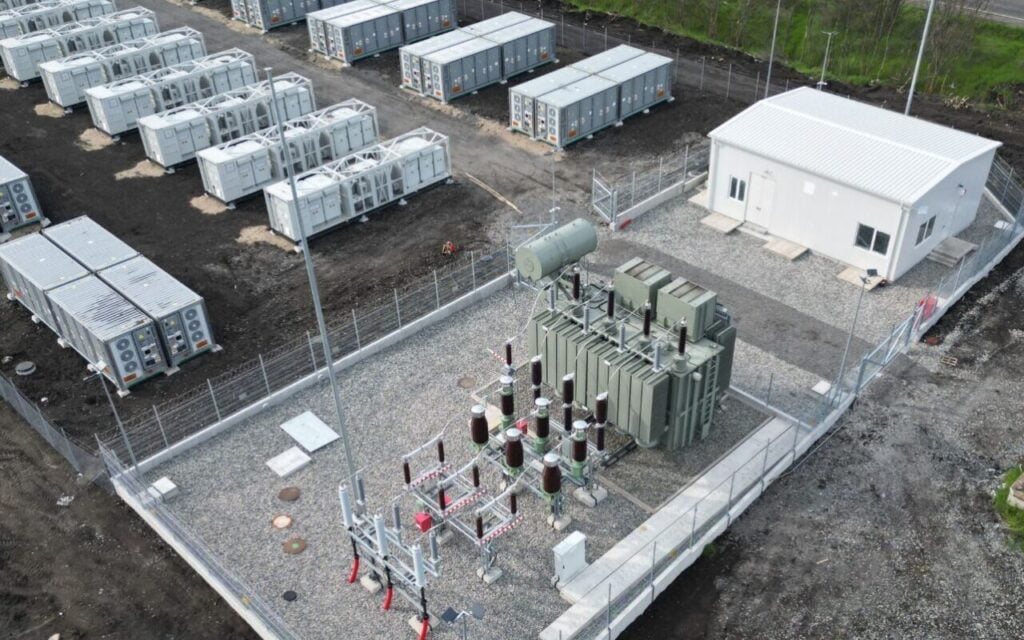
Deployment is spread across the country. Some batteries have been added to existing or newly built solar parks, while many of the largest projects are standalone systems connected close to substations or existing grid infrastructure.
Capital’s project-level database currently covers 100 operating projects with a combined capacity of about 4.84GW. Within this sample, roughly two-thirds of the capacity is standalone and one-third is co-located with renewable generation. The database covers most, but not all, of the 5.4GW reported at system level.
Both categories are front-of-the-meter. Bulgaria has no reliable statistics on residential or commercial behind-the-meter batteries, but the available evidence suggests that this segment remains very small. Regulated household electricity prices and the compensation mechanism limiting business consumers’ exposure to high market prices have weakened the economic case for such installations.
Who is investing in the market?
The ownership structure is quite diverse. International developers such as Renalfa, Enery, Rezolv and ContourGlobal are present alongside Bulgarian developers including Sunotec, Electrohold and Suntera. We also see industrial groups investing in their own renewable assets, as well as local entrepreneurs entering the energy sector through a battery project for the first time.
Larger projects typically combine an EU grant, own equity and bank debt. International institutions such as the EBRD and IFC are involved in some portfolios, together with commercial banks including UniCredit, DSK/OTP, UBB/KBC, Raiffeisen International, Citi and Eurobank.
Public support made construction easier to finance, but it does not guarantee future revenues. Some of the new investors have limited experience in electricity trading or operating flexible assets. Their results will increasingly depend on dispatch strategy and access to different markets, rather than simply owning a battery.
