ACEN Corp, the renewable energy platform of Philippines conglomerate Ayala Corporation, has loaned PHP9 billion (US$144 million) to subsidiaries within the group for renewable energy and battery storage projects.
In transactions disclosed to the Securities and Exchange Commission (SEC) of the Philippine Stock Exchange (PSE) on 3 September, ACEN Corporation said it executed two short-term loan agreements with its wholly owned subsidiaries.
In the first, ACEN Corporation agreed to lend project developer subsidiary GIGA ACE 8 up to PHP3.24 billion. The loan is intended to support the construction of Palauig 2, a 300MWdc solar PV project, including transmission and substation infrastructure.
Palauig 2 joins the existing 65MW Palauig 1 plant, which was completed in 2021 in Zambales, in the Central Luzon region. It is one of the areas with the highest solar irradiance in the Philippines.
Try Premium for just $1
- Full premium access for the first month at only $1
- Converts to an annual rate after 30 days unless cancelled
- Cancel anytime during the trial period
Premium Benefits
- Expert industry analysis and interviews
- Digital access to PV Tech Power journal
- Exclusive event discounts
Or get the full Premium subscription right away
Or continue reading this article for free
In 2023, as construction began on the project, ACEN Corp said Palauig 2 would require a 1,200MW transmission line, with the estimated total cost at PHP16 billion at the time.
Meanwhile, the other PHP6 billion loan agreement was signed with ACEN Corp subsidiary Sanmar Solar.
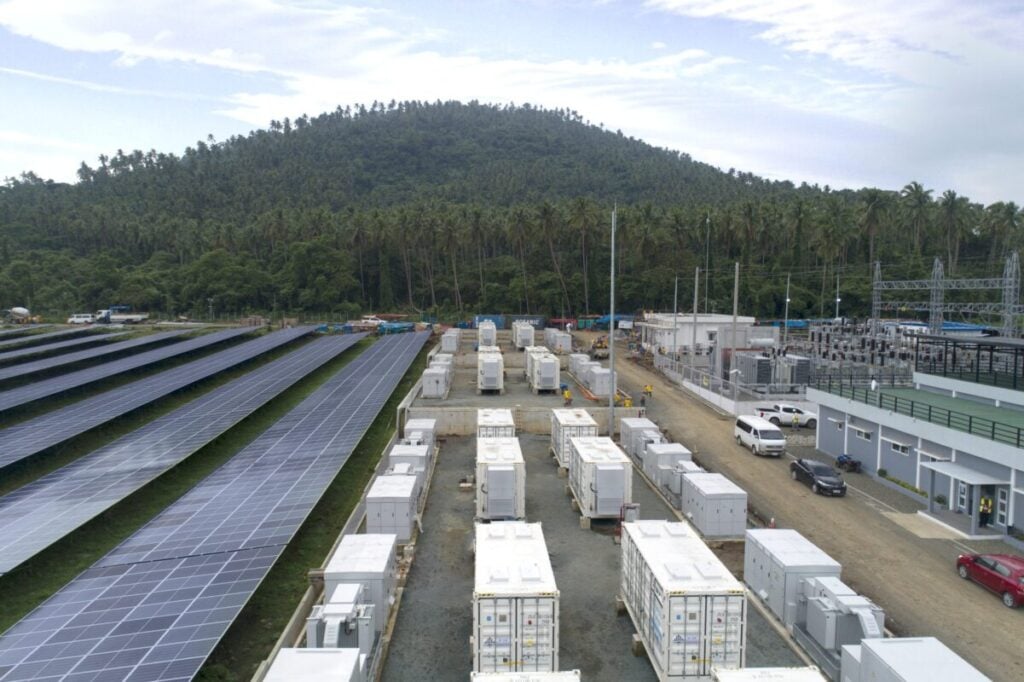
The loans to Sanmar Solar will support the construction of SanMar Battery Energy Storage System Project. The 500MW/1,000MWh battery energy storage system (BESS) will be installed at the site of SanMar Solar, an existing 585MW solar PV plant, also in Zambales province.
SanMar Solar repurposed land that had lain idle and was otherwise unusable, due to its coating of lahar, debris left in the aftermath of a volcanic eruption.
For ACEN Corp, which also has significant renewable energy and energy storage portfolios in Australia and India, the Philippines remains its largest market by far. The company reported a 17% year-on-year increase in renewable energy generation and 41% increase in revenues in the Philippines in its recent H1 2026 results.
In July, the company said it is turning Zambales into one of the country’s largest renewable energy hubs, with the SanMar Solar and Palauig Solar projects alongside 775MW/1,660MWh of BESS projects it now has under construction in the province.
ACEN was the developer of the Philippines’ first-ever hybrid solar-plus-storage project, piloting the combination of 120MW solar PV generation capacity with two 20MW/40MWh BESS facilities, inaugurated in 2022.
Since then, the Philippines has raced to become the leading country in Southeast Asia for battery storage deployments, largely due to market design that allows asset owners to stack revenues from multiple applications.
National legislation to create a framework for energy storage development, utilisation and commercialisation was passed at the beginning of this year, and in February the government Department of Energy (DOE) issued instructions that large-scale renewable energy plant developers integrate energy storage into their proposals.
Read coverage from, and related to, the Energy Storage Asia Summit 2026, which took place in Thailand in July, covering the Southeast Asian market.