Australia’s grid-scale battery energy storage system (BESS) fleet earned an estimated AU$37.62 million (US$26.48 million) in the National Electricity Market (NEM) in October 2026.
The figure comes from NEMPulse, a platform that tracks BESS dispatch and revenue using public data from the Australian Energy Market Operator (AEMO). It covers 63 grid-scale systems across New South Wales (NSW), Victoria, Queensland and South Australia.
Total revenue from energy and Frequency Control Ancillary Services (FCAS) markets was up 13% to AU$33.35 million in September. Measured per MW per day, which strips out fleet growth and the length of the month, earnings rose 3% to AU$126/MW/day.
Normalised across the fleet’s 9,595MW and 22,964MWh of active capacity, BESS earned AU$3,921/MW and AU$1,638/MWh in October, equivalent to about AU$46,000/MW a year when annualised.
Try Premium for just $1
- Full premium access for the first month at only $1
- Converts to an annual rate after 30 days unless cancelled
- Cancel anytime during the trial period
Premium Benefits
- Expert industry analysis and interviews
- Digital access to PV Tech Power journal
- Exclusive event discounts
Or get the full Premium subscription right away
Or continue reading this article for free
That compares with the third quarter, when 59 grid-scale BESS earned a combined AU$88.91 million, with five days delivering 15% of revenue, equivalent to roughly AU$38,000/MW annualised across 9,342MW of systems.
NEMPulse’s figures are estimates of gross market revenue based on dispatch. They exclude contracts, hedges and network-support schemes, so the actual commercial revenue earned by each project will differ. You can find a full breakdown of estimated revenue and capture rates in the graph below.
Energy arbitrage, charging when wholesale prices are low and discharging when they are high, supplied 97% of October’s total. FCAS, the services AEMO buys to keep grid frequency stable, made up 2%.
The remaining 1% (AU$254,000) came from estimated Frequency Performance Payments, which reward units whose output helps correct frequency. Within FCAS, regulation services, which make continuous small corrections, accounted for 57%, and contingency services, which respond to sudden events, accounted for 43%.
Trading conditions widened. The average daily price spread across the five NEM regions, measured as the top two hours minus the bottom two hours, was AU$189/MWh, up 62% on September.
The highest spot price reached AU$23,200/MWh during an extreme price event in NSW, matching the market price cap set by the Australian Energy Market Commission (AEMC) for 2026-27.
NEMPulse flagged 22 price events in total during the month. Revenue remained concentrated, with five of October’s 31 days accounting for 38% of the fleet’s total earnings. The strongest day was 12 October, at AU$6.82 million.
That afternoon, a 2-hour “extreme” price event hit NSW, and the state’s BESS earned an estimated AU$5.63 million as prices peaked at AU$23,107/MWh, according to Franz David Schaefer, a senior analytics specialist at energy retailer EnergyAustralia.
In NEMPulse’s data, the best single result for a single system on a single day was New England BESS on 12 October, which earned AU$975,000.
Schaefer’s estimate, covering both of the site’s units during the 2-hour window, put ACEN Australia’s New England BESS at about AU$1.82 million.
Over the month, the top earners were Eraring Battery Energy Storage System (AU$2.63 million), Orana BESS (AU$2.06 million) and Melbourne Renewable Energy Hub Connection A3 (AU$1.86 million).
Origin Energy’s Eraring site in NSW is home to a 460MW/1,770MWh first stage that began commercial operations in January, with a 240MW/1,030MWh second stage to follow, taking the site to 3,160MWh once all announced stages are built.
By region, NSW’s 17 systems earned the most at AU$11.87 million, followed by Victoria (AU$10.60 million), Queensland (AU$8.49 million) and South Australia (AU$6.66 million).
South Australia led on a normalised basis at AU$5,839/MW and AU$3,523/MWh.
Duration also shaped earnings. Systems with a 3-hour duration earned AU$5,635/MW and those of 4 hours or more AU$5,525/MW, against AU$3,572/MW for 2-hour and AU$2,713/MW for 1-hour systems.
Capture rates and the ‘perfect foresight’ benchmark
NEMPulse also measures “capture,” the share of revenue a BESS earns compared with a perfect-foresight strategy that knows every price in advance. In October, the fleet captured 38% of that benchmark on energy arbitrage, leaving “an estimated $57.67M on the table”.
Capture fell 24 percentage points from 62% in September, according to NEMPulse. In June, when 55 grid-scale BESS earned an estimated AU$17.98 million, the fleet captured 32%.
NEMPulse also re-ran the same systems using PREDISPATCH, AEMO’s published short-term price forecasts, instead of hindsight. That approach reached 42% of the perfect-foresight ceiling across the 31 forecast-covered days, against 37% actually realised.
The platform said this isolates what public price information alone is worth, calling it “a reference point, not a floor”, as real dispatch can beat it or fall short of it.
Results varied widely between systems. Templers Battery Energy Storage System (75%), Clements Gap BESS (71%) and Melbourne Renewable Energy Hub Connection A3 (67%) recorded the highest capture.
At the other end were Broken Hill Battery Energy Storage System (4%), Pine Lodge BESS (-2%) and Summerfield BESS 1 (-97%). The 240MW/960MWh Summerfield BESS in South Australia was acquired by Palisade Investment Partners in April, according to a DLA Piper investment report.
NEMPulse cautioned that “capture reflects strategy, contracting and constraints as much as skill, so a low figure is not automatically underperformance.”
The Liddell BESS, which earned AU$1.80 million in October at 19% capture, sat idle during the 12 October event despite holding a 95.3% state of charge, with 104.2MW committed to FCAS. Schaefer said of the idle systems: “Some of that will be contracts or network obligations, but probably not all of it.”
That caveat applies to the Waratah Super Battery, which earned AU$1.16 million at AU$1,361/MW and 9% capture, the lowest normalised figures among the top 10 earners.
The 850MW/1,680MWh Akaysha Energy system is linked to the NSW System Integrity Protection Scheme (SIPS), discharging when the grid operator, Transgrid, signals it to do so, allowing existing transmission lines to carry more power. Schaefer estimated that it still earned AU$994,990 during the 12 October event.
Revenue from schemes such as SIPS is not included in NEMPulse’s figures.
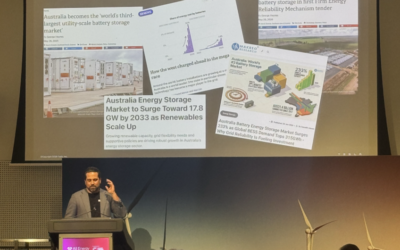
Speaking at All-Energy Australia 2026 last week, Matt Grover, director, energy markets APAC at Fluence, said “percent of perfect” analysis shared online was “a problematic metric for assessing performance”, arguing that a price spike would not have happened at all if the whole BESS fleet had been there to meet it.
How far merchant revenue can be relied on matters to investors. DLA Piper found that 53% of Australian respondents saw standalone merchant BESS as attractive, compared with 22% in Japan, while 79% targeted an equity return of 11-12%.
Alongside grid-scale BESS, 16 residential virtual power plant (VPP) and demand-response aggregator units, which pool household and business assets, earned an estimated AU$14,000 in FCAS revenue in October, or AU$148/MW of registered FCAS capacity.
Never miss an Australian energy storage story. Sign up for our Australia newsletter and get the latest project announcements, policy updates and market analysis delivered directly to you.