
ESN Premium speaks with Zane Zhou, general manager of CATL Australia and New Zealand, about TENER+, sodium-ion demand, the Collie BESS and the financing pressure facing Australian developers.
The energy storage market is only at the start of its growth, according to Zane Zhou, who heads CATL’s business in Australia and New Zealand.
“I think it’s only touching the starting base, so we will probably foresee a lot more growth in the energy storage sector,” Zhou says. “We see already significant uptake in the shipment to Australia, and we are pretty optimistic in the next couple of years as well.”
Zhou declines to give a precise ranking but says Australia sits among CATL’s top two markets in the Asia-Pacific region: “number one, number two”. The market suits CATL’s profile, he says, because Australian buyers place heavy emphasis on quality and safety, and because electrification is only just starting.
Try Premium for just $1
- Full premium access for the first month at only $1
- Converts to an annual rate after 30 days unless cancelled
- Cancel anytime during the trial period
Premium Benefits
- Expert industry analysis and interviews
- Digital access to PV Tech Power journal
- Exclusive event discounts
Or get the full Premium subscription right away
Or continue reading this article for free
“We see energy storage as a critical part of the whole electrification process, not just electric vehicles (EVs), but the storage grid infrastructure side,” Zhou says.
That view is close to the one CATL chairman and CEO Robin Zeng set out in Ningde, China, on 15 October, when he argued that the evolving role of energy storage as infrastructure demands technology that stands the test of time, pointing to electrification and new loads such as compute-intensive data centres.
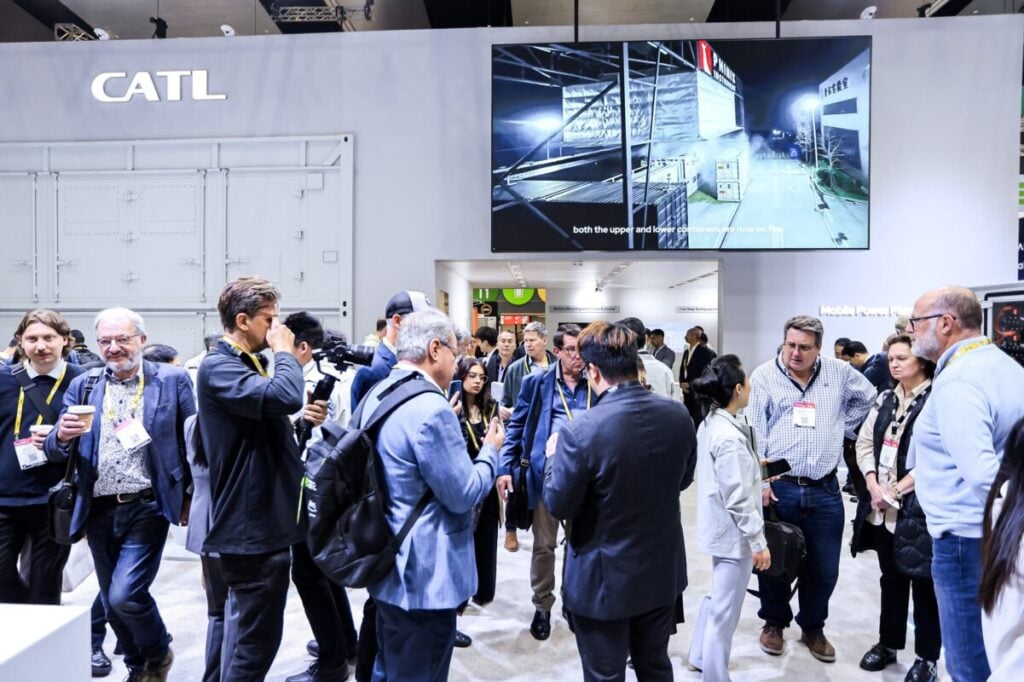
We’re speaking with Zhou at All-Energy Australia 2026 in Melbourne on 28 October, the day CATL launched its 9MWh TENER+ BESS and announced a power conversion system (PCS) agreement with Hitachi Energy at the event.
Under the Hitachi Energy MoU, CATL’s DC-side BESS products and Hitachi Energy’s PCS would form the basis of a proposed integrated offering for Australia and the Asia-Pacific region, to improve equipment compatibility and reduce integration risk. CATL also signed MoUs with EPEC Group and UNSW Sydney.
CATL already pairs its DC-side equipment with third-party PCS in Australia. At Quinbrook’s 780MW/3,075MWh Supernode in Queensland, GE Vernova is supplying power conversion, control and integration technology for Stage 3, its first grid-forming BESS project in the country, while CATL supplies TENER S systems.
CATL claims more than 17GWh of projects installed in Australia and was upgraded to AAA, the top tier, in the Q2 update of the Battery StorageTech Bankability Ratings Report, which credited its vertical integration across cell and system manufacturing.
TENER+ timing, degradation and noise
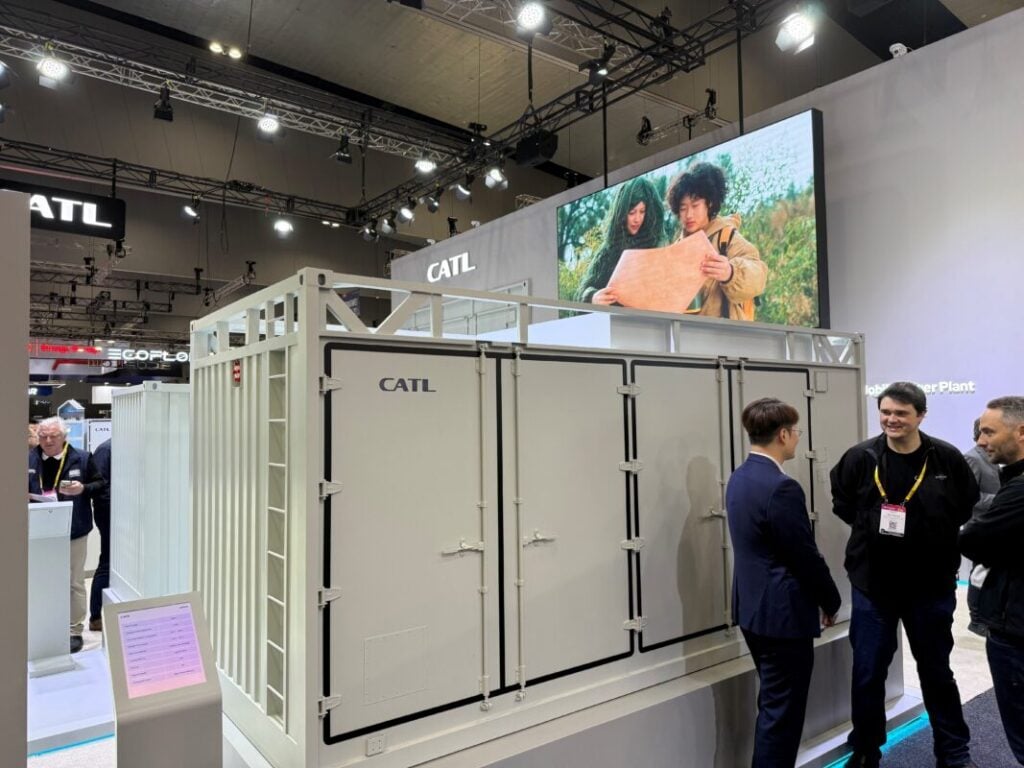
TENER+ is a 9MWh lithium-ion system that CATL says cuts container numbers by 40% and project footprint by 35%. TENER Stack, which CATL launched at ees Europe in 2025 in response to transportation weight limits, also reached 9MWh, using two half-height units, each under 36 tonnes, stacked on a 20-foot footprint.
“TENER Stack is obviously much higher, and it can break into two parts for transportation. It’s still the 20-foot footprint, but because of the density and the height, there might be restrictions in certain areas,” Zhou says.
Zhou describes TENER+ as CATL’s next-stage product, one that “also has a lot of EPC savings”. Zhou expects it to reach the Australian market in one to one and a half years, citing the time required for projects to work through the process of design and of meeting its strict grid codes, the Generator Performance Standards (GPS), before the financial close and notice to proceed (NTP).
CATL also wants to localise the product first. “We want to see more feedback from the market in other regions so that we can do a little bit more detailed localisation for the products launching into Australia,” Zhou says.
Asked whether TENER+ carries the zero-degradation claim attached to the original TENER, for which CATL claimed no cell degradation in the first five years of operation, and what Australian buyers will be warranted for over a 25-year life, Zhou says the answer depends on how each system is operated.
“It actually depends on the working profile, especially in Australia, because everyone’s trading strategy is different,” Zhou says. CATL simulates each customer’s revenue stack and operating profile, Zhou adds, with temperature range and trading strategy the biggest factors.
On the length of that period, Zhou gives a range rather than a single figure. “It’s varying from probably 20 to 10-15 years, but I would say it’s definitely more than six to seven years unless you don’t have any resting time and you keep charging and discharging consecutively.”
TENER+ operates below 65dBA, a level CATL says makes it suitable for sites near residential communities. Zhou says Japan and Australia are among the markets with the most specific noise restrictions, and that the figure is 5-10dBA lower than the previous version.
“We see a lot of customers requesting really low noise level products, and we hope that this can reduce some of their concerns in the DA process,” Zhou says, referring to development applications.
Grid access still decides where projects go, however. “Connection points are always the key theme. It’s like a property market: location, location, location,” Zhou says, calling noise reduction one way to give customers more choice of site.
Sodium-ion: mining and data centres first
TENER Sodium, CATL’s sodium-ion BESS, operates in temperatures of up to 55°C and delivers more than 10,000 cycles at 45°C, according to the company.
An ESN Premium look inside the sodium-ion TENER’s container found it also runs at 65dBA and uses a dedicated bidirectional voltage regulation system to hold a steady 690V output across the sodium cells’ wider voltage range.
Zhou says Australian interest is coming from specific segments.
“We receive a lot of interest in the sodium, and in particular, for example, mining, data centre,” Zhou says. “I think they are extremely interested in those kinds of products.”
Zeng also told the Ningde conference that CATL is pairing high-rate cells with control strategies for the fast-changing loads at AI data centres, while coordinating lithium-ion and sodium-ion systems in hybrid power plants.
On bankability, Zhou notes that lithium-ion took about eight to 10 years to reach maturity and expects sodium-ion to follow a similar path, moving from no references to wide acceptance.
Zhou says CATL will ship at least 1GWh of sodium-ion batteries in China this year and has signed framework deals worth a few GWh in Europe, with European deliveries starting in the second half of 2027.
Europe’s system integrators have moved quickly on sodium-ion with CATL (Premium access), with Intilion targeting up to 3GWh in the DACH region and Alfen agreeing a 5GWh deal, even though most European developers and owner-operators had said the technology was not yet bankable.
Merus Power, which is finalising the technical specification between its PCS and CATL’s sodium-ion BESS, rejected that view.
“If CATL guarantees it, then it will be bankable,” said Mikko Marttala, the Finnish firm’s director for system deliveries and services.
For Australian users, Zhou points to “the wider range of temperature and stability, and also the availability”.
The trade-off is energy density: CATL’s TENER sodium-ion cell stores 160Wh/kg, compared with 180-190Wh/kg for the large-format LFP cells in a sodium-ion and LFP comparison for BESS, an ESN Premium analysis that notes energy density matters less for most BESS applications than for EVs.
CATL aims to offer both chemistries so customers can match them to their trading strategies, Zhou says.
Collie benchmark and the financing squeeze
CATL’s largest Australian reference is Synergy’s 500MW/2,400MWh Collie BESS in Western Australia, which the state-owned utility completed in February using 640 CATL EnerC containerised LFP units and 160 inverter units.
The project sits opposite the 350MW Collie coal power station, which is due to close in 2027.
“I think we’re very happy with how it went,” Zhou says. As far as CATL knows, there were no hiccups in production, delivery, or on-site performance, Zhou adds, with Synergy carrying out its own integration.
Zhou describes Collie as part of the first wave of projects above 2GWh in Australia and globally.
“We had really good lessons in the full commissioning process as well,” Zhou says, adding that gentailers in the National Electricity Market (NEM) are referring to the Synergy project as a positive signal.
Looking ahead to the next 12 months, Zhou expects plenty of shipments to Australia, though many will come from contracts signed in 2024 and 2025, with NTP already locked in for 2027 delivery.
New projects face a harder path, although some are still closing: Quinbrook secured AU$469 million (US$305 million) of debt for Supernode Stage 3 in August.
“Australia has a high interest rate,” Zhou says, adding that a large volume of BESS capacity has entered the system over the past year and is reducing price volatility.
“If you look at the revenues on the market, I think a lot of IPPs feel the stress from the financial closing side.”
Revenue still depends on PPA pricing and price volatility.
“It’s a pure merchant, so it is one of the charming sides of the Australian market,” Zhou says, noting that other markets are watching how Australia deploys BESS at pace.
“We obviously know there’s going to be more volatility, but in the short term, I think a lot of IPPs are seeing difficulty and challenges in getting the financial close.”
Never miss an Australian energy storage story. Sign up for our Australia newsletter and get the latest project announcements, policy updates and market analysis delivered directly to you.
