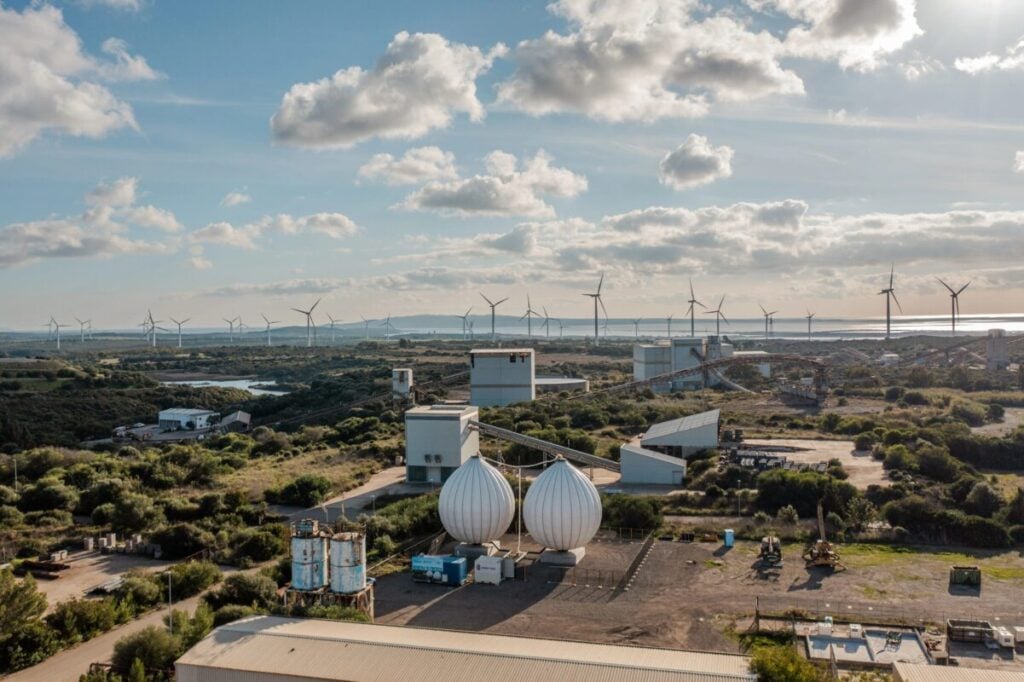
The Italian government has declared an AI data centre in development by Energy Vault, featuring renewable energy and hybrid energy storage technologies, to be of strategic national interest.
US-headquartered energy storage technology and power infrastructure project developer Energy Vault said yesterday (1 September) that the Italian Council of Ministers’ decision gives its project an accelerated approval pathway.
In a decision made in early August, the council approved strategic national interest status for two data centre developments: Energy Vault’s 30MW Digital Vault Sulcis edge AI data centre in Sulcis, Sardinia, and K2 Strategic’s 400MW hyperscale data centre campus in the Milan metropolitan area.
The Council of Ministers is the executive branch of the Italian government, comprising 17 department heads and led by Prime Minister Giorgia Meloni. Minister of Enterprise and Made In Italy Adolfo Urso had proposed the declaration, pursuant to Article 13 of the national Asset Decree, to attract €25 billion (US$28.9 billion) in foreign direct investment (FDI) into seven data centre projects.
Try Premium for just $1
- Full premium access for the first month at only $1
- Converts to an annual rate after 30 days unless cancelled
- Cancel anytime during the trial period
Premium Benefits
- Expert industry analysis and interviews
- Digital access to PV Tech Power journal
- Exclusive event discounts
Or get the full Premium subscription right away
Or continue reading this article for free
The K2 Strategic project represents an investment of around €5.3 billion and the Energy Vault project around €1.49 billion, according to a government announcement on 4 August.
Digital Vault Sulcis now becomes a government-designated programme, which Energy Vault said establishes an accelerated pathway for administrative approvals. Speed-to-power, basically the timeline for getting data centres online and supplied with reliable energy, has become an important competitive edge in the race for compute.
From the initial ~30MW edge AI data centre, the site can be expanded to between 50MW and 60MW of IT capacity and up to 100MW of total site power capacity, through phased expansion.
The designation also means that a special Government Commissioner is expected to be appointed to coordinate administrative activities and support the programme’s accelerated implementation. Energy Vault hopes to begin construction by 2028 and begin commercial operations in 2030.
Hybrid energy storage technologies at repurposed coal mine
The AI data centre will be integrated with renewable energy generation and energy storage at the site of the former Monte Sinn coal mine in Nuraxi Figus, southern Sardinia.
Owned by Sardinian state coal mining corporation Carbosulcis, the project promotes the sustainable repurposing of a disused industrial site into an advanced technology hub, which the Italian government said is consistent with its industrial revitalisation and redevelopment strategy for the region. Energy Vault and Carbosulcis first announced the project in 2024.
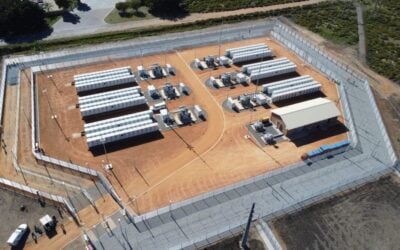
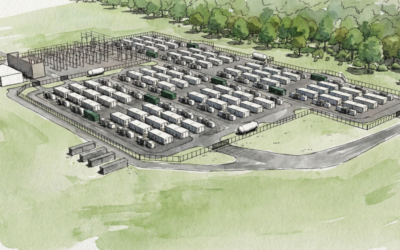
Beginning with a pilot deployment, Energy Vault will build a hybrid gravity-plus-battery energy storage system at the site, pairing the company’s modular pumped hydro energy storage (PHES) technology, EV0, with its B-VAULT battery energy storage system (BESS) solution.
EV0 is part of Energy Vault’s range of gravity-based energy storage solutions, which the company claims are flexible, low-cost infrastructure assets designed for a 35-year+ lifetime without energy storage medium degradation.
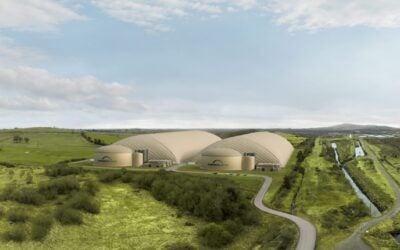
Unlike conventional pumped hydro, which consists of two large bodies of water at different heights from which water is dropped through turbines to generate electricity or pumped back up to charge, EV0 features modular prefabricated membrane pods at either end of an incline.
The product is designed to be paired with other forms of energy storage at underground mines. At the Carbosulcis mine, four vertical mine shafts with depths of up to 500 metres constitute the existing infrastructure to host the pumped-storage technology.
This will be the first commercial deployment of EV0. A prototype is already under construction at the site. The hybrid PHES-battery plant will be controlled by Energy Vault’s VaultOS energy management system (EMS) and hybrid power plant controller (PPC).
The European Commission (EC) produced a case study of the project, Miniera d’Energia (‘Mines to Energy’), in 2025.
It describes the project combining 20MW of gravity storage with 80MW of lithium-ion (Li-ion) BESS to help facilitate the local use of renewable energy and support the Sardinian electricity grid, although the case study does not mention the planned data centre campus.
Energy Vault and Carbosulcis were designing the project to enable a 100MW peak power output, with the gravity storage system configured for a 4-hour duration of discharge at full rated power.
In Phase 1, a 10MWp solar PV system will be deployed alongside a 10MW Li-ion BESS. The integrated energy storage system will be deployed in Phase 2, along with an additional 10MW of solar PV capacity. In the final, third phase, three wind turbines of 4.2MW generation capacity each will be deployed at the site.
Studies were also being undertaken for a potential underground adiabatic compressed air energy storage system and the development of digital platforms for virtual power plant (VPP) integration and smart grid management, according to the EC document. The case study said the energy hub would generate annual savings worth more than €750,000.
In addition to 9GWh/year of energy generated to be used internally at the site complex, surplus energy production of about 53GWh/year could be sold to the Sardinian Regional Authority, the study said, although it is not clear if the data centre campus’ addition changes those numbers.
Energy Vault raises full-year revenue guidance
Energy Vault became known in around 2019 and 2020 as a startup marketing a novel gravity-based energy storage technology, swinging huge blocks of a concrete-type material from a giant crane to store and dispatch kinetic energy.
The company was among energy storage startups to list on stock exchanges during a wave of Special Purpose Acquisition Company (SPAC) mergers. Since its New York Stock Exchange (NYSE) listing in 2022, Energy Vault has diversified its business model significantly.
While it still develops gravity storage technologies, the company launched a battery storage system integrator subsidiary, Energy Vault Solutions, in 2021 and its own suite of BESS products.
Its share price fell below US$1 in 2024, triggering a NYSE listing warning. Shortly after, Energy Vault embarked on a new growth strategy, including the launch of a build, own, operate (BOO) project developer and independent power producer (IPP) subsidiary.
The Sardinian mine project aligns with the BOO strategy and the company’s more recent strategic move into powered AI infrastructure solutions. In early August, Energy Vault announced a strategic agreement to support an undisclosed data centre customer’s 1.25GW project in Texas.
The company announced its Q2 2026 financial results on 11 August, raising its full-year revenue guidance to between US$270 million and US$310 million and GAAP gross margin guidance to 20%-25% at the high end of the range.
It had previously projected total full-year revenue between US$225 million and US$300 million, reaffirmed in its Q1 results in May.