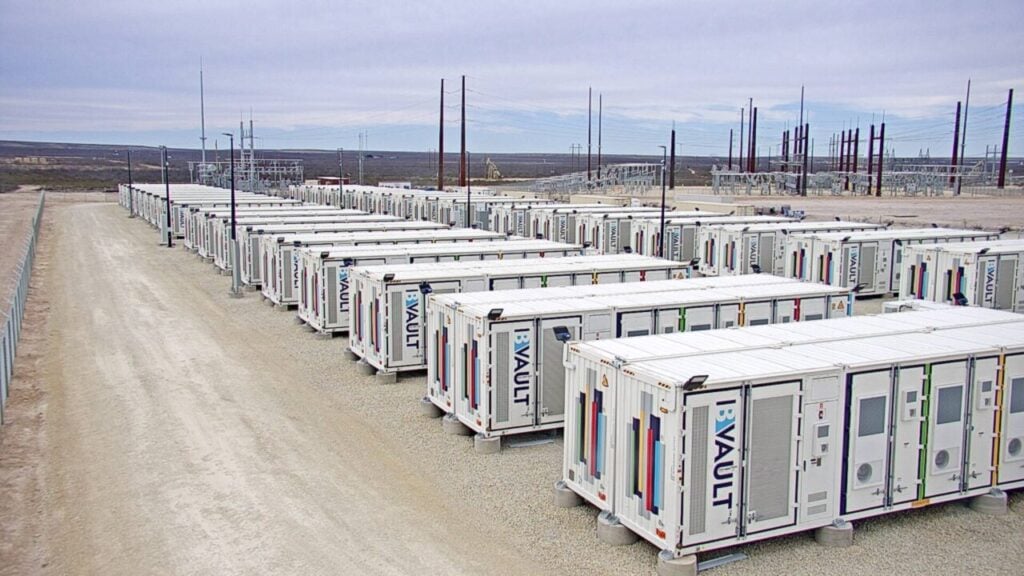
Energy storage developer and system integrator Energy Vault has entered into a strategic agreement supporting hyperscaler AI data centres for a customer in Texas, US.
Announced 7 August, Energy Vault will supply battery energy storage systems (BESS), grid-forming power conversion systems (PCS), and AI infrastructure control software, supporting an initial deployment totalling 1.25GW of power infrasturcutre for the undisclosed data centre customer.
The company expects the agreement to generate approximately US$500-$600 million in revenue during the second half of 2026 and 2027.
The agreement combines Energy Vault’s products with the partner’s power generation capabilities, including generator sets and engineering, procurement, and construction (EPC) services from global equipment manufacturer Caterpillar. The integrated system is designed to provide grid-independent power for AI data centres and high-performance computing facilities.
Try Premium for just $1
- Full premium access for the first month at only $1
- Converts to an annual rate after 30 days unless cancelled
- Cancel anytime during the trial period
Premium Benefits
- Expert industry analysis and interviews
- Digital access to PV Tech Power journal
- Exclusive event discounts
Or get the full Premium subscription right away
Or continue reading this article for free
Unlike conventional deployments where components operate independently, Energy Vault claimed the integrated system manages generation, storage, power conversion, and electrical infrastructure as a unified power plant.
AI computing workloads create variable power demands as GPU clusters scale up and down, generating transient voltage, frequency, and power quality requirements. The integrated architecture is designed to manage these fluctuations through real-time coordination of generation and storage assets.
Energy Vault’s control software functions as an operating system for the site’s power infrastructure, managing power flows, voltage and frequency stability, generator cycling, and fuel efficiency while responding to dynamic AI compute demands.
Initial deployments are expected within four to 12 months, operating independently of traditional utility interconnection schedules. The company claimed that the modular design allows customers to deploy AI infrastructure before permanent grid connection is available, with the option to integrate utility power, renewable generation, and additional distributed energy resources (DERs) as requirements expand.
In May, Energy Vault released its Q1 2026 financial results, noting expansion in the company’s project portfolio, AI infrastructure, and operations in Australia and Japan.
The company also positioned itself in a shift from EPC company to independent power producer (IPP), targeting PPAs with data centres and hyperscalers over tolling agreements or offtake deals with utilities.
Battery Asset Management Summit USA 2026 will be held 15-16 September in Garden Grove, California, hosted by Energy-Storage.news publisher Solar Media (part of the Informa Group). The agenda emphasises addressing the roles of AI, cybersecurity, and second-life applications, broken down into two tracks: Technical Asset Management and Commercial Asset Management. This year, the conference is also co-located with Solar & Storage Finance Summit USA. Visit the official site for more details.