Having just begun construction on a 2.8GWh battery energy storage system (BESS) in Belgium, Giga Storage has progressed its 1.4GWh project in Germany to the ready-to-build stage.
Elsewhere in Germany, developer Enerpeak has entered a joint venture (JV) to develop 700MW/1,500MWh of BESS across two projects, system integrator Intillion has received a BESS order for a wind farm co-location, while the government recently awarded 480MW of contracts to solar-plus-storage developers in its latest ‘innovation’ tender.
Our publisher Solar Media recently held the first edition of the country-focused Energy Storage Summit Germany conference in Berlin. You can read some of the hottest takeaways here in Cameron Murray’s excellent special edition of the BESS Industry Buzz column, in addition to many tagged articles from, and related to, the event.
1.4GWh Albatross at strategic location for wind transmission
Netherlands-headquartered Giga Storage, which develops large-scale battery storage projects to own and operate, announced the status update for its 350MW/1,400MWh Albatross project on Friday (2 October).
Try Premium for just $1
- Full premium access for the first month at only $1
- Converts to an annual rate after 30 days unless cancelled
- Cancel anytime during the trial period
Premium Benefits
- Expert industry analysis and interviews
- Digital access to PV Tech Power journal
- Exclusive event discounts
Or get the full Premium subscription right away
Or continue reading this article for free
Giga Storage anticipates a final investment decision (FID) in Q4 2026 so that construction can begin in the first half of next year, with commissioning in 2028. The company is developing Albatross in collaboration with UK-based Isenau, from which it acquired the project in mid-2025.
The acquisition marked Giga Storage’s international expansion outside the Netherlands and Belgium, where it began with Giga Rhino, a partially crowd-funded 7.5MWh project in the Netherlands.
From there, it has progressed to projects that are largely of unprecedented scale in both countries. Notable examples include the 300MW/1,200MWh Giga Leopard project in Groningen, Netherlands, for which financing closed last June to begin construction, and the 2.8GWh Green Turtle project in Belgium that Giga Storage began building in September after ordering Megapack 3 BESS equipment from Tesla.
The developer was acquired by Paris-headquartered infrastructure investor InfraVia Capital Partners in 2024. Giga Storage CEO Kevin Dijkers said InfraVia’s backing was essential in enabling its international expansion at the time Albatross—then referred to as Giga Albatross—was acquired.
Albatross is strategically located near a village called Neuenkirchen in Lower Saxony, close to Germany’s North Sea coast, which hosts around 9.2GW of offshore wind generation. The BESS will connect to the high-voltage grid via transmission system operator (TSO) Amprion’s adjacent 380kV Merzen substation.
Merzen substation was recently upgraded and Albatross asits between two existing HVDC power lines transmitting to Germany’s southern demand centres. The region is also home to Conneforde–Cloppenburg–Merzen, a two-year transmission upgrade project that will add 60km of line, sending locally generated renewable energy to urban and industrial consumers.
Newcomers Enerpeak, BESS Broadway aim to deploy 700MW of CATL BESS at two sites
Enerpeak, a relatively new market entrant founded in Munich in 2023 as a developer of large-scale BESS in Germany, from site acquisition to long-term operation, will develop two projects totalling 700MW of output and ~1,500MWh energy storage capacity.
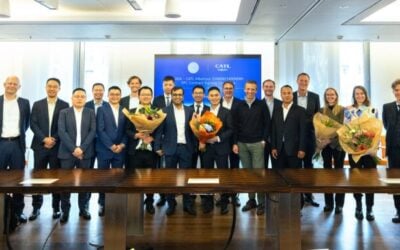
The company announced last week (1 October) the formation of a joint venture (JV) with BESS Broadway, a developer that claims to be a strategic partner of China’s CATL, the world’s biggest lithium battery manufacturer.
Not much info is available online about BESS Broadway. No website could be readily found, although a LinkedIn search turned up executive leadership seemingly based largely in London, Hong Kong and Australia, with experience from companies including DNV and Zenobe Energy.
Kit Jennings, whose LinkedIn profile lists them as BESS Broadway’s Senior Legal Counsel since taking the post a few weeks ago, said in a recent post that BESS Broadway is a grid storage investment platform with a 25GW+ development pipeline across Europe, Latin America, and Asia-Pacific markets.
Enerpeak said the two projects in Germany mark BESS Broadway’s first entry into the market and are being planned with CATL BESS technology. Timelines for development were not given, other than Enerpeak’s assertion that the JV aims to get them to the ready-to-build stage “in the coming years.”
Both will directly connect to TSO Tennet’s high-voltage transmission network, with one located in the North and the other in the South of the country. Enerpeak said it has applied to expand the BESS sites to a combined 1.4GW.
On the same day as the JV announcement, Enerpeak shared photos of a groundbreaking ceremony at its 20MW/50MWh Schweinfurt-Oberndorf battery storage project. The project, built at an existing substation in central Germany and co-developed with Stadtwerke Schweinfurt, is targeted for commissioning in the first quarter of next year.
Intilion supplies BESS for under-construction wind farm
German battery storage system integrator Intilion will deliver a 98MWh BESS for co-location at an onshore wind power plant, around 90km from Hamburg, northern Germany.
The company said yesterday that it has received an order to supply, install and commission the front-of-the-meter (FTM) BESS with 45MVA power output at Wind Park Kloddram, a 64.5MW generation facility currently under construction in the village of Jesow, near the municipality of Vellahn.
Intilion will supply scalecube, the company’s modular energy storage system with integrated control systems that come with a 97% availability guarantee.
The integrator’s announcement did not mention the name of the customer, although some quick research revealed that wind turbine manufacturer Vestas received an order in May 2025 for 65MW of its V162 7.2MW turbines for Kloddram. The customer is named there as Lindenhof Gmbh, which appears to be a local developer, again with very limited online presence.
Intilion claimed the BESS will enable the wind power plant’s generated electricity to be flexibly marketed and to adjust its feed into the grid according to market conditions and grid requirements. The company also highlighted that co-location maximises the value of shared grid connections.
BNetzA awards 480MW in second 2026 innovation tender
Speaking of which, our colleagues at PV Tech recently reported on the latest in Germany’s ‘innovation’ tenders. Held twice a year by federal network regulator BundesnetzAgentur (BNetzA), the energy procurement awards contracts for projects that combine two or more clean energy technologies and is basically dominated by solar PV and BESS co-location or hybrid projects.
The latest tender—the second this year—was advertised for 475MW of solar-plus-storage capacity. A total of 53 bids for a combined 678MW were submitted to the once-again oversubscribed auction, with 480MW across 32 projects ultimately contracted.
Successful bids were awarded at prices varying from 4.5 euro cents/kWh (5.1 US cents /kWh) to 5.4 cents/kWh, with an average of 5.14 cents/kWh. The price for this auction was slightly lower than the previous round that closed in June at 5.34 cents/kWh. BNetzA president Klaus Müller said this drop was because the auction was “once again highly competitive”.
However, while this auction was oversubscribed and prices moved down, interest in Germany’s innovation auctions for flexible renewables has waned in 2026. Prior to this year, the previous three innovation auctions were more than three times oversubscribed, with the latter two drawing applications for more than four times the available capacity.
Bavaria was awarded the most capacity in the recent auction, with 12 projects worth 177MW, followed by Brandenburg (four projects for 94MW) and North Rhine-Westphalia (four projects for 48MW).
Despite a decline in demand for innovation auction contracts, Germany has still been a leading light for Europe’s public energy auctions. Its last two standalone utility-scale solar PV auctions have been significantly oversubscribed, each awarding over 2GW of new capacity.
Earlier this year, PV Tech Premium spoke with the chief investment officer of Polish developer R.Power about how revenue certainty and incorporating storage have maintained appetites for the German government’s tenders.
Innovation tender item by William Norman, first published on PV Tech on 29 September 2026.