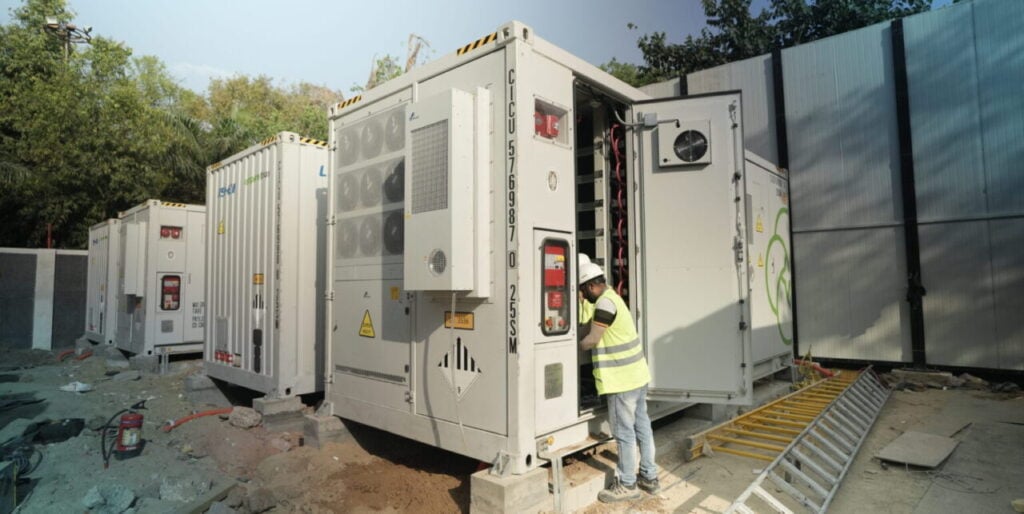
Two pilot deployments of sodium-ion (Na-ion) battery storage technologies are currently being solicited in India.
India’s largest utility company, NTPC, which is partially state-owned and operates around a quarter of the country’s grid-connected power plants, has followed up recent pilots of other non-lithium energy storage technologies with a Na-ion pilot.
NTPC issued invitations for expressions of interest (EOI) through its tender portal yesterday (9 September), to develop and install a grid-connected sodium-ion battery energy storage system (BESS).
The BESS would be deployed at NTPC facilities, whether thermal power stations or offices, and its technical performance, safety, reliability, degradation, operational characteristics and techno-commercial viability would be assessed. Submissions will be accepted until 15 October 2026.
Try Premium for just $1
- Full premium access for the first month at only $1
- Converts to an annual rate after 30 days unless cancelled
- Cancel anytime during the trial period
Premium Benefits
- Expert industry analysis and interviews
- Digital access to PV Tech Power journal
- Exclusive event discounts
Or get the full Premium subscription right away
Or continue reading this article for free
The pilot is intended to trial the potential of Na-ion for further large-scale BESS sites across NTPC’s portfolio. With India currently tendering for and constructing multiple gigawatt-hours of lithium-ion (Li-ion) battery storage, there is a need to diversify the mix of resources and supply chain dependencies, NTPC said.
According to a report from the trade association India Energy Storage Alliance (IESA), demand for advanced chemistry cell (ACC) batteries in India stood at 28GWh in 2025, with around 60% for electric vehicles (EVs) and 40% for BESS applications.
By the mid-2040s, IESA projects demand of over 700GWh, while the Institute for Energy Economics and Financial Analysis (IEEFA) and JMK Research have forecast a 36.5% CAGR in battery demand, to ~272GWh, by the 2030 financial year (FY2030).
Yet the supply chain for lithium iron phosphate (LFP) batteries that power nearly all new BESS facilities is largely based in or controlled by China. Research firm Wood Mackenzie Power & Renewables said in a recent report that self-sufficiency in India’s battery cell supply is at least a decade away.
Against a backdrop of limited domestic availability of lithium resources, NTPC is considering sodium-ion as an alternative technology based on more widely available raw materials. Reducing domestic dependence on imported lithium and other critical materials could provide potential for the development of an indigenous supply chain. Technology development and manufacturing at scale could make Na-ion cost-competitive, NTPC said.
The utility is seeking proposals under two options: applicants can bid to build a sodium-ion pilot BESS with 100kWh of usable capacity, or alternatively, applicants can propose the pilot’s capacity.
NTPC will share some costs with applicants, but financial weighting will be based on the technology readiness level (TRL) of the proposed technologies.
Full tender details can be found here.
Promising drop-in alternative to lithium
While sodium-ion technologies make headlines across the world with established players such as CATL advancing to mass production and new entrants such as General Motors (GM) seeing sodium-ion as a leapfrog technology, it is worth noting that, like lithium-ion sub-chemistries, not all Na-ion batteries are the same.
An analysis piece for ESN Premium, published in April, examined the potential for sodium as a drop-in replacement for lithium, using as it does many of the same production techniques. The article also looked at the four main sodium-ion chemistries, which are:
- Sodium Nickel Iron Manganese Oxide (NFM)
- Sodium Vanadate Phosphate (NVP)
- Sodium Iron Fluorophosphate (NFPP)
- Prussian Blue Analogues (PBA)
They range from NFM, which comes at the lowest cost but has a limited cycle life, to NVP, which has high power density and structural stability but costs more, to NFPP, designed for longevity and safety but with a trade-off in energy density and PBA, which has a high theoretical capacity that is difficult to achieve in practise.
Alongside ongoing Li-ion BESS deployments, NTPC and its subsidiaries, including NTPC Green Energy, have to date also trialled a 3MWh flow battery, which it tendered in 2024 and awarded to Indian vanadium redox flow battery (VRFB) maker Delectrik Systems.
The same VRFB provider was recently selected to provide a 100MWh flow battery system at the 30GW Khavda Renewable Energy Park in Gujarat. Meanwhile, other non-lithium technologies NTPC is taking an interest in include the carbon dioxide-based CO2 Battery from Italian company Energy Dome, which the utility announced a 160MWh pilot for in January 2025.
Distribution transformer-connected pilot project
In early August, Global Energy Alliance for People and Planet (GEAPP), an organisation dedicated to ending energy poverty and accelerating green economic transition, invited expressions of interest (EOI) for a ~200kWh – ~300kWh sodium-ion battery energy storage system (BESS).
In partnership with an undisclosed ‘leading utility’ in North India, GEAPP is seeking qualified manufacturers, system integrators and engineering, procurement and construction (EPC) contractors to supply, integrate and commission the BESS at a selected distribution transformer site.
The system must be designed for up to two full charge-discharge cycles per day over a 12–15-year project lifetime and retain a state of health (SoH) of at least 70% by the end of life.
As well as demonstrating the potential of sodium-ion chemistries, GEAPP aims for the project to show the value of connecting batteries to the grid at distribution transformer (DT) level. The tender document describes DT-level BESS as representing “a direct intervention at the last-mile of the grid that can relieve overloaded DTs, improving feeder voltage profiles, absorbing excess rooftop solar generation, and reducing aggregate technical and commercial (AT&C) losses through better load management.”
Deadline for proposals to the GEAPP pilot closed 4 September. The pilot is being run under India Grids of the Future Accelerator, a US$25 million GEAPP programme to modernise power distribution networks launched in February.
Energy Storage Summit India returns for its second annual edition at India Expo Mart, Greater Noida, 22-24 October 2026, co-located with Renewable Energy India (REI) Expo. For the full agenda and booking details, click here.