
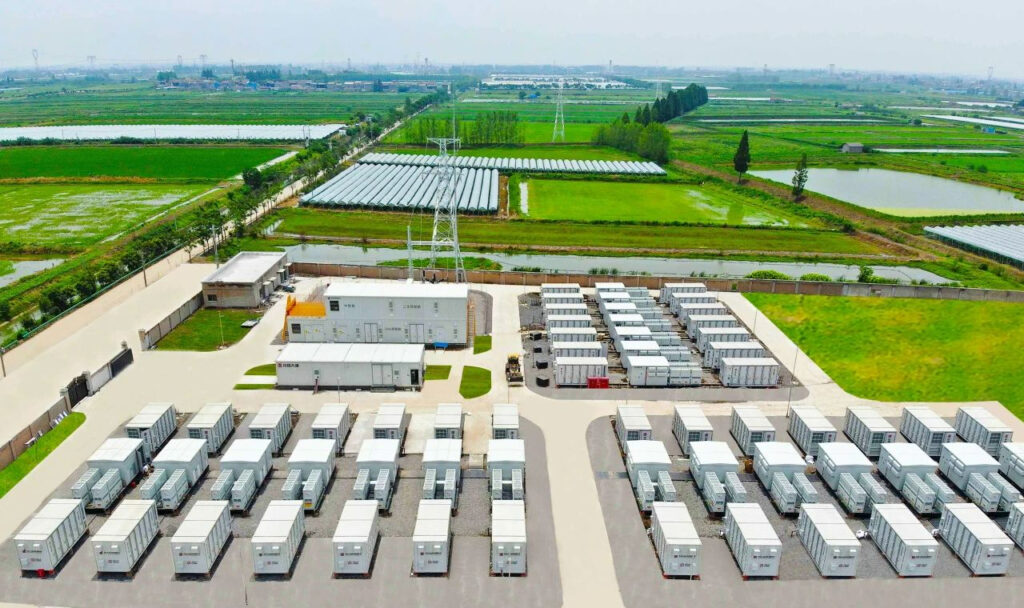
Following CATL and HyperStrong’s 60GWh announcement yesterday, there has been no better time to look at the different sodium-ion cell chemistries and battery products available for BESS today.
CATL, the world’s largest lithium-ion manufacturer, and HyperStrong, China’s largest battery energy storage system (BESS) integrator, revealed a huge three-year sodium-ion battery supply and co-operation agreement yesterday.
The potential for sodium-ion (Na-ion) as a drop-in replacement for lithium-ion in BESS has been discussed for years. But its commercialisation appeared to have been pushed back by the faster-than-expected price falls for lithium iron phosphate (LFP) batteries over the last few years. We explored the topic when US sodium-ion startup Natron Energy went under last year.
CATL and HyperStrong’s announcement could show an inflection point in adoption of sodium-ion for BESS, as the two leading players in their respective fields. So what are the different sodium-ion chemistries and battery products available today?
Try Premium for just $1
- Full premium access for the first month at only $1
- Converts to an annual rate after 30 days unless cancelled
- Cancel anytime during the trial period
Premium Benefits
- Expert industry analysis and interviews
- Digital access to PV Tech Power journal
- Exclusive event discounts
Or get the full Premium subscription right away
Or continue reading this article for free
Why sodium-ion?
First, the why. One reason that sodium-ion is being considered as an alternative to lithium-ion is for fire safety. Failures at the cell level in lithium-ion batteries is less than one in ten million, but with the scale it is being deployed at, the risk of a fire event is one that investors must factor in. The fire safety risk for sodium-ion is much lower, though it isn’t zero.
Sodium-ion batteries are also much safer to transport to locations ready for installation. They have 100% depth of discharge (DOD) capabilities, so they can be discharged to 0V and restarted without affecting energy capacity and cell performance. On the other hand, lithium-ion must be transported with low levels of charge to prevent battery damage, but this also increases their safety risks during transport.
Sodium-ion also has a wider safe operating temperature range than lithium-ion, enabling deployment in more extreme climates without risking cell failure.
Another reason why there’s an interest in sodium-ion BESS is material abundance. Lithium is finite and frequently suffers from price spikes due to geopolitical tensions and trade wars, whereas sodium can be found everywhere—including being extracted from seawater—and is the sixth most abundant element on Earth. Switching to sodium makes domestic production a lot easier for countries who want to bring supply chains onshore and not rely as much on global or China-dominated markets.
Some forecast that demand for sodium-ion demand could reach hundreds of gigawatt-hours (GWh) by the late 2020s, making sodium-ion batteries a critical part of the energy industry going forward.
While lithium-ion still dominates, more companies are starting to develop sodium-ion batteries for BESS (as well as EVs and other electronics). Like a lot of battery developments, there is a high concentration of development and production in China, but it’s not the only region.
Which types of sodium-ion cells are suitable for BESS?
Just like lithium-ion has NMC, LFP, NCA and other battery chemistries, sodium-ion batteries can also have different chemistries with different cathode materials. The four main sodium-ion battery chemistries are:
- Sodium Nickel Iron Manganese Oxide (NFM)
- Sodium Vanadate Phosphate (NVP)
- Sodium Iron Fluorophosphate (NFPP)
- Prussian Blue Analogues (PBA)
Each battery chemistry has advantages and disadvantages for BESS, and each one can be used in different situations. For example, NFM is the lowest cost option because they use a lot of nickel, iron, and manganese—which are abundant and cheaper than other metals—so is suitable for cost-sensitive applications. They also have a relatively high energy density but tend to have a more limited cycle life than other sodium-ion chemistries.
NVP cells have a high electrical conductivity, power density and structural stability, with minimal risk of thermal runaway. This makes these cells ideal in BESS applications that require fast charge and discharge—such as peak shaving or EV infrastructure—but the cost of the vanadium and more complex synthesis processes mean that these cells are more expensive.
NFPP is designed for longevity (long cycle life) and safety (low thermal runaway risk), but this comes at the expense of a lower energy density (due to a lower electrical conductivity). They also contain no toxic elements so are very environmentally friendly as well.
Finally, PBA is also another low-cost option because it uses abundant materials and is created with a low temperature synthesis method. These cells also have a high safety with a lower thermal runaway risk, and excellent low temperature performance for grid scale storage. The electrodes also have an open-structure framework which promotes fast charging and long cycle life.
However, even though they have high theoretical capacity, it is difficult to achieve them in practice. This is because the electrode synthesis process is susceptible to moisture. So, a lot of the electrodes are fabricated with vacancy defects and water molecule inclusion that limit their practical capacity.
The companies commercialising Sodium-ion for BESS
There are currently many companies looking to scale up sodium-ion cells for various grid-scale and commercial & industrial (C&I) systems. Many of these companies are already actively involved in lithium-ion and have moved into the sodium-ion realm, whereas other companies are solely focused on commercialising sodium-ion technology.
CATL
CATL is the biggest battery producer in the world, and while its main focus is lithium-ion, it has created sodium-ion batteries and sodium-ion/lithium-ion hybrid systems. Its first sodium-ion batteries, Naxtra, focused on EVs (as has its hybrid systems) but it recently announced a new BESS-focused sodium-ion cell at the 14th Energy Storage International Conference and Expo (ESIE 2026) that uses a hard carbon anode and a layered oxide composite cathode.
The planned commercial rollout is 2026, and this product may well be part of or the basis of the deal with HyperStrong.
The cell in question is 300+Ah with an energy density of 160Wh/kg, energy conversion efficiency of 97%, cycle life above 15,000 cycles (retaining at least 80% capacity), and an operating temperature range of -40-70°C. Compared to its EV Naxtra offerings, it has a higher stated cycle life, but a slightly lower energy density, but some of the other characteristics, such as the operating temperature, remain the same. The cells have shown no thermal runaway in nail penetration, crushing and overcharging safety tests.
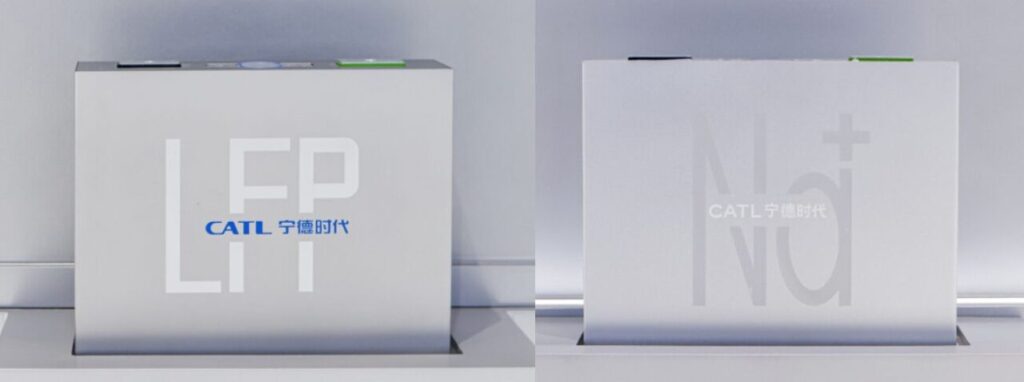
These cells have been designed for 2-to-8-hour utility-scale storage, shared storage, renewable energy projects, and AI data centres. It’s been suggested that they will be used for storage scenarios where durability and cold weather operation are as important as energy density.
CATLs main offerings are still firmly rooted in the lithium-ion market, but it has the infrastructure and ecosystem to significantly scale up sodium-ion BESS. It is especially well poised to capture Northern China markets that get very cold in the winter and could benefit from the low temperature operation capabilities of sodium-ion.
BYD
Another battery and EV giant, BYD, has innovated lithium technology much further than many other companies with its blade battery architecture. Back in 2024, BYD Energy Storage’s UK and Ireland Head, Kai Wang, announced (in a now deleted LinkedIn post) that the company was developing a sodium-ion NFPP BESS product using long form blade battery cell architecture. It’s thought that these BESS could achieve energy storage costs as low as $0.03USD/kWh.
Coined the MC Cube-SIB ESS (MC Cube), the R&D cells achieved 200Ah capacity, voltage range of 800V-1400V, nominal voltage of 1200V, and over 10,000 cycles and have since been deployed into MWh-scale BESS, with the first phase being a 2.3MWh demonstration system, according to a battery executive on LinkedIn. In 2025, the MWh system passed acceptance testing and was officially connected the grid. Since then, the system has been operating autonomously and has been stable without fluctuations.
HiNa
HiNa is a Chinese company dedicated to sodium-ion technology and hasbeen one of the most prolific companies for commercialising sodium-ion BESS so far. HiNa established the first GWh-scale mass production line for sodium-ion batteries. The battery plant is in Fuyang, with the first phase providing 1GWh with the aim of a 5GWh capacity in the future. HiNa also works with upstream and downstream partners in China―such as Mianyang Lithium Source and Yuheng Battery―to develop a robust supply chain, something which is a wider global challenge for sodium-ion commercialisation compared to lithium-ion which has well-established supply chains.
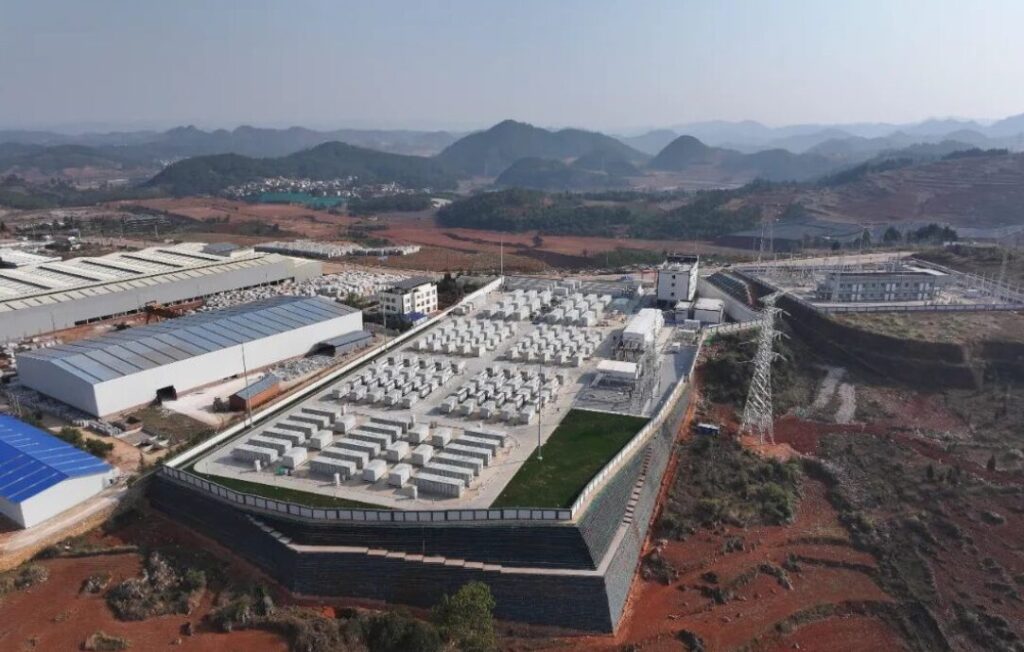
HiNA currently has four different sodium-ion product lines that have entered mass production, two of which are geared towards stationary storage. HiNa has deployed multiple MW-scale BESS in Shanxi, Guangxi, and Hubei in China.
It supplied the largest sodium-ion project in the world in China at 100MW/200MWh (pictured above) plus the largest lithium-sodium hybrid energy storage station―a 200MW/400MWh energy station that uses 40MWh of sodium battery capacity in Qiubei County. It also delivered a 1.1MWh system to Germany.
HiNA’s battery cells for stationary storage are compared below:
| HE240 | NE170 | |
| Nominal capacity | 240Ah | 170Ah |
| Nominal voltage | 3V | 2.9V |
| Energy density | >150Wh/kg | >100Wh/kg |
| Cycle life | 8000 cycles at 0.5P | 10000 cycles at 1P |
| Operating temperature range | -40-60°C | -40-60°C |
| Use cases | Large-scale energy storage | Frequency regulation and distributed energy storage |
Hithium
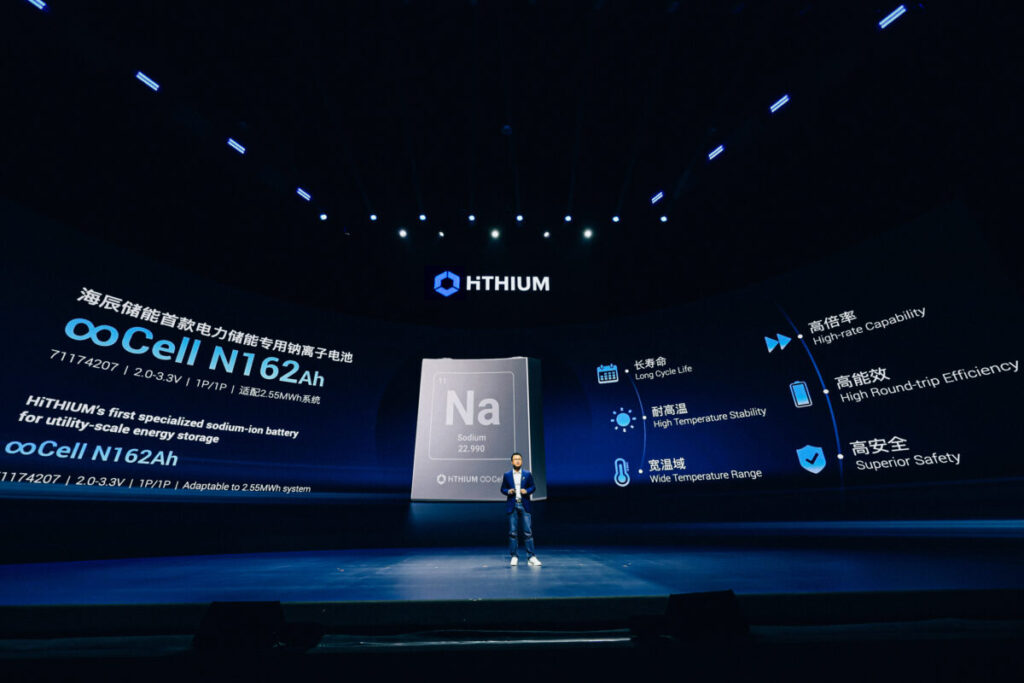
Hithium has a sodium-ion cell geared towards utility scale storage called ∞Cell N162Ah, launched in 2024 and claimed as the first in the world.
This is a 162Ah cell with a sodium iron ortho-pyrophosphate cathode, and has a gravimetric energy density of ≥ 95Wh/kg, volumetric energy density of 173 Wh/L, cycle life above 20,000 cycles and a capacity retention rate of 94.2% after 4,000 cycles at 25°C.
The cells also have an operating temperature range of -40°C to 60°C, with a charging temperature range of -10-60 °C, discharging temperature range of -40-60°C and a recommended storage temperature range of -20-35°C. The cells have an operating voltage of 1.5-3.3V with a nominal voltage of 2.82V, and an energy efficiency of 94% at 1P.
These 162Ah cells are being used to develop a range of BESS solutions designed for long duration energy storage (LDES) applications. This includes a 625MWh 8h BESS and 625MWh 4h BESS for LDES, and a 2.28MWh 1-hour BESS for handling sudden power surges. Hithium is primarily targeting AI data centre energy storage.
Envision Energy
Envision has only recently got involved in the sodium-ion space and recently announced at ESIE 2026 that it is now manufacturing sodium-ion storage cells―that only came of the production line in March this year. The cells to date have capacity of 180Ah, cycle life of at least 20,000 cycles, and an operating temperature range of -40-70°C. The company has stated that it plans to develop the sodium-ion cells for AI data centre backup and extreme temperature storage environments.
Peak Energy
Peak Energy has a NFPP sodium-ion energy storage system, GS-1.1, built for grid‑scale deployment. It possesses a 3.1MWh capacity, has been designed for 4+ hour duration, has a 95% DC Round-trip efficiency, a -40-55°C operating temperature range, and a service life of at least 20 years. Between 2026-2028 Peak Energy has stated that it plans to scale battery production capacity to 5GWh of cells and systems, with an expansion to 50 GWh by 2032.
Peak Energy has deployed its GS-1.1 systems in Colorado in a 3.5MWh installation at the solar and renewable energy test facility SolarTAC. Peak Energy has also announced a multi-year agreement with Jupiter power to supply 4.75 GWh of sodium-ion BESS between 2027-2030. This includes an initial 720 MWh project in 2027, with the other 4GWh being held under capacity reservation.
This year, Peak Energy also signed an agreement with RWE Americas for a 3.1MWh pilot sodium-ion BESS in eastern Wisconsin, which will be the first sodium-ion deployment in the Midcontinent Independent System Operator (MISO) electricity market.
Phenogy
Phenogy has not long come out of stealth mode, so there are not yet many technical specifics on the Phenogy 1.0, Phenogy 1.1, and Phenogy 2.1 sodium-ion offerings from the company. However, the startup unveiled its first commercial-scale deployment of its sodium-ion technology in 2025, which is the largest sodium-ion BESS installation in Europe. While detail wasn’t given on the cells, the single container system was installed at Bremen Airport in Germany to deliver 400 kW power and 1 MWh storage capacity. The sodium-ion system has been paired with 50 kW solar array and is currently operating in island mode.
Comparing the different commercial cells
Based on the available data for the above companies (other than Phenogy where not much is available on specifics, and Peak Energy as it is a BESS), the following table compares the different companies (some data is missing):
| CATL | BYD | HiNa | Hithium | Envision | |
| Nominal capacity | 300+Ah | 200Ah | 170Ah 240 Ah | 162 Ah | 180Ah |
| Nominal voltage | – | 1200V (800-1400V range) | 3V 2.9V | 2.82V (1.5-3.3V range) | – |
| Energy density | 160Wh/kg | – | 150Wh/kg 100Wh/kg | ≥ 95Wh/kg 173 Wh/L | – |
| Cycle life | 15,000 | 10,000 | 8000 10,000 | 20,000 | 20,000 |
| Operating temperature range | -40-70°C | – | -40-60°C -40-60°C | -40-60°C | -40-70°C |
| Efficiency | 97% | – | – | 94% | – |
Concluding thoughts
The energy storage sector is undergoing rapid scaling to support grid and C&I projects around the world. On the grid side, the integration of more renewable energy systems and the connection of more EVs is putting intermittent strains on the grid, so new BESS systems are being implemented to buffer these intermittent loads. Additionally, the increased number of AI data centres is putting strain on the energy grid because they draw a lot of power from the grid. So, BESS are needed here to buffer demand but to also help power data centres (alongside renewables) because it can take a long time to be connected to the grid and new data centres sometimes need to operate off-grid for a while.
Talk of sodium-ion keeps coming back around and is starting to gain more traction, thanks to its better fire safety, operating temperature and deep discharge characteristics, plus its lower theoretical cost and more plentiful base minerals.
Battery cells have transitioned from a product-centric focus to a complete system level focus, and at large scales, the safety and cost of sodium-ion BESS may start to present a higher value proposition.
A number of companies focusing on sodium-ion EV batteries have already gone under (and some BESS ones), but the value proposition for sodium-ion BESS is higher than EV systems energy density is not as critical.
It will likely take some time for the status quo to change, as LFP—which is inherently safer than other lithium-ion architectures—is dominating the BESS market right now, but sodium-ion is slowly working away in the background and continuing to gain more interest and commercial traction.
Most of the innovation and commercial scaling is still in China, but there is interest in Europe and the US for sodium-ion technology that may mature more in the future.
