
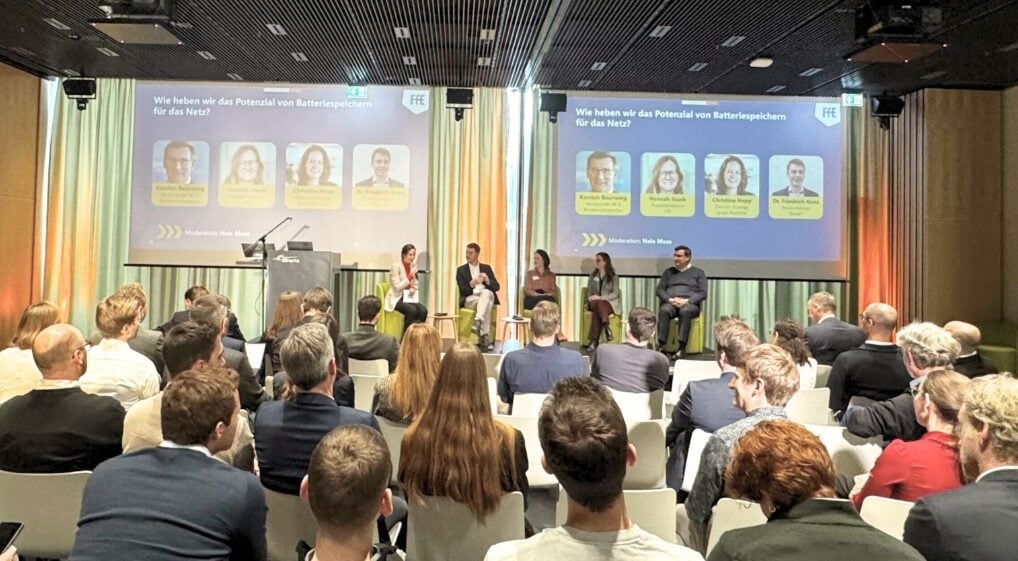
We hear from Christina Hepp, strategy director at battery energy storage system (BESS) owner-operator Green Flexibility, on the big successes and challenges in the German market today.
Hepp will be speaking at the Energy Storage Summit at The Battery Show Europe, in Stuttgart, Germany next week (9-11 June), and gave us this Q&A on the big picture topics in the country in the lead-up to this event.
Alongside other industry experts she’ll help kick off the show with the ‘Evolving German Storage Market Business Case’ opening panel discussion at 10.55am on Day One.
Her comments come as regulators put to bed any possibility that the 4 August 2029 deadline for BESS projects being exempt from grid fees would be brought forward, paving the way for investment into the industry to continue.
Try Premium for just $1
- Full premium access for the first month at only $1
- Converts to an annual rate after 30 days unless cancelled
- Cancel anytime during the trial period
Premium Benefits
- Expert industry analysis and interviews
- Digital access to PV Tech Power journal
- Exclusive event discounts
Or get the full Premium subscription right away
Or continue reading this article for free
However, as Hepp explains, the interaction between grid fees and other rules like the BKZ construction fee and FCAs still needs serious thought. See the full Q&A below.
We interviewed Hepp and Green Flexibility CEO Christoph Ostermann after the company secured a €400 million investment commitment from Partners Group in early 2025 (ESN Premium article). The company recently inaugurated a 40MW/80MWh project in Balzhausen, Germany.
Market in Germany is entering a complex phase
Energy-Storage.news: How would you characterise the current state of the German energy storage market, in terms of the key trends, major successes and achievements, and challenges still to be overcome?
Christina Hepp: The German storage market has developed from a niche flexibility topic into a core infrastructure question of the energy transition. Storage is becoming a key enabler for renewable integration, congestion management and system flexibility. One of the biggest achievements is the emergence of storage as one of the first fully subsidy-free infrastructure asset classes, which has led to strong investor interest, supported by rising volatility and widening spreads across power markets.
At the same time, the market is entering a more complex phase. The main challenges today are less technological and increasingly linked to system integration and regulatory consistency. Many storage projects are economically viable in principle, but uncertainty around grid access, future grid fee design, permitting, FCA models and BKZ treatment creates growing complexity for long-term investment decisions.
A key point is that storage still does not fully reflect its system relevance in the political and regulatory agenda. The political narrative focuses heavily on a reliable and affordable energy transition, while storage is still too often treated as a secondary topic rather than a core infrastructure component of the future energy system.
How is the financing of BESS projects evolving?
Financing has become significantly more complex and more sensitive to regulatory uncertainty. Storage is a fully market-based asset class and therefore depends on stable and predictable long-term regulatory frameworks. Investors need to assess combined effects from multiple regulatory and grid-related mechanisms, such as future grid fees post-2029, uncertainty around transition and trust protection, BKZ applicability and FCA variability across grid operators. In practice, it is this cumulative uncertainty, rather than any single parameter, that is increasingly shaping bankability.
What are the key policy questions and grey areas which German industry and government still need to find solutions for, to unlock storage’s full potential for the grid?
Flexible connection agreements (FCAs)
FCAs are an important tool because they can enable grid connections in regions where fully unrestricted access is currently not feasible. At the same time, we see a very broad spectrum of FCA designs in practice, from relatively transparent and manageable approaches to highly restrictive concepts that can materially impact project economics and operational flexibility.
The key question is not whether FCAs are good or bad, but how they are designed. A one-size-fits-all FCA design is unlikely to work because regional grid situations and operational requirements differ. However, the market needs more consistency and comparability around core FCA parameters, operational logic and restriction mechanisms.
In our experience, FCAs work best when restrictions are applied only where they are necessary from a grid perspective and both the grid operators and the project side have a clear understanding of the operational and economic implications. This is why we use our REGIOlink approach to help translate regional grid requirements into transparent and economically viable connection solutions.
Grid charge/discharge fees exemption expiry in August 2029
The recent update from the regulator on grid fees is a step in the right direction, especially regarding trust protection. It is important that storage continues to be recognised as a system-supporting flexibility asset and is not burdened with consumption-based grid fees in the future.
At the same time, this clarification comes relatively late. Earlier discussions around a potential premature or even retroactive end of the exemption created significant uncertainty and slowed investment decisions across the market. The direction is improving, but the market needs clear and investable rules quickly.
The interaction with FCAs is not yet fully solved, and the postponement of further FCA discussions to 2027 does not reflect the urgency seen in today’s market reality, especially given the current diversity of FCA models as explained earlier. At the same time, dynamic grid fees should remain part of the discussion. Well-designed price signals could unlock additional value from storage for both the energy system and more efficient grid utilization.
BKZ fees
BKZs are in principle understandable as a mechanism to allocate grid-related costs. The key grey area arises when BKZs interact with restricted connection models such as FCAs. If a project cannot freely use its connection capacity, then this should also be reflected in the BKZ logic.
Capacity market
A capacity market could in principle create an opportunity for BESS to play an even larger role as a system-relevant asset. The key question is whether future market design properly reflects the value of flexibility assets or whether storage is structurally disadvantaged through overly rigid product definitions or technology-specific assumptions.
Grid connection backlog
We welcome the introduction of a maturity-based prioritisation mechanism at the TSO level and see value in extending similar approaches to the DSO level. Criteria should reflect project development milestones to differentiate serious and advanced projects and should ensure that storage as a system-relevant flexibility asset is appropriately considered, without structural bias against specific configurations or asset types.
How is the role of TSOs and DSOs in the German energy storage market evolving?
The role of TSOs and especially DSOs is changing fundamentally. Large-scale flexible assets such as BESS introduce a very different operational dynamic compared to traditional generation assets. Grid operators are still building operational experience with these flexibility-driven business models, including evolving forecasting capabilities and system handling in day-to-day operations. This requires closer operational alignment between grid and storage operators to ensure effective system integration, reflection of regional grid requirements and economically viable operation of storage assets.
The Energy Storage Summit at The Battery Show Europe in Stuttgart is now right around the corner, running next week on 9-11 June. Use our discount code ESN20 for 20% off.
See our other recent Q&As with speakers from the event below:
