
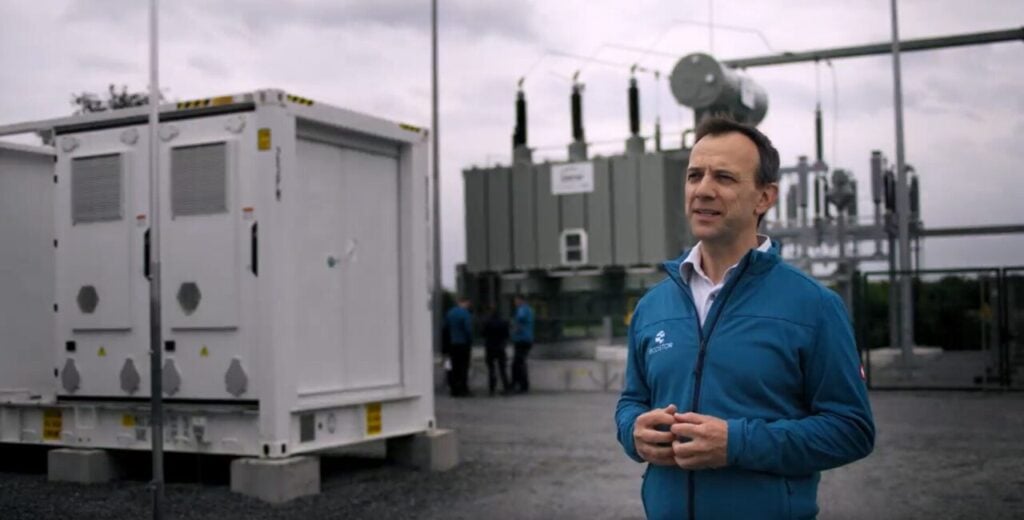
While Germany is often described as the ‘hottest’ energy storage market in Europe, growing uncertainty on multiple policy and regulatory fronts has led to a ‘cooling’ of investor interest.
That’s according to Georg Gallmetzer, managing director of owner-operator Eco Stor, one of the key players in the German market with some of the largest battery energy storage system (BESS) projects in the country in operation and under construction and development.
Gallmetzer says that uncertainty around grid fees, connection and flexible connection agreements (FCAs) as well as future inertia and capacity market (CM) opportunities have made the long-term direction of the German large-scale storage market unclear. He says it will take until 2027 or later for clarity.
He will be speaking on the ‘The Evolving German Storage Market Business Case’ panel discussion, which kicks proceedings off at the Energy Storage Summit at The Battery Show Europe, in Stuttgart, Germany in two weeks’ time (9-11 June). See our full Q&A with him in preparation for the event below.
Try Premium for just $1
- Full premium access for the first month at only $1
- Converts to an annual rate after 30 days unless cancelled
- Cancel anytime during the trial period
Premium Benefits
- Expert industry analysis and interviews
- Digital access to PV Tech Power journal
- Exclusive event discounts
Or get the full Premium subscription right away
Or continue reading this article for free
We will also be diving into the topic of FCAs and grid connection limitations in a webinar with consultancy Clean Horizon next week (2 June), sign up here.
‘German market is in a strong phase of insecurity’
Energy-Storage.news: How would you characterise the current state of the German energy storage market, in terms of the key trends, major successes and achievements, and challenges still to be overcome?
Georg Gallmetzer: The BESS market now (May 2026) is in a phase of strong insecurity driven by multiple parallel regulatory processes (grid fees, BKZ, grid reservation process, grid restrictions & FCA terms, new opportunities with inertia & capacity market, permitting law, incoming gas peakers capping price peak opportunities, etc.).
These processes will have significant impact on the future BESS market. Clarity will take until early 2027 or longer to have clear view on how the market may proceed. Under these circumstances the interest of international investors entering the German market has cooled down.
How is the financing of BESS projects evolving?
Without clarity on multiple regulation topics above BESS financing is very challenging and sometimes impossible.
How is the balance between merchant and tolling/fixed revenue schemes changing? In other words, to what extent are offtake and contracted revenues key to getting project finance?
Offtake is absolute key for larger projects.
What are the key policy questions and grey areas which German industry and government still need to find solutions for, to unlock storage’s full potential for the grid?
Grid fees
Anything is possible. Maximum uncertainty for now. A view of BnetzA on grandfathering terms will be published on May 27th 2026. A grandfathering deadline anticipation prior to August 4th 2029 is likely. I don’t have a view of the grid fee scheme after the new grandfathering deadline. A draft will be published in Summer 2026 (July?). Then consulting will start. The final decision of BnetzA shall occur in late 2026. BnetzA has not communicated anything than the process timing for decisions/publication so far.
BKZ (a one-off fee for projects to cover grid upgrade costs)
BKZ will be regulated together with grid fees. A continuation of today’s BKZ ruling from November 2024 is likely.
Grid reservation process
Transmission system operator (TSO) level: the new maturity grade process has started. It will treat the hundreds of GW of grid queue and award a low single digit GW available capacity. As a result, the several hundreds of GW of existing grid queue will be eliminated for good.
Distribution system operator (DSO) level: maturity grade process will also come at DSO level, though with less standardisation. DSOs also use strict FCA terms that are financially unviable for investors in order to eliminate the grid queue.
Grid restrictions & FCA terms
DSO level: our 100MW/238MWh Bollingstedt project (pictured above) was the lighthouse project used by EON DSO SH-Netz to experiment with FCA terms (ramp rates, ancillary caps, feed-in and charge restrictions) over a full year of operation. The experiment concluded now (May 26) with a new FCA standard in the EON grid that draws down investor returns to the edge of financial viability. In some cases above, in some cases below thresholds for financial viability (investor return requirements).
Reason for FCA terms is the ‘blind flight’ of BESS operation for the grid control centers. They can’t maintain grid security and grid stability if BESS operates with too quick ramp rates and too high ancillary activation, as well as unforeseen market-driven feed-in / charge into already congested grids because the redispatch process is slower than the market activation of BESS.
TSO level: same issue. Though TSOs have better instruments to cope with blind flight of unforseen market driven feed-in / charge schedules from BESS. Nevertheless, TSOs will have to limit ancillary service volumes per asset and at the same time improve substatially their redispatch processes in order to maintain grid security and grid stability despite the upcoming large volumes of market-driven BESS.
New opportunities with inertia
With all the downside described above, inertia fortunately is a future opportunity that will help BESS overcoming the investor hurdle rates in the context of grid fees, grid restrictions, BKZ, etc.
New opportunity in the capacity market (CM)
The new German government is going to release a 10GW gas-focused capacity market despite technology agnostic EU regulation. This will probably be very expensive (shortage on gas turbines) and late (DCs clearing the gas turbine availabilities).
We believe BESS with adequate de-rating is equivalent with regard to energy security but much cheaper for the German consumer bearing this cost. Additionally, new gas power will cap peak prices and therefore reduce shortage price signals, which cannibalises BESS revenues.
Permitting law
The scope of privileged permitting §35 BauGB (speed route to BESS permit) was substantially limited end of 2025 and may be further limited in the course of 2026. As a consequence, permitting processes become substantially more complex with longer duration for the included small scope of land plots around substations or can be easily deliberately inhibited by authorities.
See articles written off comments from other event speakers here (BW ESS) and here (Aquila Clean Energy EMEA). Go to the event page here.
Energy-Storage.news‘ free webinar next week, The Impact of Germany’s Ramp Constraints and Grid Limitations on the Energy Storage Business Case, sponsored by Clean Horizon taking place 2 June 2026 at 11am CEST. This webinar will provide a comprehensive overview of the current grid constraint landscape in Germany, with a focus on what it means in practice for the storage business case.
