
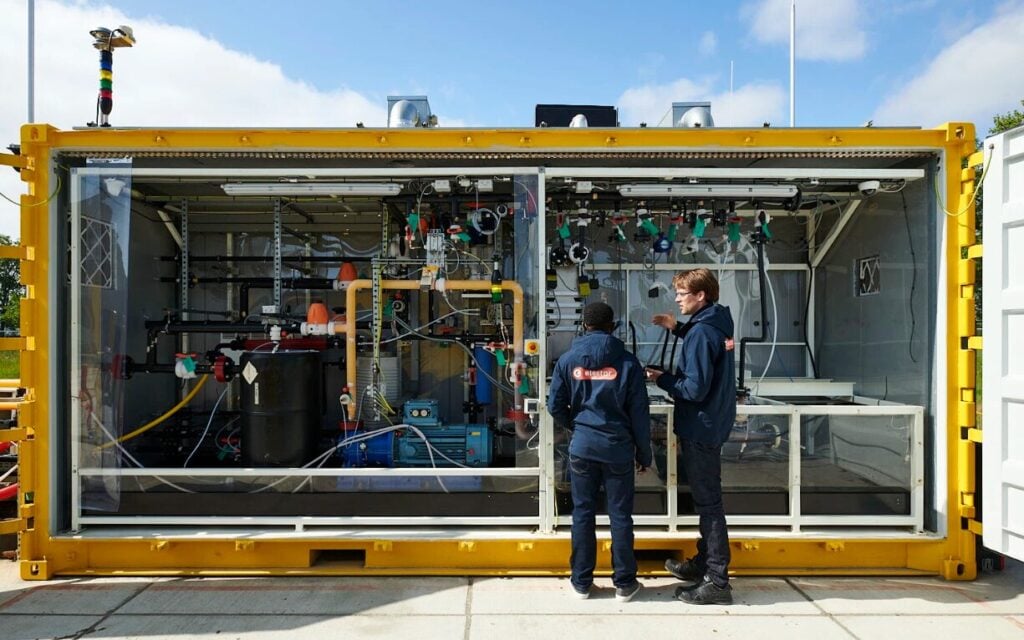
Elestor claims its hydrogen-iron flow battery delivers 75%+ round-trip efficiency, a 20-25 year lifespan, and has a potential capex at gigawatt-hour scale of 15€/kWh for long-duration storage.
In this article, we provide a breakdown of the chemistry, cost economics and real-world case studies behind Elestor’s hydrogen–iron flow battery for long-duration energy storage (LDES) using scientific papers the company has published.
What is a hydrogen–iron flow battery, and why does it matter for LDES?
Long-duration energy storage (LDES) systems need low capital expenditure (capex), high round-trip efficiency (RTE), and the durability to withstand decades of continuous cycling. Redox flow batteries are gaining traction for LDES because they can meet all three requirements. Among the various flow battery chemistries, Elestor has developed a hydrogen–iron flow battery.
Flow batteries store chemical energy in liquid electrolytes containing active ions, held in large tanks called reservoirs. The active materials on each side of the cell are kept separate to prevent contamination and are circulated in a closed loop. As the electrolytes are pumped through the electrochemical cells (the “stack”), redox reactions occur and ions exchange through a membrane connecting the two electrodes. Depending on the direction of the reaction, the system either charges or discharges.
Try Premium for just $1
- Full premium access for the first month at only $1
- Converts to an annual rate after 30 days unless cancelled
- Cancel anytime during the trial period
Premium Benefits
- Expert industry analysis and interviews
- Digital access to PV Tech Power journal
- Exclusive event discounts
Or get the full Premium subscription right away
Or continue reading this article for free
How flow batteries work: decoupling power and energy capacity
One of the main benefits of flow batteries is their decoupling of power and energy. The power level (MW) is determined by how many electrochemical cells are connected in series in the electrochemical stack and the surface area of the ion-selective membrane between the two electrodes.
On the other hand, the capacity (MWh) is determined by the volume of the two electrolytes―the catholyte and anolyte―in the reservoir (and by default, the size of the electrolyte reservoirs). So, unlike traditional batteries where power and capacity scale simultaneously, either power or energy capacity (or both) can be independently scaled to meet LDES requirements for different applications.
Different flow battery chemistries use different active materials. Vanadium flow batteries use different valence states of vanadium on either side of the cell. Zinc-bromine flow batteries use positive zinc ions on one side and negative bromine ions on the other. Hydrogen-bromine flow batteries have drawn significant interest because bromine is more abundant than metals like vanadium, though supply can be volatile since most of it originates in the Middle East.
Why iron as the redox couple?
Elestor’s hydrogen–iron flow battery uses iron, a highly abundant material that isn’t geographically restricted and can even be extracted from seawater. Pairing iron with hydrogen as the redox couple allows the system to achieve both high power density (W/m²) and high energy density (kWh/m³), which can translate into lower per-MWh costs than some competing flow chemistries. Power and energy density are not quite as high as a hydrogen-bromine redox couple, but they outperform many other flow chemistries.
Inside the Elestor hydrogen–iron flow battery is an electrochemical cell stack connected in series, and the membranes in the stack are connected to an aqueous and acidic iron-based solution on one side and a hydrogen gas circuit on the other side of the battery. The iron solution uses Fe2+/Fe3+ as the active ions which originate from iron sulphate (FeSO4) dissolved in water and sulphuric acid (H2SO4). Proton conductive membranes separate the two active materials, and a hydrogen-fed anode, a carbon-based cathode optimised for iron redox kinetics, and compression and current collector hardware make up the rest of the key components of the battery system.
How does Elestor’s hydrogen-iron flow battery work?
In the Elestor hydrogen–iron flow battery, hydrogen is oxidised at the anode (loses electrons), while the iron is reduced at the cathode (gains electrodes). The combination of these REDuction and the OXidation reactions make up the redox reactions of the cell, and the electrochemical reaction equation is depicted as:
Cathode: 2Fe³⁺(aq) + 2e⁻ → 2Fe²⁺(aq)
Anode: H₂ → 2H⁺ + 2e⁻
Overall: 2Fe³⁺(aq) + H₂ → 2Fe²⁺(aq) + 2H⁺
Because iron is a low-cost material that is not as susceptible to price hikes as other materials, Elestor has stated that its hydrogen–iron flow battery system has an active material cost of 2.8€/kWh, a cost potential at GWh scale of 15€/kWh, and a Levelised Cost of Storage (LCOS) at system level of 0.02€/kWh. Other claims include a 20–25-year lifespan under standard operating conditions, the ability to undergo tens of thousands of charge–discharge cycles, an energy efficiency of at least 80%, and a round-trip efficiency (RTE) of at least 75% at the system level.
Elestor hydrogen–iron flow battery: key performance and cost metrics
| Metric | Elestor Claim |
| Active material cost | 2.8 €/kWh |
| System capex | 15 €/kWh |
| Levelised Cost of Storage (LCOS) | 0.02 €/kWh |
| Round-trip efficiency (RTE) | ≥ 75% (system level) |
| Energy efficiency | ≥ 80% |
| Lifespan | 20–25 years |
| Cycle life | Tens of thousands of charge–discharge cycles |
One of the other main benefits of this type of flow system is that they sustain operational stability under continuous cycling and the core components are not affected by interruptions and restarts. Like any flow battery system, the electrolytes can be replaced as needed (without removing infrastructure) to ensure that the electrolyte is free from contamination and is always going to be delivering the expected capacity.
Case study 1: energy independence for islands
Elestor has been performing different analyses looking at how its hydrogen–iron flow battery can be used as an improvement to the current energy storage capabilities in different energy storage scenarios. The first case study involves how diesel generators can be replaced with solar and BESS, while still delivering baseload power, in Bonaire in the Caribbean, Santiago (Cabo Verde) in the Atlantic Ocean and Guadalcanal (Solomon Islands) in the Pacific.
The study looked at both LFP batteries and Elestor’s hydrogen–iron flow LDES as the energy storage medium on these islands. The overall results of the study showed that baseload renewable energy systems can competitively replace diesel generators on island nations and can reduce electricity costs for the island by 25–40%.
In terms of Elestor’s LDES, the LDES with Baseload Renewable Energy Systems (BRES) reduced the levelised cost of energy (LCOE) by 25% compared to PV-plus-LFP systems. According to Elestor and Charged Islands (a partner on the project) the LCOE on Bonaire dropped from 285 to 211€/MWh with the addition of the LDES, as well as dropping from 280 to 208€/MWh in Santiago because most of the long-duration storage was handled by the LDES while LFP was used for short-term cycling and fast balancing, so most of the energy was cheaper flow energy. The study showed that the flow LDES won’t fully place LFP or diesel generators on island nation, but LFP can instead be used for frequent cycling and short-duration balancing, allowing LDES to provide lower energy costs when the island has deep energy deficits.
Case study 2: enabling affordable green hydrogen for clean fuel production by applying LDES
Elestor has also produced a techno-economic assessment for using its LDES solution as part of green hydrogen fuel plants, zeroing in on Ain Sokhna in Egypt as the location of interest because it combines high solar and wind generation capacity. Using 10 years of hourly solar and wind data for Ain Sokhna, both Li-ion and Elestor’s LDES were analysed.
It should be noted that the modelling was performed by Elestor and the results have all come from them, so there is always the possibility of some bias. The model looked at how a 15–60-hour hydrogen-iron flow LDES from Elestor could buffer renewable electricity upstream of the electrolyser in the green hydrogen plant without separate downstream hydrogen storage. The model used Li-ion costs of €200/kWh, hydrogen storage costs of €1,040/kg, and Elestor’s expected commercial costs for 2029–2030.
According to the Elestor model, the LDES stabilises the power input to the electrolyser, allowing a continuous and predictable operation of both hydrogen production and downstream processes. It also means that the electrolysers don’t need to be oversized to compensate for variability. The model also showed that in a baseload hydrogen case, Elestor’s LDES configuration 36-hour hydrogen-iron flow battery (with an estimated RTE of 75.7%) reduces the levelised cost of hydrogen (LCOH) by 20% compared to LFP and is mainly driven by a higher electrolyser capacity factor and 37% lower installed electrolyser capacity for the same baseload supply. It was also estimated by Elestor that the hydrogen–iron flow battery approach would reduce capex by 17%.
