In this news roundup, Grenergy, MaxSolar and Saft, and Amarenco have made significant advancements on BESS projects in Spain, Germany, and France.
Grenergy closes financing for 618MWh BESS in Spain
Independent power producer (IPP) Grenergy has closed a senior non-recourse financing of €100 million (US$113.75 million), including credit facilities, for the 618MWh Oviedo battery energy storage system (BESS) project in Spain.
Announced 22 July, the transaction was signed with financial institutions Santander and Sumitomo Mitsui Banking Corporation (SMBC), which Grenergy claims as “the first financing in Spain for a project of this kind.”
The Oviedo project also reached another milestone in February with the signing of the first financial tolling agreement for a stand-alone BESS project in Spain. The agreement was signed with an unnamed international utility with an investment-grade credit rating and will run for ten years starting in 2028.
Try Premium for just $1
- Full premium access for the first month at only $1
- Converts to an annual rate after 30 days unless cancelled
- Cancel anytime during the trial period
Premium Benefits
- Expert industry analysis and interviews
- Digital access to PV Tech Power journal
- Exclusive event discounts
Or get the full Premium subscription right away
Or continue reading this article for free
BESS projects in Spain typically achieve bankability through subsidies or long-term tolling agreements and are frequently co-located with solar PV installations.
Oviedo has begun construction on an industrial site next to the La Estrecha substation in La Corredoria. The company expects it to enter into operation during the first half of 2027.
It is also considered a “flagship” project for Grenergy’s European standalone storage development platform, Greenbox, which has a 30GWh development pipeline across Poland, Romania, Germany, Italy, Spain and the UK.
Grenergy said that Spain is consolidating its position as one of the company’s strategic markets for the coming years. In the country, the company is developing standalone projects and hybridisation initiatives.
In June, Grenergy signed a 1TWh night-time power purchase agreement (PPA) for its 3.5GWh Elena BESS in Chile. The PPA signing came shortly after the inauguration of the project, which is located in the Antofagasta region of Chile. A ceremony was led by President of Chile, José Antonio Kast Rist, and attended by national and regional authorities, including Minister of Energy Ximena Rincón and Minister of Science, Technology, Knowledge and Innovation Ximena Lincolao.
Elena BESS is part of Grenergy’s massive Oasis de Atacama solar-plus-storage development that will eventually pair 2GW of solar PV with 11GWh of battery storage. The company is also building the 1.1GW solar, 4GWh BESS Central Oasis platform in Chile and rolled out the same business model for Escuderos, a project in Spain that will combine 200MW of solar and 704MWh BESS capacity. CATL was signed up as BESS supplier for the Escuderos and Oviedo projects in May.
Recently, Spain awarded US$188 million to seven pumped hydro storage projects totalling around 2.1GW/21GWh, while Portugal set a target of 1.4GW of new capacity by 2040 as part of a new National Energy Storage Strategy, following the blackout of the Iberian Peninsula last Spring.
MaxSolar and Saft sign agreement for Germany BESS project
MaxSolar, an EPC provider and IPP, and battery manufacturer and BESS integrator Saft have signed an agreement for the first BESS project in Quitzow, Brandenburg, Germany.
The Quitzow II project, developed by Denker & Wulf AG and being delivered on a turnkey basis by MaxSolar as EPC partner, will provide an installed capacity of 30MW and a storage capacity of 76.5MWh.
The BESS will be constructed by Denker & Wulf AG as a co-location project alongside an existing wind farm and its associated substation, making use of the existing grid infrastructure.
For the project, Saft, which has been owned by French energy giant TotalEnergies since 2016, claimed it will provide “advanced BESS technology,” drawing on its long-standing experience.
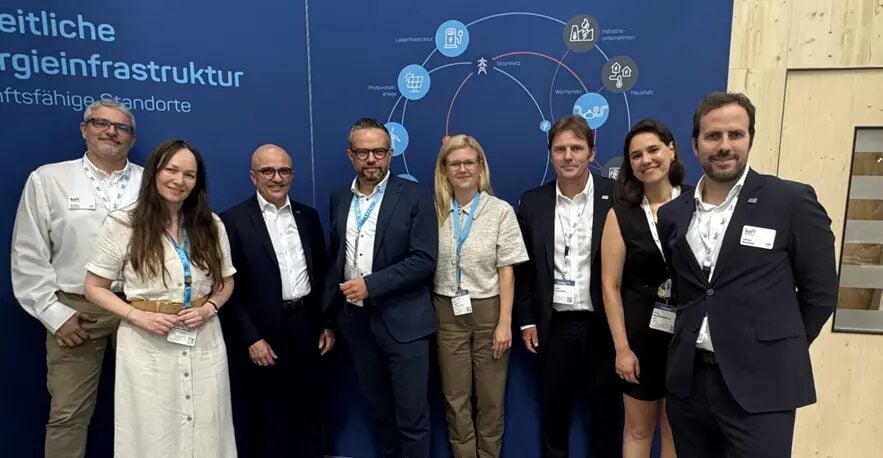
The announcement also follows a meeting between both companies during the latest edition of Intersolar Europe, where MaxSolar and Saft formalised a broader strategic cooperation. Building on the successful launch of Quitzow II, the two companies intend to explore additional opportunities for BESS projects across Europe.
Earlier this week (21 July) the Federal Network Agency (Bundesnetzagentur or BnetzA) announced the launch of Germany’s first capacity market (CM) auction in September, enabled under the Electricity Supply Security and Capacity Act (StromVKG).
In February, investor RP Global and MaxSolar entered into a memorandum of understanding (MOU) to develop solar and storage projects in Germany. The terms of the agreement see RP Global RP Global acting as project investor and long-term owner while MaxSolar delivers the projects on a turnkey EPC and long-term O&M basis.
In October 2025, energy trading company Foxwell Power (FWP) contracted Saft to supply a BESS solution for a 356MWh project in Taiwan, to be deployed in Taichung, Taiwan’s second-largest city.
Amarenco begins construction of 200MWh BESS in France
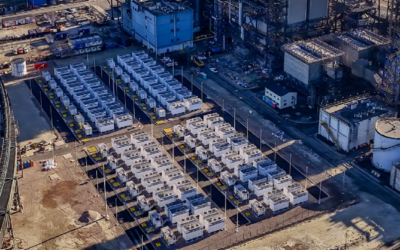
Ireland-headquartered IPP Amarenco has begun construction of the 100MW/200MWh Osmo BESS project in France.
Osmo, located between Os-Marsillon and Mourenx, in the Lacq industrial basin, uses lithium iron phosphate (LFP) battery cells and is being developed close to existing infrastructure on a former industrial site.
Financing was finalised with financial institution Société Générale and Amarenco claimed it is focused on limiting the environmental footprint of the project while making use of an underused area of land.
This announcement also follows the March update that Amarenco had raised a US$74 million debt facility to repower and augment its Claudia BESS project in France.
Claudia was originally deployed in 2024 as a 105MW/100Wh, approximately 1-hour system, but is being expanded to 94MW/188MWh.
Large-scale BESS activity in France has gained momentum in the past year as developers capitalize on ancillary services and grid balancing opportunities.