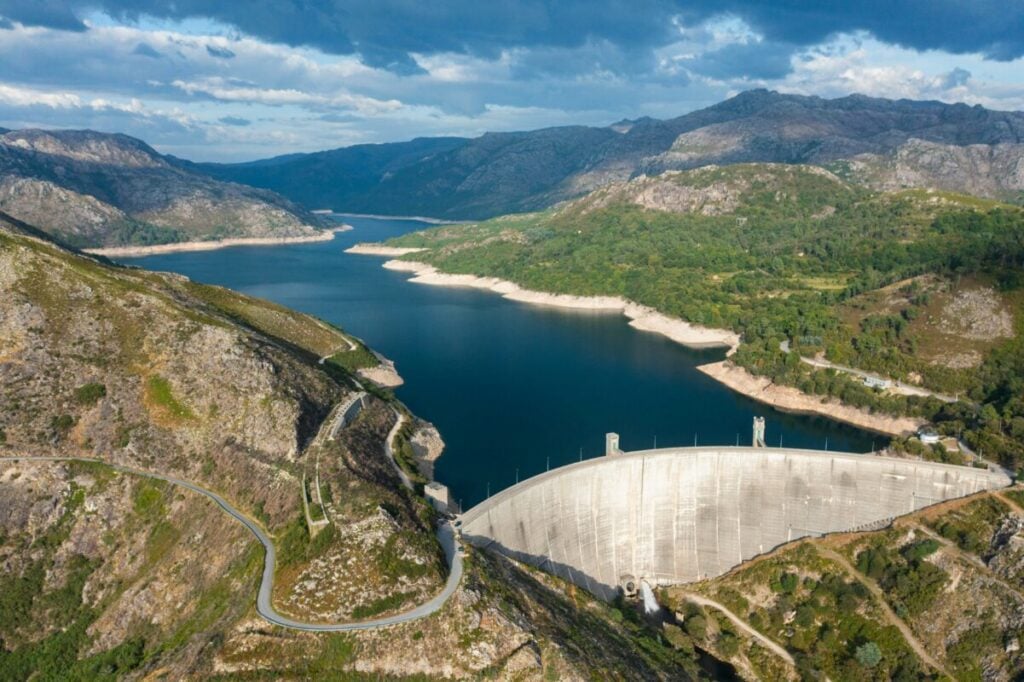
Spain has awarded €165 million (US$188 million) to seven pumped hydro storage projects totalling around 2.1GW/21GWh, while Portugal has set a target of 1.4GW of new capacity by 2040 as part of a new National Energy Storage Strategy.
The announcements follow the Iberian Peninsula-wide blackout in Spring 2025, since which both countries have taken various steps to accelerate the deployment of energy storage.
Pumped hydro energy storage has huge potential thanks to its scale and inherent ability to provide long-duration energy storage (LDES). However, projects take much longer to be approved and constructed, so there are many more battery energy storage system (BESS) projects being developed, and BESS actually overtook pumped hydro for installed capacity globally last year in gigawatt terms. But every pumped hydro project progressed moves the needle significantly.
Spain’s MITECO awards funding to seven projects
The Ministry for Ecological Transition (MITECO) of Spain has awarded €165 million (US$188 million) in grant funding for seven pumped hydro energy storage projects.
Try Premium for just $1
- Full premium access for the first month at only $1
- Converts to an annual rate after 30 days unless cancelled
- Cancel anytime during the trial period
Premium Benefits
- Expert industry analysis and interviews
- Digital access to PV Tech Power journal
- Exclusive event discounts
Or get the full Premium subscription right away
Or continue reading this article for free
The funding comes from the EU’s NextGeneration EU funding programme, administered via the Recovery and Resilience scheme (Plan de Recuperación, Transformación y Resiliencia in Spanish).
The €165 million for the seven projects is specifically part of the BORALMAC 2 programme, which had its budget increased from €90 million initially after the quantity of applications received.
The hydroelectric plants that will receive the funding are in the regions of Andalusia, Asturias, Aragon, Extremadura, Catalonia and Galicia. They will add 2,071MW of installed generation capacity and will enable a total energy storage capacity of 21,091MWh, or 21.09GWh.
The majority of the funding will go to building entirely new pumped hydro energy storage plants, along with upgrades to an existing hydropower plant.
It follows the first BORALMAC scheme which awarded €100 million in funding to four projects adding 2GW of pumped hydro storage capacity. The scheme is part of meeting the objectives set out in Spain’s National Energy and Climate Plan (NECP), something each EU Member State has produced to set out its decarbonisation plans.
Since the Spring 2025 blackout, the government of Spain has accelerated its rollout of EU-backed grants for battery energy storage, passed a grid resilience decree, provided funding to domestic battery manufacturing, and launched a capacity market (CM).
See all (predominantly BESS) news from Spain’s energy storage market here.
Portugal targets 5GW of pumped hydro storage by 2040
The government of Portugal has revealed its new National Energy Storage Strategy, setting outs its plans to use storage to decarbonise and shore up its energy system over the coming decades.
Within the announcement was a commitment to expand its pumped hydro storage capacity from 3.6GW operational currently to 3.9GW by 2030 and 5GW by 2040. That means adding 300MW of new capacity by 2030 and 1.4GW by 2050.
The trade body International Hydropower Association (IHA) welcomed the move, calling it “…a landmark initiative, representing one of the strongest national policy commitments to long duration energy storage seen in Europe”.
The government is also launching a tender for financial support for 750MW of standalone BESS projects and 300MW of renewables-plus-storage projects.
You can watch a presentation on the Strategy and Measures for Energy Storage in the National Electricity System on Youtube here.
A few months after the Spring 2025 blackout, the government of Portugal committed to investing €400 million to improve its grid management capabilities and increase its BESS installations.
Prior to that, Portugal had already awarded €100 million in funding to 43 winning projects 500MW of BESS capacity, in January 2025.