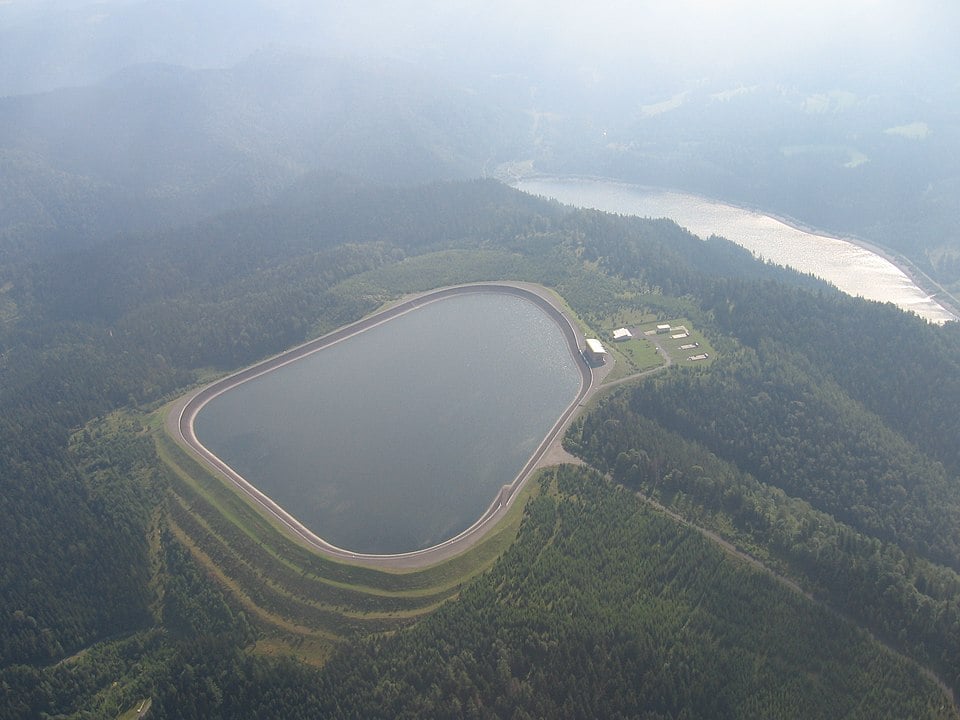
European Commission (EC) funding is supporting a project to integrate battery storage at a pumped hydro energy storage (PHES) plant in Slovakia.
The European Union (EU) executive and legislative arm highlighted this week (25 August) that €2.1 million (US$2.44 million) funding is being used for the project, which assesses how best to hybridise the 735MW Cierny Vah PHES plant with a battery energy storage system (BESS) and modernise two of the facility’s six units.
The effort is being funded through the Connecting Europe Facility (CEF) for Energy, the EU programme to implement Trans-European Networks for Energy policy. It aims to support investments in new cross-border energy infrastructure and upgrades to existing infrastructure.
‘Modernisation of Pumped Hydroelectric Energy Storage in Cierny Vah’ was designated a Project of Common Interest (PCI).
Try Premium for just $1
- Full premium access for the first month at only $1
- Converts to an annual rate after 30 days unless cancelled
- Cancel anytime during the trial period
Premium Benefits
- Expert industry analysis and interviews
- Digital access to PV Tech Power journal
- Exclusive event discounts
Or get the full Premium subscription right away
Or continue reading this article for free
It began in October 2024, coordinated by Slovenske Elektrarne, Slovakia’s biggest electricity utility. The state owns 34% of Slovenske Elektrarne, and Slovak Power Holdings, a joint venture between Czech power company EPH and Italy-headquartered Enel, owns the remaining 66%. However, EPH is expected to buy out Enel’s share during this year.
The EC said this week that over the next two years, preparation will be made for converting two pumped turbine units to variable-speed turbines, which will improve Cierny Vah’s operational efficiency.
At the same time, the optimal configuration and design integration for a BESS of up to 80MW/160MWh will be studied. These studies are expected to define technical specifications for hybridising the PHES plant, from market simulations and financial assessments to detailed technical design of components and control systems.
Slovenske Elektrarne has called the project SE Integrator, noting that the need for it arises from the growing share of variable renewable energy (VRE) on the grid. This results in short-term fluctuations, which batteries can help solve, as well as longer-term mismatches between renewable production and grid demand, e.g., daytime solar vs the evening peak.
The project will enter the Final Investment Decision (FID) phase upon the conclusion of the EC-funded studies. The European Commission said that in addition to balancing the Slovakian grid, balancing energy could be exported and traded with neighbouring countries such as Hungary, Poland, and the Czech Republic.
Various projects involving the hybrid integration of batteries to run-of-river hydroelectric generation facilities have been carried out, are ongoing or are planned around the world, including projects in the Philippines, Bulgaria, Germany and other regions.
The direct pairing of long-duration energy storage (LDES) pumped hydro with battery storage appears to be a much rarer concept so far, although developers SENS and Callio in Finland announced a project early last year which would combine the two, along with solar PV generation at a decommissioned mine.