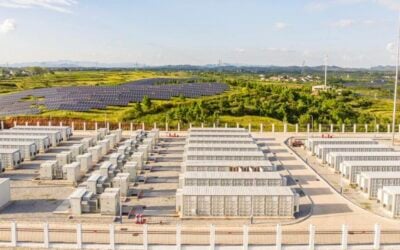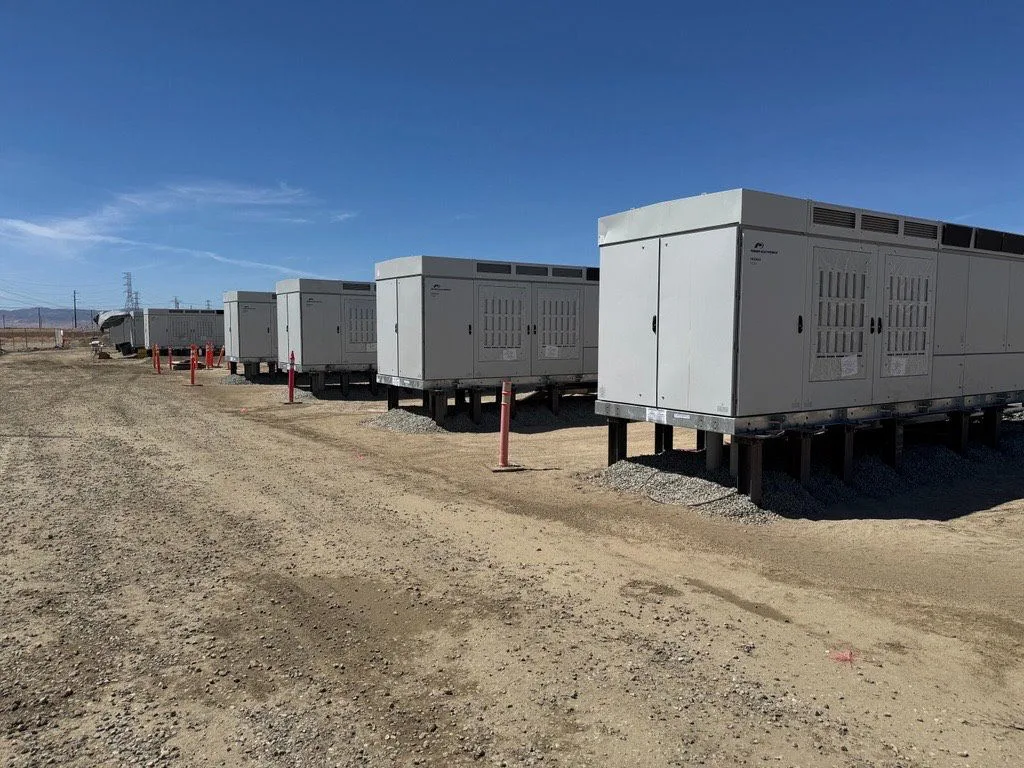
REV Renewables and its parent company, US energy sector developer and investor company LS Power, have commissioned the Tumbleweed Energy Storage facility in Kern County, California, US.
Announced 18 June and celebrated with a ribbon-cutting ceremony alongside local officials, community leaders, and industry partners, the project is the first 8-hour duration battery energy storage system (BESS) in California.
Tumbleweed was developed in partnership with California community choice aggregators (CCAs) Ava Community Energy and California Community Power (CC Power), on behalf of CCAs CleanPowerSF, Peninsula Clean Energy, Redwood Coast Energy Authority, San José Clean Energy, Silicon Valley Clean Energy, Sonoma Clean Power, and Valley Clean Energy.
The companies said the system was brought online ahead of the California Public Utilities Commission’s (CPUC) requirements.
Try Premium for just $1
- Full premium access for the first month at only $1
- Converts to an annual rate after 30 days unless cancelled
- Cancel anytime during the trial period
Premium Benefits
- Expert industry analysis and interviews
- Digital access to PV Tech Power journal
- Exclusive event discounts
Or get the full Premium subscription right away
Or continue reading this article for free
As part of the ribbon-cutting celebration, REV Renewables announced a US$5,000 community investment in the Kern County Economic Development Women in STEM Scholarship programme and a US$2,500 community investment in Rosamond Little League, “supporting educational opportunities, youth development, and long-term community vitality in the region.”
In 2022, CC Power voted to enter into an energy storage service agreement for the Tumbleweed BESS project. It was the “first major procurement” for long-duration energy storage (LDES) by CC Power, a representative of Silicon Valley Clean Energy, one of the CCA groups, told Energy-Storage.news at the time.
While the capacity of the project was not disclosed in the commissioning announcement, in 2022, it was stated as 69MW/552MWh. Engineering, procurement, and construction (EPC) contractor Mortenson notes work on two phases of the Tumbleweed project, with a final expansion totalling 125MW/1,000MWh.
This followed the CPUC’s mandate requiring energy suppliers to deploy 11.5GW of energy resources—nearly all low or zero-emissions—within five years to meet what the commission defined as ‘Mid-Term Reliability’ requirements.
This addressed natural gas plant retirements and the Diablo Canyon nuclear facility closure. The CPUC ordered California’s investor-owned utilities (IOUs) and CCAs to procure varying resource capacities.
In June 2020, before the Mid-Term Reliability ruling, 11 CCAs sought LDES providers with eight-hour minimum discharge capability. By October 2020, eight CCAs issued a request for offers (RFO) for up to 500MW of 8-16 hour storage with 10-year contracts.
The CC Power Joint Powers Agency, formed after the RFO, said its agreement with REV Renewables’ Tumbleweed project satisfies 55% of the Mid-Term Reliability requirement for eight-hour minimum storage procurement.
LDES uptake
Market research firm Wood Mackenzie’s ‘Long Duration Energy Storage Trends’ report projects that net zero scenarios require global average storage duration to expand from 2.5 hours today to approximately 20 hours, particularly for countries aiming to exceed 50% renewable energy penetration by 2030.
However, global LDES funding declined 30% in 2025, while venture capital (VC) funding fell by 72%. While there was an increase in deployment in 2025, it was considerably less than the 806% jump between 2023 and 2024.
Priya Shrivastava, energy storage supply chain research manager at Wood Mackenzie, noted that emerging LDES technologies will find it difficult to achieve the similar dramatic cost reductions that lithium-ion (Li-ion) has seen over the past decade,
While data centres have recently been noted as a potential pathway to the commercialisation of non-lithium LDES technologies, Li-ion, as of July 2025, accounts for half of the global long-term project pipeline for inter-day (8-70 hours) LDES, and most of the projects coming online by 2030, according to market intelligence firm Sightline Climate.
REV Renewables and LS Power’s BESS market stumbles
In 2024, REV Renewables and subsidiaries owned by NextEra Energy reached settlement agreements with the US Federal Energy Regulatory Commission (FERC) totalling over US$3.1 million for alleged violations in California’s energy market, with REV accused of providing inaccurate state-of-charge (SOC) forecasts for its Vista battery project that resulted in improper regulation awards and payments totalling US$1.64 million between 2022-2023.
NextEra’s violations involved co-located solar-battery facilities that deviated from dispatch instructions while providing ancillary services due to programming logic that prioritised solar output, earning approximately US$381,724 in revenue that should have been curtailed under rules enacted in December 2021.
In July 2025, the US Environmental Protection Agency (EPA) entered into a settlement agreement with LS Power to direct cleanup after a Li-ion battery fire at the company’s Gateway energy storage facility in San Diego, California.
Gateway, which was thought to be the world’s largest single-site battery project when it came online, caught fire on 15 May 2024. According to the settlement agreement, the company is required to perform environmental monitoring throughout all battery handling activities. It must also safely remove, package, and dispose of all affected battery packs and submit detailed work plans along with progress reports to the EPA.