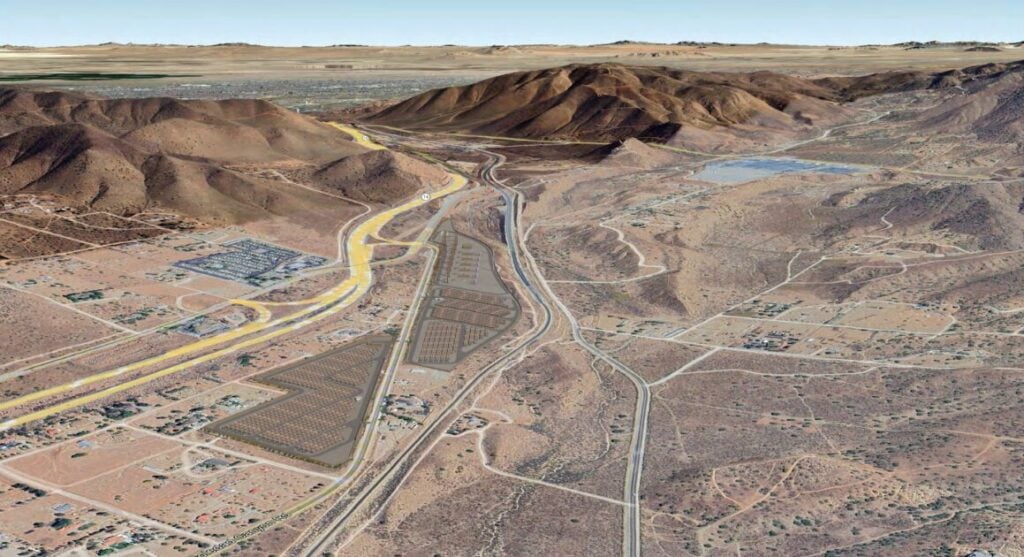
Coval Infrastructure has become the latest developer to submit an application with the California Energy Commission (CEC), as part of the regulator’s opt-in certification scheme.
With an expected 1.15GW/9.2GWh of BESS capacity, the Prairie Song Reliability Project will become the largest development in terms of discharge capacity to be assessed by the regulator since the scheme opened in 2022.
The developer’s application follows a big milestone for the CEC last month as it approved the first project as part of its opt-in certification scheme.
As reported by Energy-Storage.news, the CEC approved Intersect Power’s Darden Clean Energy Project (DCEP) which is expected to feature a 1.15GW/4.6GWh BESS paired with a similarly sized solar farm.
Try Premium for just $1
- Full premium access for the first month at only $1
- Converts to an annual rate after 30 days unless cancelled
- Cancel anytime during the trial period
Premium Benefits
- Expert industry analysis and interviews
- Digital access to PV Tech Power journal
- Exclusive event discounts
Or get the full Premium subscription right away
Or continue reading this article for free
Despite having only received a handful of applications so far, the CEC revealed last month that it was bracing for a “flood of [opt-in] applications.” The process was introduced as a pathway for developers to get permitting for their projects at state, rather than local, level.
9.2GWh of long-duration energy storage
The Prairie Song project will comprise a 1.15GW/9.2GWh BESS utilising lithium iron phosphate (LFP) technology, located across two sites straddling Soledad Canyon Road, approximately 6 miles south of Palmdale in Los Angeles County.
The business subsidiary for the Prairie Song project was first incorporated with the California Secretary of State in 2017 as 16DO 8ME, LLC, by solar and storage developer Avantus.
Prior to a 2022 rebrand, Avantus was known as 8minute Solar Energy, and would incorporate all of its business subsidiaries in this manner, using a combination of random numbers and letters followed by its distinguishable “8ME” signature.
At the end of last year, ownership of the project was transferred from Avantus to a Coval Infrastructure subsidiary, Ambar Power DevCo, LLC. In April of this year, the business subsidiary name was changed to Prairie Song Reliability Project, LLC.
CAISO interconnection already agreed by previous owner
The Prairie Song project will connect to the California Independent System Operator (CAISO)-operated grid via Southern California Edison’s (SCE’s) 500kV Vincent substation.
Despite having only just submitted its application with the CEC, the project already has permission to connect to the CAISO grid. Prior to selling the project, Avantus secured an interconnection agreement for the project which was finalised in 2022 as part of the system operator’s cluster 12 process.
According to the queue request, named Angeleno Solar Farm, the project’s developer would be able to connect a 1.15GW BESS along with 1.15GW solar, opening up future options for the developer to potentially co-locate the energy storage element.
With CAISO’s oversubscribed and slow interconnections process remaining a huge barrier to overcome in the quest to break ground, Coval Infrastructure has managed to avoid this entirely through the purchase of this project.
The developer hopes to commence construction on its Prairie Song project no later than March 2027, with commercial operations slated for June 2029.
270-day countdown to opt-in decision begins
Once the regulator deems that the application has all the necessary information, the CEC will commence a 270-day countdown period during which time the regulator will decide whether to approve the project or not.
Based on the timelines of previous applications, it could be sometime before the CEC commences this countdown
For example, Intersect Power submitted an application for its DCEP in November 2023, which the CEC deemed complete a whole 10 months later during September 2024.
In the instance of Engie’s Compass Energy Storage project, the CEC took a whole year to deem the application complete, after the regulator requested additional information on two separate occasions during the 12-month period.
As the approvals process is still in its infancy, developers may learn from previous mistakes and the commencement of the countdown period may be expedited.
US$1 million fee to enter process
Although the CEC’s opt-in process offers developers an alternative to local permitting routes, it has some distinct potential drawbacks. The first is the price for submitting an application, which can cost developers up to US$1 million.
As it stands, submitting an application costs US$356,282, plus an additional US$712 for each megawatt-hour of energy storage capacity. Luckily for developers of the biggest projects, the CEC caps application fees at US$1,068,853.
The second notable drawback is the impression the opt-in applications can create amongst communities, with some having accused developers of attempting to circumvent local opinion.
With the CEC offering the public a chance to submit public comments on projects, the community of San Juan Capistrano has made its opinion on Engie’s Compass Energy Storage project abundantly clear.
After receiving more than 1,1000 overwhelmingly negative comments on the project, the CEC has until January next year to decide whether to certify the project.
This article originally incorrectly stated that a different developer owned the project and submitted the application to CEC’s opt-in process. As the piece now reflects, Coval Infrastructure is the project’s owner and developer.