
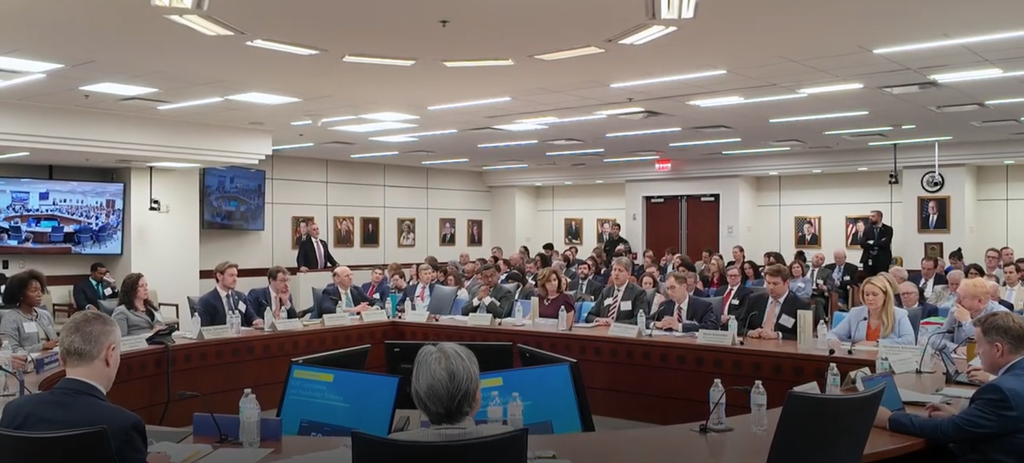
Few grids illustrate the strain of America’s data centre boom more starkly than the PJM Interconnection.
PJM is the regional transmission organisation (RTO) spanning 13 states and the District of Columbia, and home to Virginia’s “Data Centre Alley” — the world’s largest concentration of data centres.
With electricity demand forecasts surging, PJM’s capacity market has come under sustained political and regulatory pressure, culminating in a series of pivotal Federal Energy Regulatory Commission (FERC) decisions that have shifted attention squarely onto the states.
FERC’s rulings and what they left unresolved
In January, the Trump administration, governors from both parties, and US Secretary of Energy Chris Wright jointly called for a temporary restructuring of PJM’s market framework to bolster reliability and curb consumer costs through more than US$15 billion in new baseload generation.
Try Premium for just $1
- Full premium access for the first month at only $1
- Converts to an annual rate after 30 days unless cancelled
- Cancel anytime during the trial period
Premium Benefits
- Expert industry analysis and interviews
- Digital access to PV Tech Power journal
- Exclusive event discounts
Or get the full Premium subscription right away
Or continue reading this article for free
PJM responded with a Reliability Backstop Procurement (RBP) mechanism and later filed a two-part reform plan with FERC on 31 July and 7 August, including a one-time RBP auction planned for 30 September to 21 October.
FERC broadly accepted the RBP framework but delayed its effective date by five months, citing PJM’s failure to show clearly how data centres would be required to pay for their own capacity.
Claire Lang-Ree, clean energy advocate at the Natural Resources Defense Council (NRDC), stated of the decision, “FERC’s decision leaves the public exposed to rolling blackouts and higher bills caused by data centre electricity demand… Instead of requiring data centres to bring their own new capacity, FERC’s decision will force the public to continue paying for data centres’ power supply.”
According to news agency Reuters, FERC’s scrutiny of PJM’s data centre strategy did not stop there. In an order filed that week, the Commission rejected the core of a separate PJM plan to manage data centres by temporarily cutting their grid power during periods of high demand, finding that the proposal strayed outside PJM’s authority.
That plan, filed with FERC in August, had sought to require new data centre customers of 50MW or more to pay for new power supplies that cover their full electricity needs, or risk disconnection during emergencies.
FERC said PJM could submit a revised curtailment plan but would need to address outstanding issues, including why data centres specifically would be shut off ahead of other large energy users.
The same order approved a narrower element of PJM’s proposal: a new database to track data centres connected to the grid, which was set to begin development on 13 October, covering details such as energy providers, in-service dates, power ramp-up schedules, backup generation, fuel sources, and location.
Reuters also reported that PJM forecasts that data centre demand in its Midwest and Mid-Atlantic territory could nearly triple by 2030 to around 29GW, a surge that, combined with years of shrinking net supply, has contributed to capacity costs rising by more than 1,000% since 2024 and a projected 6. GW shortfall that could risk blackouts.
Taken together, these rulings show that FERC is willing to approve administrative tools like the data centre registry, but is drawing a firmer line around curtailment and cost allocation, insisting these are matters requiring state-level rules rather than unilateral RTO action.
Lang-Ree’s core argument reflected this dynamic — that PJM’s proposals, while an important step, cannot succeed without matching action at the state level.
Without coordinated state frameworks, she noted, it remains unclear which customers will face curtailment during grid-stress events and who ultimately bears the costs of new backstop procurement.
Maryland shows what state-led action can look like
While PJM and FERC continue to work through market-wide reform, Maryland has already moved from policy to procurement, offering an early proof point for how states can act without waiting for federal clarity.
Evan Vaughn, executive director of non-profit advocacy group Mid-Atlantic Renewable Energy Coalition (MAREC) Action, points to the state’s Next Generation Energy Act—which underpinned the recent selection of the Chalk Point and Jade Meadow storage projects—as a model that provides long-term revenue certainty.
He says this certainty is essential because PJM’s capacity market offers only a one-year forward price signal, despite its three-year-ahead structure.
Vaughn also identifies Pennsylvania and Ohio as the next likely fronts for battery expansion; PJM’s interconnection queue currently holds roughly 50GW of storage capacity awaiting deployment.
With FERC’s rulings now shaping the timeline and scope of PJM’s capacity and data centre reforms, and state policymaking still uneven across the RTO, the coming months are likely to prove decisive for the distribution of costs and environmental burdens.
As Lang-Ree said, “There are a lot of wins that states could get out of these policies, but I think they all need to come together. There’s going to be a lot more media moments that we see out of the next few months.”
