Australia’s federal government is developing a National Critical Minerals Strategy, with materials for batteries and other clean energy technologies at its heart.
To be included in today’s Federal Budget 2022-2023 announcement, the government led since April this year by Labor Party prime minister Anthony Albanese will pledge funding towards various related initiatives.
The strategy is being developed in collaboration with industry and community stakeholders and Albanese’s office made a joint announcement of the strategy last week with Madeleine King, national Minister for Resources, as well as Minister for Northern Australia.
The country wants to be able to make the most of its large reserves of various critical minerals, helping accelerate the transition to sustainable energy, while also creating a battery industry that could be worth a predicted AU$7.4 billion a year to the economy by 2030 and employing nearly 35,000 people.
Try Premium for just $1
- Full premium access for the first month at only $1
- Converts to an annual rate after 30 days unless cancelled
- Cancel anytime during the trial period
Premium Benefits
- Expert industry analysis and interviews
- Digital access to PV Tech Power journal
- Exclusive event discounts
Or get the full Premium subscription right away
Or continue reading this article for free
The strategy will also seek to support other technologies and industries like solar PV and electric vehicles (EVs).
“Australia’s natural resources have powered our nation and we are committed to supporting the critical minerals sector and new clean technologies to reach our target of net zero, and make our nation an economic powerhouse with a clean energy future,” Albanese said.
“Today’s new initiatives will ensure we can create and support local jobs, diversify global supply chains and meet the growing demand for batteries, electric vehicles and clean energy technology.”
The strategy will be implemented alongside National Battery Strategy and Electric Vehicle Strategy initiatives. In 2020, the previous Liberal Party government had sanctioned the construction of a AU$2 billion Critical Minerals Facility.
Before leaving office, the Liberal government of former PM Scott Morrison had published its own Critical Minerals Strategy, but the government Department of Industry, Science and Resources noted that that strategy, published in March, remains subject to change on its dedicated webpage.
Already announced is that the government’s AU$1 billion Value Adding in Resources Fund will be leveraged, part of a National Reconstruction Fund, to go alongside the Critical Minerals Facility.
Another AU$50.5 million has been pledged from the budget to establish an Australian Critical Minerals Research and Development Hub, staffed by organisations including the national science agency CSIRO.
AU$50 million will also be allocated over three years to the national Critical Minerals Development Program. Funding will be disbursed on a competitive basis and follows on from AU$50 million already committed to six projects.
The announcements come shortly after the US government announced a US$2.8 billion funding boost for 20 battery value chain companies, and the UK’s announced that it will make US$235 million of funding available for battery and battery manufacturing R&D over the next three years.
A few days ago, the Albanese government announced the first two large-scale transmission system projects to be supported by the national Rewiring the Nation initiative, a programme which aims to upgrade and expand the network to accomodate the country’s transition to renewable energy.
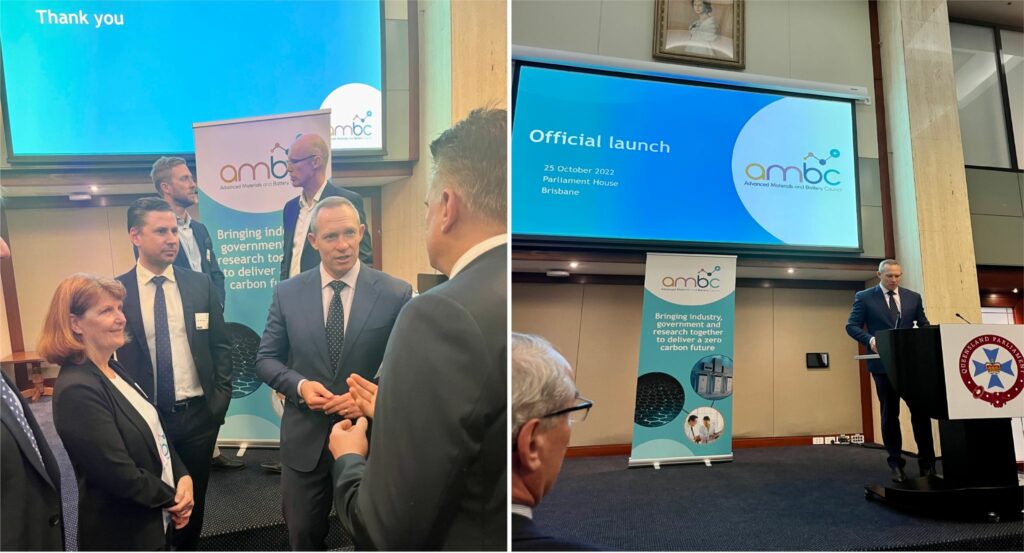
In related news, Australia’s Advanced Materials and Battery Council (AMBC) held a launch event at the state parliament of Queensland today. Although headquartered in Queensland, the council is an effort to foster the development of advanced manufacturing and research for the battery materials value chain across the country.
The AMBC has been formed by technology start-ups, universities and governments.