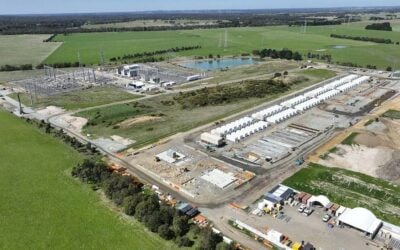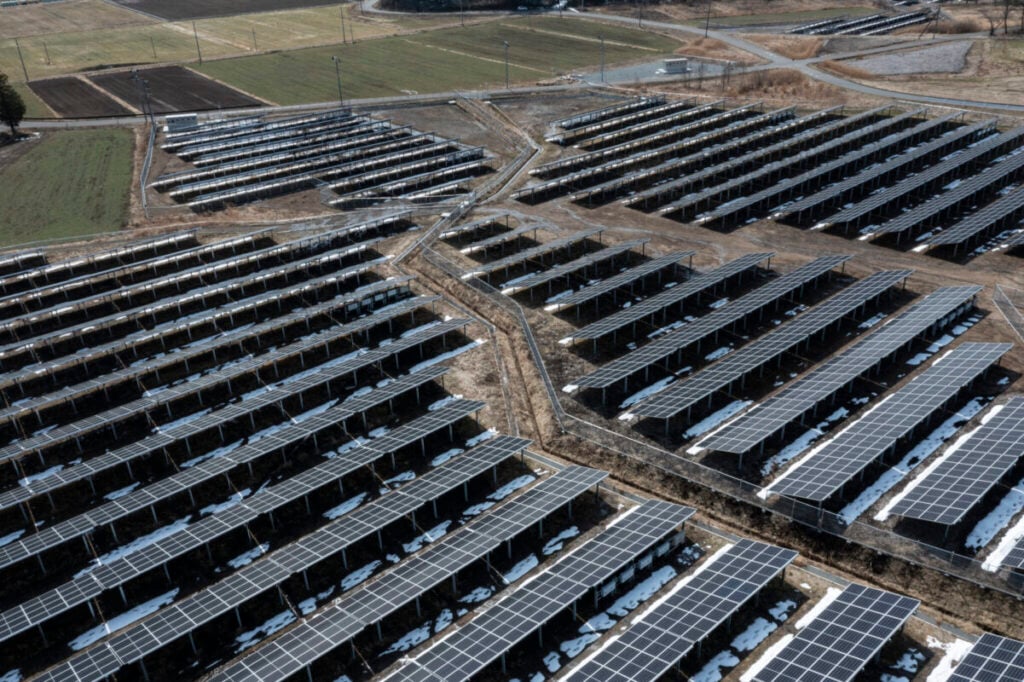
Sustainable infrastructure investor Actis’s renewable energy platform in Japan has closed financing on a 50MW/196MWh battery storage project.
The company said yesterday (14 September) that Nozomi Energy, the development platform Actis launched in 2023, has reached financial close on its Nozu Battery Energy Storage System (BESS) project in Oita Prefecture, southern Japan.
Financial terms of the deal were not disclosed. Actis said the developer secured non-recourse financing from the Japanese commercial bank Aozora Bank, which required a demonstration of capabilities in key areas, including feasibility analysis, design optimisation, project development, contracting, finance, and construction.
The project will be built in Usuki City, a rural part of Japan’s main southern island, Kyushu. The region became a hot spot for renewable energy development after the introduction of high feed-in tariffs (FiTs) throughout Japan in 2012.
Try Premium for just $1
- Full premium access for the first month at only $1
- Converts to an annual rate after 30 days unless cancelled
- Cancel anytime during the trial period
Premium Benefits
- Expert industry analysis and interviews
- Digital access to PV Tech Power journal
- Exclusive event discounts
Or get the full Premium subscription right away
Or continue reading this article for free
Nozomi Energy was awarded a 20-year fixed revenue capacity market contract for Nozu BESS in Japan’s inaugural Long-Term Decarbonisation Power Source Auction (LTDA), hosted in the 2023 financial year (FY2023) by the national association of transmission system operators (TSOs), OCCTO.
It was one of two similar-sized projects for which the developer won contracts, each for 37MW of capacity. They were among 1.67GW of successful energy storage bids in that first staging of the LTDA, comprising 32 BESS bids totalling 1.1GW and three pumped hydro energy storage (PHES) projects totalling 577MW.
At the time the win was announced, in May 2024, Tareq Sirhan, Actis head of energy for North Asia, Energy Infrastructure, said Nozomi Energy “won the auction because its proposed capacity payments were lower.”
LTDA set out first long-term revenue opportunity for BESS in Japan
The LTDA followed the launch of Japan’s first capacity market auctions, which were held in 2020. The LTDA differs in design from the usual single-year capacity market as it aims to secure long-term investment in low-carbon resources, rather than securing capacity to meet grid demand.
LTDA was the first mechanism to offer a long-term contracted revenue to battery storage operators in Japan. While the payments are fairly low, equivalent to about a 3% IRR according to one source, their contracted nature gives financiers some comfort in the bankability of projects.
However, the contract terms require that, while BESS assets may participate in other market opportunities, operators must return 90% of any additional merchant profits to the scheme administrator, OCCTO. This means the scheme may be of limited commercial interest to some developers.
The scheme changed in scope for the most recent FY2025 auction, in which the government Ministry of Economy, Trade and Industry (METI) introduced a new duration requirement. While previous LTDAs included tranches of awards for 3-hour to 6-hour assets and 6-hour or longer, only projects of 6-hour duration or longer were awarded fixed-revenue contracts for capacity delivery beginning in FY2027.
A total of 19 BESS projects that met the new requirement, totalling 1,251MW, were selected in the FY2025 auction, announced in May. The FY2024 auction had selected 25 battery projects of 3-hour to 6-hour duration, one of 6-hour duration and two 6-hour+ PHES plants, with a total 1.3GW of contracts awarded to BESS bids.
What is thought to be the first project awarded an LTDA contract to go into commercial operation was inaugurated in Kyushu in March. Developer Hexa Energy Services held a completion ceremony for its 30MW/120MWh Tagawa BESS in the spring, although the asset actually went into operation last November.
Actis, the sustainable investment arm of US growth equity firm General Atlantic, founded Nozomi Energy three years ago as a US$500 million renewable energy platform focused on Japan.
The developer aims to have a 1.1GW portfolio of onshore wind, solar PV generation and battery storage in Japan by 2027. It currently has 521MW of operational assets and claims to be on track to reach its target.
Nozomi Energy president and CEO Jose Antonio Millan Ruano said the Nozu project’s financial close demonstrated an ability “to originate, develop and finance complex renewable energy infrastructure in Japan” and marks the next stage of the developer’s growth “into flexible infrastructure.”
Parent company Actis is also an investor in MTerra Solar, a strategic partnership building a 3.5GW solar PV and 4.5GWh BESS project in the Philippines, with utility Manila Electric Company (Meralco) and Meralco subsidiary Solar Philippines New Energy Corporation. The first 600MWac solar phase of that project recently went into commercial operation, supplying power to Meralco.