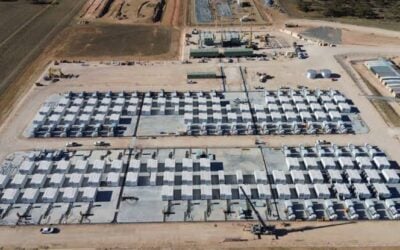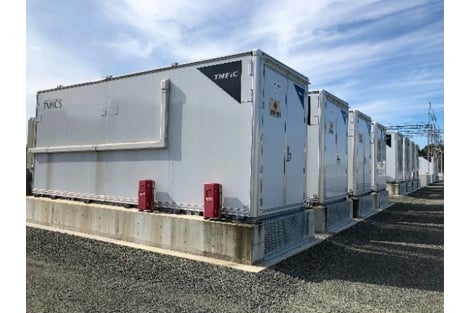
Japanese multinational financial services group Orix Corporation has begun construction of its first battery storage projects to be supported by external investment.
The company announced the start of construction at the 70MW/280MWh Yufu Energy Storage Plant in southern Japan and 75MW/309MWh Yonezawa Energy Storage Plant in the north yesterday (30 September).
Orix is a major financial services provider in Japan, operating across 10 business segments, including corporate financial services, insurance, energy, real estate and others.
It entered the Japanese energy storage market in 2022 and brought its first 113MWh project, Kinokawa Energy Storage, online in 2024 through a joint venture with utility Kansai Electric Power.
Try Premium for just $1
- Full premium access for the first month at only $1
- Converts to an annual rate after 30 days unless cancelled
- Cancel anytime during the trial period
Premium Benefits
- Expert industry analysis and interviews
- Digital access to PV Tech Power journal
- Exclusive event discounts
Or get the full Premium subscription right away
Or continue reading this article for free
In the same year, construction began on Orix’s 134MW/584MWh Maibara-Koto Energy Storage project after the company secured a contract in the first Long Term Decarbonization Power Source Auction (LTDA) capacity market.
However, Yufu Energy Storage Plant in Oita Prefecture, on the southern island of Kyushu and Yonezawa in Yamagata Prefecture, about 330km north of Tokyo, are the first grid-connected energy storage assets for which Orix has used external capital from investors to develop.
Orix will own a 23.7% stake in the projects, while the remaining 76.3% will be held collectively by three investors. Orix said the investors included Mitsubishi UFJ Trust and Banking Corporation, the trust banking arm of financial services group Mitsubishi UFJ, but did not name the other two.
Orix will be responsible for asset management, while an Orix Group company, Orix Renewable Energy Management Corporation, will manage plant construction safety as well as operations and maintenance (O&M) after COD.
The company said the projects highlight two aspects of its strategy: first, to expand its asset management business, and second, to improve capital efficiency by incorporating third-party capital.
Yufu Energy Storage Plant in Oita is scheduled to begin commercial operation in 2028, while Yonezawa Energy Storage Plant in Yamagata is scheduled to begin commercial operation in 2030.
BNEF expects 1.3GW of deployments in Japan this year
Japan’s energy storage market continues to have strong, fundamental drivers for long-term deployment, but developers face falling ancillary services revenues, policy uncertainty and lengthy grid connection queues, Umer Sadiq, energy market analyst for Japan at BloombergNEF (BNEF), told Energy-Storage.news.
In an interview to be published soon via ESN Premium, Sadiq, based in Tokyo, told the site that BNEF expects around 1.3GW of energy storage to be deployed in Japan, including front-of-the-meter (FTM) and behind-the-meter (BTM) segments this year, up from 1.1GW in 2025.
Broadly speaking, the Japanese market currently comprises BESS projects under three business models: those with long-term contract awards through the LTDA, smaller unsubsidised merchant projects typically of around 2MW/8MWh and larger merchant projects receiving Capex support through subsidy schemes.