Battery storage and solar have driven Australia past the halfway mark in National Electricity Market (NEM) renewable energy penetration, but investors warned on Tuesday (28 July) that the investment signals needed to broaden the technology mix are not yet in place.
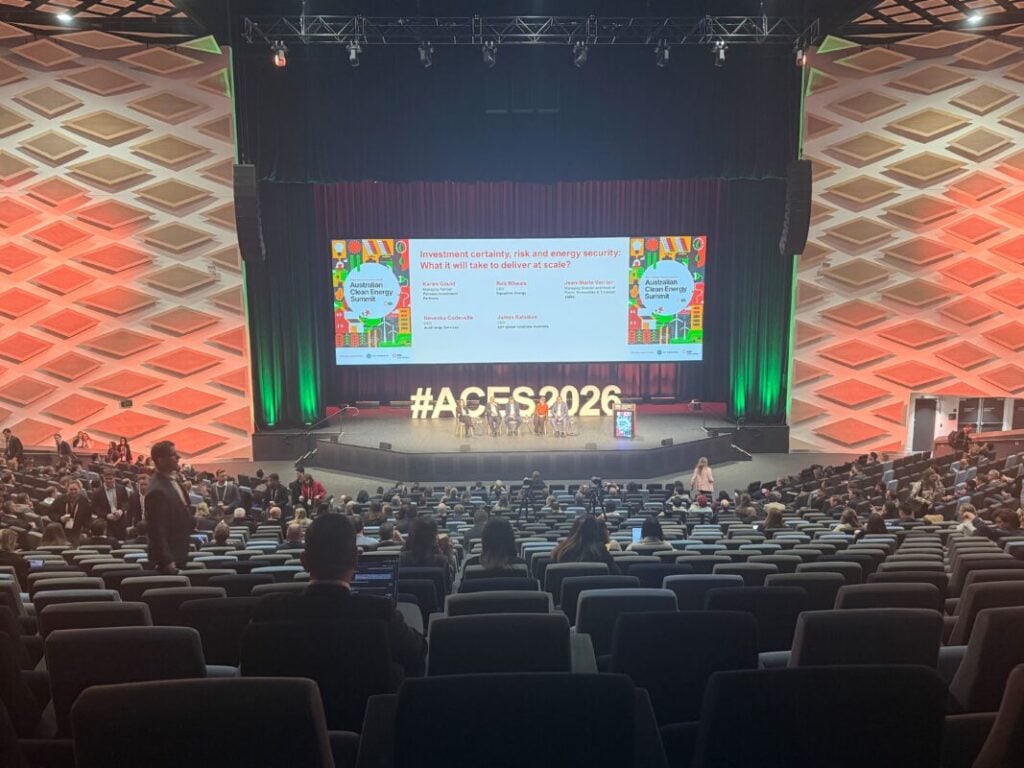
Speaking at the Australian Clean Energy Summit 2026 in Sydney, Nevenka Codevelle, chief executive of ASL (AusEnergy Services), opened by celebrating where the industry had arrived.
“We are the third largest market in the world for utility-scale battery storage systems, after China and the US. That’s something to be pretty proud of.”
She added that utility-scale solar, battery storage and hybrids were among the areas where Australia was leading the world.
Try Premium for just $1
- Full premium access for the first month at only $1
- Converts to an annual rate after 30 days unless cancelled
- Cancel anytime during the trial period
Premium Benefits
- Expert industry analysis and interviews
- Digital access to PV Tech Power journal
- Exclusive event discounts
Or get the full Premium subscription right away
Or continue reading this article for free
Australia’s strong credentials for renewable energy and storage buildout have resulted in increasing penetration into the NEM, as coal-fired power and gas are being phased out. In fact, in the final quarter of 2025, at the start of the country’s summer period, renewables and storage met more than half of total energy needs for the first time.
The panel was chaired by Karen Gould, managing partner at Palisade. It featured Codevelle alongside James Katsikas, chief executive of EDF Power Solutions, Jean-Marie Verrier, managing director and head of power, renewables and transition at Sumitomo Mitsui Banking Corporation, and Rob Wheals, chief executive of Squadron Energy.
Verrier drew on his experience since moving to Australia in 2006 to describe a country that had faced down multiple industry crises and kept building.
“We went through the Marginal Loss Factor (MLF) crisis, where your cash flows dropped by 20% in one day. We went through significant difficulties in the solar construction sector. And if you think about it, we have faced those issues head-on each time, and we are still there. The megawatts are climbing, and we are getting closer to the target.”
Wheals framed the current moment as halftime rather than full time, with the second to be tougher than the first.
“We’ve now passed more than halfway in terms of renewables penetration in the NEM. Ring the bell. These things don’t happen accidentally. The second half is going to be tougher. There’s no doubt. It’s going to take the same amount of ambition, optimism, enthusiasm, and courage that we’ve had in the first half of the game to go and deliver in the second half.”
The panel identified a structural dynamic that has shaped recent deployment. Solar and battery storage are attracting capital because their economics work, while other technologies the grid also needs are not receiving the same flow of investment.
Wheals noted that if the NEM were built purely on solar-based hybrids, Squadron’s analysis showed it would require five times as much infrastructure to be deployed.
“You cannot build a whole electricity system purely on solar-based hybrids.”
Katsikas said the competition for capital was global, not domestic. EDF Power Solutions has 30 potential destinations for its capital, and Australia must compete on the quality of its investment signals.
“The billions of dollars that we need to invest in solar PV plants, batteries, and everything in between come a lot from foreign investment. That foreign capital has a lot of places to go right now, and we’ve got to keep that in mind.”
He pointed to India, where the government has identified sites, handed them to developers with funding attached and set six-year delivery timelines. This has helped India become the third-largest country in the world in solar PV capacity.
“Those are the types of initiatives that other countries are using to attract that type of foreign investment.”
CIS and LTESAs central to getting solar and storage projects across the line
The panel’s discussion of Capacity Investment Scheme Agreements (CISAs) and Long-Term Energy Service Agreements (LTESAs) revealed how central those mechanisms had become to project financing.
Codevelle noted that what began as an insurance product had become a prerequisite.
“In the first tenders, LTSAs were nice to have, but not a must-have. Roll forward to today, and CISAs and LTSAs are almost a precondition for the other planets to align.”
Katsikas said that holding a CISA changed the entire negotiation process between contractors and financiers for solar and storage projects.
“It allows you to sit in front of contractors and say, ‘I have a guaranteed level of revenue.’ You can sit in front of organisations like the CEFC and say, ‘I have revenue to a point sorted. We can start to discuss how you’re going to help me fund the project.'”
However, Katsikas cautioned that the mechanisms needed to be targeted carefully.
“Not every project is real. There are a lot of ghost projects out there, and these mechanisms must be allocated to the projects that we think are going to get done, because otherwise we end up competing to the lowest common denominator.”
On the tenor gap, Wheals was direct about what carrying the remaining merchant risk means in practice.
“The off-take provider cannot give you the 15-year PPA that you need on a 20-year wind farm. They’ll give you somewhere around 10, which means you rely as an investor on a merchant assumption, which means I’m taking all the risk.”
He said the Electricity Services Entry Mechanism (ESEM) needed to be simple enough for a market to evaluate properly.
“The moment it becomes too complex and not easily understandable, not transparent, you’ll find there will not be a lot of participants in that market, and then it’s not going to work.”
Verrier raised concerns about whether the additional services to be paid for through the ESEM could be reliably forecast to support investment decisions.
“We will need independent forecasters to do a forecast for those additional services. I am sceptical about some of those services and about the methodology for forecasting. So, it needs to be done right.”
Data centres as an investment opportunity for solar and storage
The panel turned to data centres as a potential demand driver for new solar and storage investment, echoing the thoughts of Sabooh Whitelaw, associate vice-president, energy and utilities at AirTrunk, who earlier in the day said large data centres should serve as “anchor tenants” for new renewable energy generation, storage, and transmission investment.
Wheals said the industry should treat the incoming load as an opportunity rather than a threat.
“It would be naive to think we can turn back this AI tide. The only real decision for us is: are we going to treat them as a friend and embrace it, or do we see it as a foe and push back?”
He noted that forecast data centre demand through to 2030 represented around 12TWh of additional electricity, and that the government’s requirement for data centres to bring their own power was a direct opportunity to accelerate the deployment of solar and storage.
“I think there’s a real opportunity there which we should embrace.”
Wheals called for a policy to encourage data centres to locate closer to generation projects where possible and to require them to procure large-scale generation certificates.
Codevelle noted that South Australia’s inaugural Firm Energy Reliability Mechanism (FERM) tender had seen battery storage systems win all contracts. ESN Premium spoke exclusively to ASL about the 1.3GW tender, explaining how the technology-neutral process led to an all-battery outcome.
She said the design of firm products in New South Wales was also evolving to ensure the right technologies, including long-duration storage, received the investment signals they needed.
“Long-duration storage is something that we clearly put as a priority. We’ve signalled to the market that we want you to bid competitively, but in a way that ensures your project gets away.”
Asked what each panellist hoped to celebrate at next year’s Summit, the answers were pointed.
Katsikas said he wanted bipartisan support on the energy transition. Meanwhile, Codevelle said she wanted the country to feel genuine pride in what the industry had built.
“It would be wonderful to have a sense of pride about what we’ve achieved and where we’re going and what we’re achieving together.”
Verrier said he wanted three extra percentage points of internal rate of return on solar and storage projects, and 12 months without a single special purpose vehicle, contractor, or off-taker going bankrupt.
“12 months of peace would be great,” he concluded.
Never miss an Australian energy storage story. Sign up for our Australia newsletter and get the latest project announcements, policy updates and market analysis delivered directly to you.
Solar Media (part of Informa Group) will host the Battery Asset Management Summit Australia 2026 on 25-26 August at the Amora Hotel Jamison in Sydney, bringing together asset owners, operators, trading teams and optimisers to address revenue strategy, lifecycle management and operational performance across Australia’s fast-growing battery storage fleet.
Readers of Energy-Storage.news can get 20% off their tickets using the code ESN20 at checkout. Find out more about the Summit on the official website.