India needs more bankable tenders, clearer revenue models and better coordination between procurement and grid planning to turn its battery energy storage system (BESS) pipeline into operational capacity, speakers said at Energy Storage Summit India 2026.
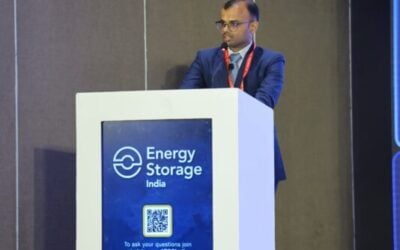
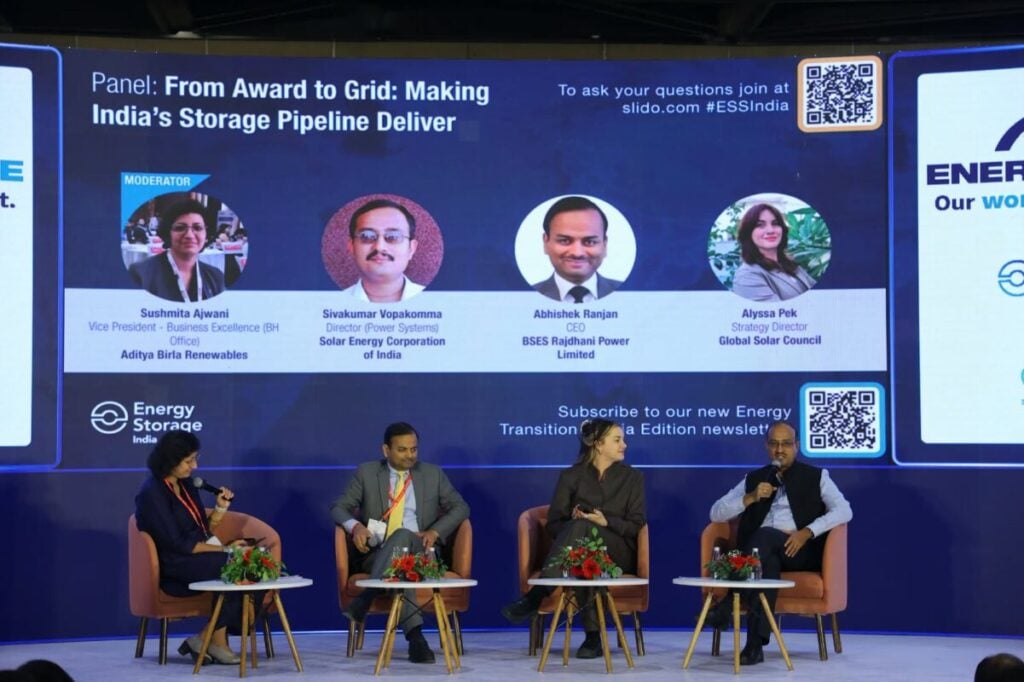
The panel, ‘From Award to Grid: Making India’s Storage Pipeline Deliver’, brought together Sivakumar Vopakomma, director of power systems at the Solar Energy Corporation of India (SECI); Abhishek Ranjan, CEO of BSES Rajdhani Power Limited; and Alyssa Pek, strategy director at the Global Solar Council. Sushmita Ajwani, vice president of business excellence at Aditya Birla Renewables, moderated the discussion.
Vopakomma said developer participation in SECI tenders has expanded from around six or seven established players to more than 20 in some cases. However, converting awards into commissioned projects remains a challenge, with construction typically taking 15–18 months.
Many storage contracts had been awarded in the six to 12 months before the panel, he said. SECI is monitoring project milestones including financial closure and land availability to track progress towards implementation.
Try Premium for just $1
- Full premium access for the first month at only $1
- Converts to an annual rate after 30 days unless cancelled
- Cancel anytime during the trial period
Premium Benefits
- Expert industry analysis and interviews
- Digital access to PV Tech Power journal
- Exclusive event discounts
Or get the full Premium subscription right away
Or continue reading this article for free
Distribution-level storage gains ground
Ranjan outlined how BESS can address local grid constraints as well as support wider renewable energy integration. BSES began deploying storage at distribution-transformer locations in Delhi in 2018, with an initial six locations totalling around 1MWh. The installations were commissioned in September 2021.
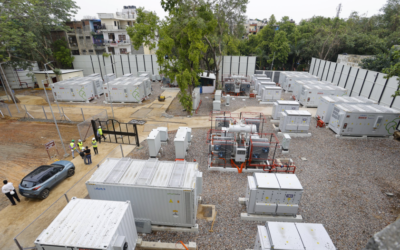
A larger 20MW/40MWh project connected at 33kV in south Delhi was commissioned in April 2025 and has been operating for more than a year, he said. BSES was also planning storage deployments at more than 910 locations facing grid constraints.
Potential benefits include energy arbitrage, peak-load management, improved utilisation of network assets and deferring investment in transmission and distribution infrastructure. Ranjan stressed that safety must remain central to deployment and called for greater flexibility in rules governing renewable energy charging under energy storage obligations.
Procurement must account for project risks
Furthermore, the panel discussed how tender design must balance developers’ ability to finance projects with buyers’ need for competitive prices.
Vopakomma said SECI had revised its contract-for-difference framework after the initial response was weaker than expected. Pek argued that developers’ risks—including land acquisition, permitting and grid connection—should be addressed early in the procurement process rather than left unresolved after an award.
She cited a Rajasthan Renewable Energy Corporation solar-plus-storage project as an example of an approach that set out land and permitting arrangements alongside grid-connection timelines.
Pek cautioned against relying solely on the lowest bid to select projects, arguing that procurement should also account for quality, efficiency, technical standards and the ability to generate revenue from different services.
“Procurement is the first step, not the finish line,” she said, pointing to international experience in markets such as South Africa and Australia, where recurring procurement and revenue stacking can help storage projects become commercially viable.
Domestic manufacturing and market design
Vopakomma said India continues to rely on imported battery cells, while domestic participation had developed in areas including packs, racks, container systems, power management systems and controls. Building domestic cell manufacturing capacity would be important as the market expands.
He also identified grid-forming inverters, ancillary services and the ability to absorb curtailed renewable electricity as further opportunities for storage. SECI is preparing additional procurement for four-hour storage systems, while state utilities are seeking access to available power, he said.
More frequent resource-adequacy planning will also be needed to reflect changing demand, including growth from data centres.
Looking towards 2030, Pek identified three priorities: stable frameworks that support multiple revenue streams, workforce development and a strategy for residential and distributed storage. Predictable policy and market rules are essential to encourage investment, she said.
Tender awards alone will not deliver India’s storage ambitions, the panellists agreed. Turning the pipeline into operating assets will require coordinated action on procurement, grid readiness, project financing, domestic manufacturing and market rules that allow storage to earn revenue from the services it provides.