Carrie Xiao reports on the recent financial and operational results of Chinese portable battery storage manufacturers, many of which are based in Shenzhen.
The Shenzhen portable energy storage cluster, anchored by Hello Tech, PowerOak and EcoFlow, has pursued brand-led strategies to expand its global footprint across more than 200 countries and regions. According to CCTV News, in the first three quarters of this year, Shenzhen’s lithium battery exports surpassed RMB 80 billion (US$12 billion), up more than 30% year-on-year, with portable energy storage accounting for a significant share.
In the portable energy storage segment, leading players including Shenzhen Hello Tech Energy Co., Ltd. (Hello Tech), Shenzhen PowerOak Newener Co., Ltd.(PowerOak) and Shenzhen EcoFlow Technology Co., Ltd. (EcoFlow) have gained strong brand recognition among end consumers. As portable energy storage systems gain wider adoption, Shenzhen-based players are reporting strong revenue growth.
Financial filings show Hello Tech reported operating revenue of RMB 2.206 billion in H1 2026, a 34.71% year-on-year increase. Its European revenue reached RMB 314 million, up 123.15% year-on-year, while North American revenue reached RMB 1.282 billion, up 39.13% year-on-year.
Try Premium for just $1
- Full premium access for the first month at only $1
- Converts to an annual rate after 30 days unless cancelled
- Cancel anytime during the trial period
Premium Benefits
- Expert industry analysis and interviews
- Digital access to PV Tech Power journal
- Exclusive event discounts
Or get the full Premium subscription right away
Or continue reading this article for free
According to the prospectus PowerOak filed earlier this year, the company generated revenue of RMB 1.777 billion in 2023, RMB 2.174 billion in 2024 and RMB 1.572 billion in the first three quarters of 2025. Its gross margin rose from 35.6% to 42.3%. As of December 31, 2025, PowerOak had cumulatively shipped more than 3.5 million energy storage products worldwide.
Outdoor recreation and emergency backup power, the two core application scenarios, underpin structural demand for portable energy storage and are fueling the sector’s rapid expansion. According to Frost & Sullivan, the global portable energy storage market grew from US$700 million in 2020 to US$3.3 billion in 2024, representing a compound annual growth rate of 46.2% over the period. The market is projected to reach US$8.5 billion by 2029.
Smart energy & grid-scale storage player Linyang Energy reports jump in overseas orders
In other financial results news from China, Nanjing-headquartered Linyang Energy, which is a technology and service provider active in areas including grid-scale battery energy storage systems (BESS), smart meters, inverters and solar PV reported a near-60% year-on-year increase in profits for the first nine months of 2026.
The Shanghai Stock Exchange-listed (SSE) company released its 2026 Q3 report earlier this week (26 October). For the first three quarters of 2026, the company reported revenue of RMB 5.857 billion, a 59.42% year-on-year increase; net profit attributable to shareholders reached RMB 440 million, up 22.63% year-on-year. The company said it had seized opportunities in the global energy storage sector, advancing the development and execution of major standalone energy storage projects in China while fulfilling overseas orders.
Since the start of the year, Linyang’s energy storage business has secured repeat orders across Europe and won bids for multiple projects in Southeast Asia. New overseas energy storage revenue topped RMB 300 million in the first half. The company plans to advance the delivery and execution of overseas orders in the second half, further expanding the global footprint of its energy storage division.
Backed by repeat orders from Europe and deeper localisation through its regional headquarters in Poland, the company has built an overseas expansion model that combines Chinese energy storage systems with local operations.
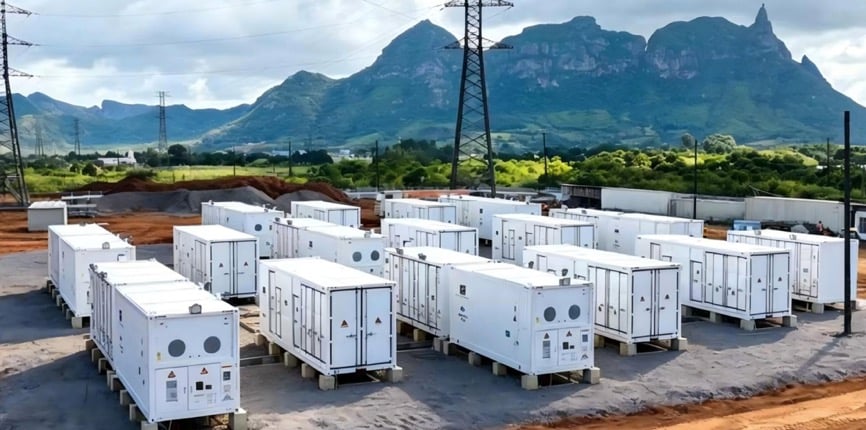
The company recently completed delivery of a 40MW/120MWh grid-tied energy storage project on an island in Mauritius and finished full-power grid-connection testing. Representing Phase 1 of a broader project, the system passed full-power charge-discharge testing and was successfully connected to the grid. Its commercial operation has validated product reliability under harsh island conditions. Linyang claimed this paves the way for further expansion across global markets.
Company filings indicate that as of the end of Q3, the company’s global annual production capacity for energy storage packs and systems stood at 15GWh. Its Poland regional hub has fully localised marketing, engineering and order fulfilment teams.