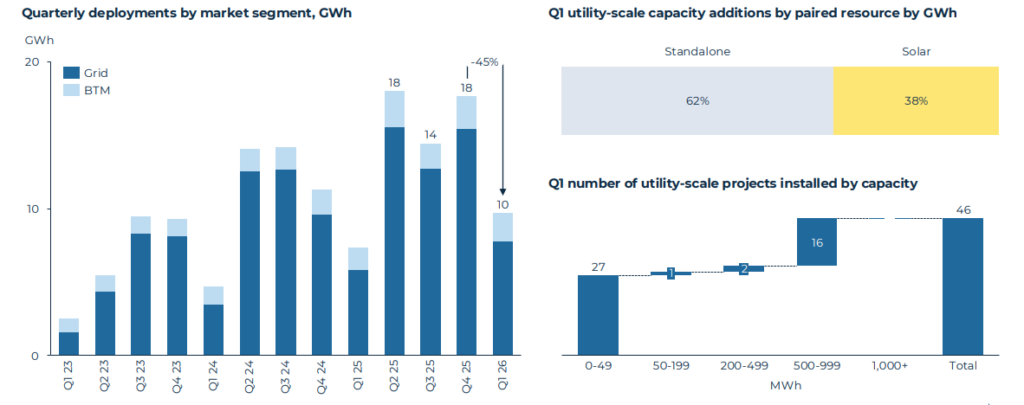
The US installed 9.7GWh of new battery energy storage system (BESS) capacity, according to the US trade association group, the Solar Energy Industries Association (SEIA).
The figure comes from SEIA’s Energy Storage Market Outlook Q2 2026 (ESMO), released 21 May, and created in collaboration with Benchmark Mineral Intelligence.
ESMO utilises Benchmark’s grid and behind-the-meter (BTM) data on US energy storage deployment, combined with SEIA’s industry expertise, to offer a detailed analysis of the US energy storage market’s current state.
Q1 2026
SEIA’s report notes that “in Q1 2026, just under 10GWh/6.77GW of BESS entered operation across the utility scale and BTM markets, a y-o-y increase of 32% (GWh).”
Try Premium for just $1
- Full premium access for the first month at only $1
- Converts to an annual rate after 30 days unless cancelled
- Cancel anytime during the trial period
Premium Benefits
- Expert industry analysis and interviews
- Digital access to PV Tech Power journal
- Exclusive event discounts
Or get the full Premium subscription right away
Or continue reading this article for free
Utility-scale installations sustained growth momentum with 7.8GWh/1.5GW deployed, while six states, including usual leaders Texas, Arizona, and California, added over 500MWh of new capacity across all market segments.
Residential BESS deployments totaled 515MWh across the US in Q1 2026, a 28% decline from Q1 2025.
According to SEIA, this contraction is expected to persist as the market adapts to the expiration of the 25D tax credit. Many projects initially planned for Q1 2026 were likely accelerated into Q4 2025 to capture the expiring incentive.
US data centre expansion is also driving diverse energy storage strategies. Beyond standard lithium iron phosphate (LFP) BESS for peak shaving, Google and Meta are deploying ultra-long-duration energy storage (LDES) systems.
Recent examples can be seen in Google’s 30GWh iron-air system with Form Energy in Minnesota and Meta’s 100GWh reservation of Noon Energy’s reversible solid oxide fuel cells, both contracted in recent months.
Other facilities have opted for multi-stage approaches such as lithium-ion for external peak shaving and high-power uninterruptible power supply (UPS) systems for load management.
According to this report, full-year and Q1 totals were the highest on record to date with 18.9GW/51GWh of BESS projects across utility-scale, residential and community, commercial and industrial segments being deployed throughout the year.
The largest quarter on record saw 5.8GW of installations by power,14.8GWh in energy storage capacity, with 4.9GW in the utility-scale segment.
Wood Mackenzie also forecast that between 2026 and 2031, approximately 500GWh of BESS will be deployed.
Looking ahead
SEIA increased its energy storage installation forecast to over 610GWh by 2030, for multiple reasons, including the ongoing US-Israeli war on Iran.
From SEIA, “As investors, developers, and grid operators respond to energy price volatility tied to disrupted global gas and gas turbine supplies, solar and storage are becoming increasingly attractive because they are insulated from fuel price swings and increasingly made in America.”
Speaking with Energy-Storage.news in April, Isshu Kikuma energy storage analyst at BloombergNEF (BNEF) stated, “For markets relying on fossil fuels, the current geopolitical tension has pushed up energy and power costs.”
He continued, “This could present a significant opportunity for low-carbon solutions, including energy storage. However, whether this incident accelerates the energy transition depends on how each market views its energy security and how long the current market environment persists. Businesses typically need to see structural changes and long-term certainty before making investment decisions.”
SEIA analysis also shows that 467 solar and storage projects have permits pending and are vulnerable to politically motivated delays or cancellations, further noting that “if federal permitting bottlenecks persist, household electric bills will continue to rise and China will surge further ahead in the race for AI leadership.”