In this US news roundup, BESS projects in California, Arizona, and Nevada advance from EDP Renewables, Tucson Electric Power, and EDF Power Solutions North America.
EDP Renewables completes 92MW solar-plus-storage project in California
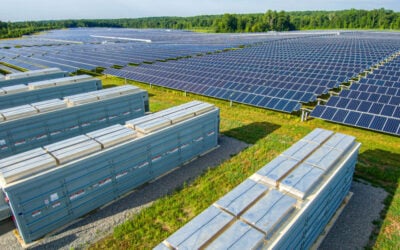
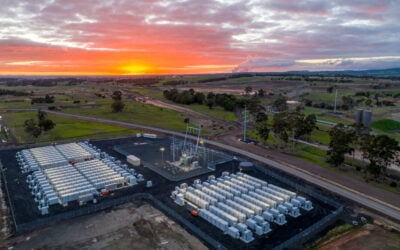
EDP Renewables North America (EDPR NA) and joint powers agency Redwood Coast Energy Authority (RCEA) have completed the Sandrini Energy Storage project, a 92MW/368MWh battery energy storage system (BESS) in Kern County, California.
Announced 18 August, the facility is collocated with the 300MW Sandrini Solar project, from which RCEA purchases 100MW of generation. RCEA has contracted 100% of the BESS capacity under an energy storage service agreement.
The project is designed to provide grid reliability services and deliver renewable energy during periods of high demand.
Try Premium for just $1
- Full premium access for the first month at only $1
- Converts to an annual rate after 30 days unless cancelled
- Cancel anytime during the trial period
Premium Benefits
- Expert industry analysis and interviews
- Digital access to PV Tech Power journal
- Exclusive event discounts
Or get the full Premium subscription right away
Or continue reading this article for free
EDPR NA claimed that the combined Sandrini Solar and Energy Storage projects supported approximately 250 construction jobs and are expected to generate more than US$25 million in local tax revenue.
The BESS project alone is expected to generate more than US$5 million in revenue for local public services including schools, roads, emergency services, and parks.
In June, EDPR NA completed Flatland Energy Storage, a 200MW/800MWh BESS in Coolidge, Arizona.
The Sandrini Energy Storage completion adds to California’s growing battery storage capacity as the state continues deploying systems to address grid reliability challenges and integrate increasing volumes of solar generation.
Recently in the state, California community choice aggregator (CCA) Central Coast Community Energy (3CE) issued a request for proposals (RFP) seeking new or existing renewable energy generating facilities which may be paired with BESS, and standalone BESS.
Additionally, the Assembly Appropriations Committee advanced two virtual power plant (VPP) bills aimed at reducing energy rates in California.
TEP completes expansion of Arizona BESS project
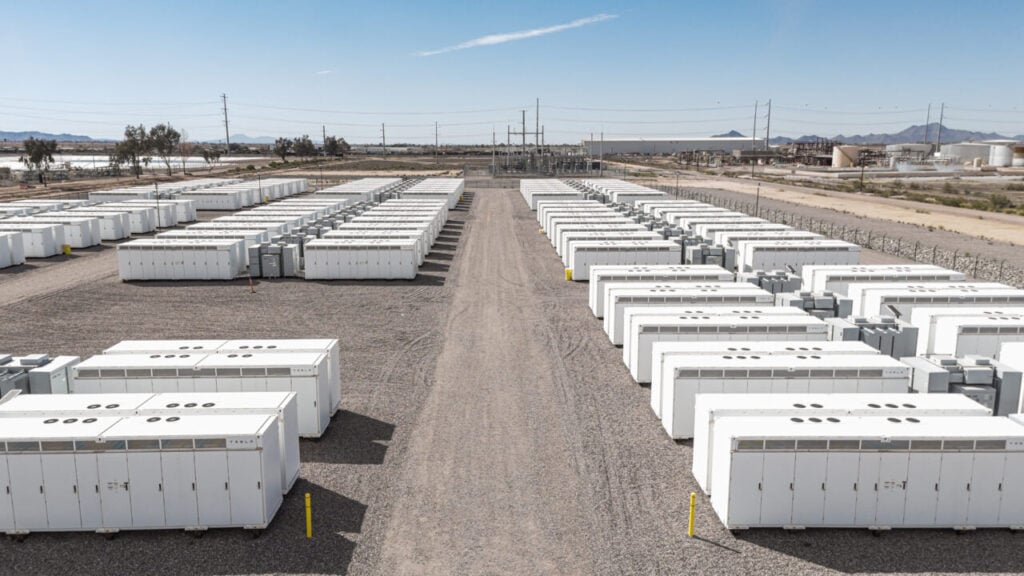
Utility Tucson Electric Power (TEP) has completed the expansion of its Roadrunner Reserve BESS in southeast Tucson, Arizona bringing the total capacity to 400MW/1,600MWh.
TEP invested US$350 million to bring the first 200MW of the system online in 2025 ahead of summer peak demand.
In 2024, TEP announced it would be adding the additional 200MW/800MWh capacity to Roadrunner after completion of the first phase.
Local officials including Tucson Mayor Regina Romero joined TEP representatives at a ceremony marking the completion of the expanded facility.
The system is designed to provide grid reliability during periods of high demand and extreme weather conditions whilst enabling greater integration of solar generation. TEP typically charges the batteries during late morning hours when solar output is high and grid demand is relatively low, then discharges the stored energy during late afternoon and early evening peak demand periods.
TEP claimed the system played a role in maintaining grid operations on 6 August 2025, when Tucson set a record hourly demand peak of 2,502MW during 111-degree temperatures. The facility has also supported service continuity during recent grid disturbances.
“As Tucson experiences hotter summers and more frequent extreme heat, building a resilient energy system is essential to protecting our community,” said Mayor Romero. “Investments in BESS help improve reliability during times of highest demand, expand our ability to use renewable energy, and ensure residents, businesses, and critical services have the energy they need when it matters most.”
Both projects were built by engineering, procurement and construction (EPC) firm DEPCOM using lithium iron phosphate-based (LFP) BESS units.
TEP is pursuing a goal to achieve net zero carbon emissions by 2050. The utility is a subsidiary of UNS Energy, which is owned by Fortis Inc., a North American regulated electric and gas utility company.
Recently in Arizona, IPP Enlight Renewable Energy announced that its US subsidiary Clēnera Holdings entered into a debt financing framework agreement for the CO Bar Complex, which consists of five projects with a combined capacity of approximately 1.2GW of solar PV generation and 4GWh of BESS.
In the same month, carbon dioxide-based long-duration energy storage (LDES) company Energy Dome and not-for-profit public utility Salt River Project (SRP) announced a 19MW/190MWh energy storage project in St. Johns.
Additionally, energy storage developer-operator Aypa Power and SRP brought the 250MW/1,000MWh Pediment energy storage project online in Mesa.
EDF signs PPAs with NV Energy for 400MW solar-plus-storage project in Nevada
EDF power solutions North America has signed two 25-year power purchase agreements (PPAs) with Nevada utility NV Energy to sell power generated at a solar-plus-storage project in the state.
The Winston Energy project, currently under construction in Lyon County, Nevada, will combine a 400MW solar PV facility with a 400MW/1,600MWh battery energy storage system (BESS). EDF expects the facility to begin commercial operations in October 2029.
“We are delighted by our continued partnership with NV Energy and ability to contribute paired solar and storage solutions which provide efficient, sustainable, and reliable energy to its customers,” said Jacqueline de Fresart, associate director of origination and power marketing at EDF power solutions North America.
EDF and NV Energy previously signed a PPA for the Arrow Canyon solar-plus-storage project in Nevada, which combines 200MW of solar PV capacity and a 75MW/375MWh BESS. This project started commercial operation in 2023 and, alongside the 234MW Switch standalone solar project that started operations in 2017, makes up EDF’s operational solar portfolio in Nevada.
The company plans to add to this portfolio through the Winston Energy project and the Bonanza solar-plus-storage project, at which EDF expects to begin commercial operations in 2028.
The signing of PPAs for solar-plus-storage projects is a trend more clearly observed in Europe, but is also emerging in North America. Last week, PV Tech Premium spoke to LevelTen Energy about the launch of its new ‘hybrid index’ to track the average price of renewable-plus-storage offtake deals, and how the practice had become commonplace enough to warrant specific tracking.
LevelTen’s Plácido Ostos said that Europe had signed more of such deals than North America—“There’s been a clear shift in the market as a whole towards hybridising,” he said—but noted that there is an appetite for renewable-plus-storage PPAs in the US.
The news follows EDF agreeing to sell its North American business to private equity firm KKR, reportedly valuing its portfolio at more than €4 billion (US$4.55 billion), although the transaction has not yet been completed.
By JP Casey
This story first appeared on PV Tech.
Battery Asset Management Summit USA 2026 will be held 15-16 September in Garden Grove, California, hosted by Energy-Storage.news publisher Solar Media (part of the Informa Group). The agenda emphasises addressing the roles of AI, cybersecurity, and second-life applications, broken down into two tracks: Technical Asset Management and Commercial Asset Management. This year, the conference is also co-located with Solar & Storage Finance Summit USA. Visit the official site for more details.