E.ON spinout Uniper Energy Storage has received €2.75 million (US$2.8 million) in EU grant funding towards a project to store hydrogen at scale in a salt cavern in Northern Germany.
Uniper Energy Storage will test the construction and operation of a new salt cavern specifically built for hydrogen storage at scale at a natural gas storage facility in Krummhoern, Northern Germany, closed since 2017.
The project, called KRUH2, is also being funded by the state of Lower Saxony and will test how green hydrogen produced by electrolysers can meet a plant’s own demand for heat, mobility and electricity. The company said the project will be the first of its kind.
A new pilot cavern will be built using an existing well, and the storage facility is scheduled to start operating by 2024. Uniper Energy Storage will invest around €10 million in the project with a storage volume of up to 250,000 cubic metres of hydrogen, though it hasn’t revealed the MW power of the planned electrolysers or the MWh storage capacity of the cavern.
Try Premium for just $1
- Full premium access for the first month at only $1
- Converts to an annual rate after 30 days unless cancelled
- Cancel anytime during the trial period
Premium Benefits
- Expert industry analysis and interviews
- Digital access to PV Tech Power journal
- Exclusive event discounts
Or get the full Premium subscription right away
Or continue reading this article for free
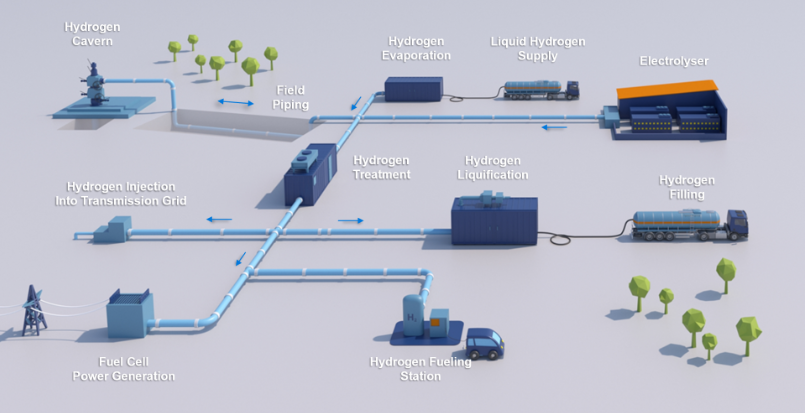
The project aims to provide information across the entire green hydrogen value chain on how the gas can be stored and how equipment and materials react to hydrogen. A flow chart from Uniper (pictured) illustrated its potential long-term use cases, including fuel for transportation, industry, powering fuel cell generation and direct injection into the transmission grid.
Doug Waters, managing director of Uniper Energy Storage, said: “We are delighted about the funding commitment from the state of Lower Saxony. With this pilot project, we are gathering the empirical data that we urgently need in a world without fossil fuels: namely, how we can realize the storage capability of green electricity in a CO2-free future.”
Uniper Energy Storage is part of Uniper Energy, which was created when energy giant E.ON spun out its conventional generation, commodities segment and energy trading businesses in 2016. Uniper Energy Storage operates natural gas storage facilities in Germany, Austria and the UK with a working gas capacity of over 7.5 billion cubic meters.
It said green hydrogen will be important for balancing energy supply and demand fluctuations in future, but that existing storage facilities for gas need to be converted for hydrogen use.
A press release said that Krummhoern’s geographic location near the windy North Sea and its decades-old energy connections to the gas and electricity grids make it an ideal location for the project.
While far from being tested or commercialised at scale anywhere, green hydrogen projects are attracting significant attention and investment globally. Its ability to scale easily, relatively low cost once scaled, and use of existing gas infrastructure make it an attractive option for many governments and companies, with Germany particularly bullish on its potential.
Its most economical use case is as a replacement feedstock for industry, particularly ammonia fertiliser production for the food industry, followed by use in transportation and then as a replacement for natural gas in combined cycle power plants. A fourth use case is for electricity energy storage, whereby the produced hydrogen is then converted back to electricity, but very low round-trip efficiency currently prevents this from being economical according to most in the industry.
While appearing considerably smaller based on the investment size, KRUH2 is set to come online a year earlier than another major green hydrogen project using a cavern, ACES Delta in Utah, US. That project is being financed by over US$1 billion in equity and Department of Energy (DOE) loans and will have 300GWh of green hydrogen energy storage capacity.
Uniper’s project funding comes a month after another green hydrogen storage project was announced at a campus of the DOE’s National Renewable Energy Laboratory in Colorado. Called HY2MEGA, the project will pair green hydrogen storage subsystems with existing electrolysers and a fuel cell plant on the site to be stored for conversion to electricity.