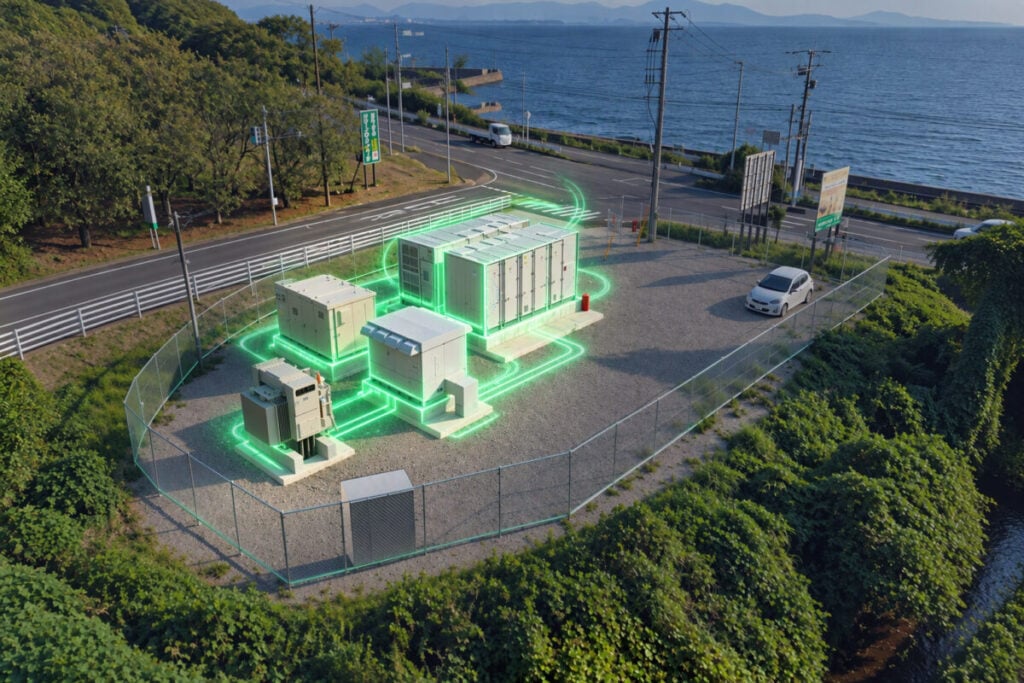
Battery energy storage system (BESS) projects in Japan by Sumitomo Corporation and Greenvolt provide an interesting snapshot of the country’s development landscape.
Last month, major Japanese trading company Sumitomo Corporation separately announced the start of construction of two large-scale projects.
At the start of October, Sumitomo Corporation said its 62MW/291MWh Namie BESS project in Fukushima, northeastern Japan, was underway. Just before the end of the month, the company said construction had kicked off at a 16MW/70MWh project in Fukuoka, on the southern island of Kyushu.
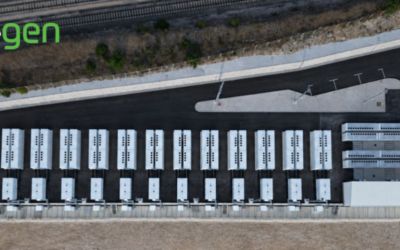
Then, early in November, international renewables and energy storage developer Greenvolt Power announced the start of commercial operation of its first BESS in Japan, a 2MW/8MWh system, also in Kyushu.
Try Premium for just $1
- Full premium access for the first month at only $1
- Converts to an annual rate after 30 days unless cancelled
- Cancel anytime during the trial period
Premium Benefits
- Expert industry analysis and interviews
- Digital access to PV Tech Power journal
- Exclusive event discounts
Or get the full Premium subscription right away
Or continue reading this article for free
Japan’s emerging BESS market is typically seeing the development of three types of grid-scale battery projects, Umer Sadiq, Japan analyst at BloombergNEF (BNEF), told Energy-Storage.news in a recent interview.
Those are: projects with contracted revenues underwritten through the Long Term Decarbonisation Power Source Auction (LTDA) capacity market auctions, and then two tranches of merchant projects, some subsidised and some not.
Developers, independent power producers (IPPs) and investors are looking to three different business models based on available revenue streams, Sadiq said, leading to the deployment of projects at very different scales.
LTDA projects tend to be on the larger end of the scale, starting at about 30MW of output, backed by government contracts for a portion of their revenue and therefore easier to finance.
At the other end of the scale are much smaller, unsubsidised merchant projects. Dozens of 2MW/8MWh systems are being deployed under this model, usually with corporate financing. They enable owners and investors to participate in electricity market trading, while limiting their risk exposure and allowing them to learn about the market before potentially embarking on larger projects, Sadiq said.
Smaller projects also face shorter wait times for grid interconnection, which in Japan, as in many other parts of the world, is a growing issue.
On the other hand, larger, government-subsidised merchant projects of 30MWh or over can still offer a 10% IRR, according to BNEF analysis. This might be a little low for an investment fund but may be ideal for the profile of big corporate players, Sadiq said.
BNEF is forecasting the deployment of around 1.3GW of energy storage in Japan for 2026, including both front-of-the-meter (FTM) and behind-the-meter (BTM), with development concentrated in the southern Kyushu island region and Hokkaido, the main northern island of Japan, Sadiq said, in an interview which will be published on ESN Premium soon.
How projects balance contracted and market revenue is a dividing line for investors: a DLA Piper study found merchant exposure divides BESS investors in Japan, Singapore and Australia.
Sumitomo Corporation announces two projects in October
On 1 October, Sumitomo said its subsidiary, BS Holdings, had begun construction on the 62MW/291MWh storage facility in Namie, Fukushima Prefecture.
The project was selected in the LTDA. Project financing has been arranged with MUFG Bank and BS Holdings expects it to go into commercial operation in 2029. The company said it worked with the community of Namie Town through development. The BESS will aid the grid integration of renewable energy in the Tohoku region, which starts about 200km north of Tokyo and spans most of the northern part of Japan’s main inhabited island, Honshu.
The LTDA is a capacity market that pays low-carbon asset owners a fixed annual fee for 20 years to keep capacity available, rather than paying for energy delivered.
The inaugural LTDA round, run by grid coordinator OCCTO, awarded 1.1GW across 32 BESS projects in April 2024. Among the winners was Nozomi Energy, the developer platform set up by Actis, which won two 37MW contracts and has since closed financing on its capacity market-winning BESS.
In May this year, OCCTO’s third round selected 1,251MW of BESS across 19 projects, with eligibility limited to projects of 6-hour duration or longer. The round also introduced the JC-STAR cybersecurity certification and capped the share of awarded capacity using cells made in any single foreign country at 30%.
Then, on 28 October, Sumitomo said preparatory work was underway at Battery Station Ishiya, a 16MW/70MWh project developed by Denki no Eki (‘Battery Station’), which is a Sumitomo Corporation joint venture (JV) with Kyushu Railway Company.
Start of commercial operations is scheduled for December 2028. The project is being built at the site of a former Kyushu Railway substation and adjacent land in Kyushu’s Nagasaki prefecture.
It’s Battery Station’s third Japanese BESS project, with the first two completed in 2024 and 2026 respectively, both in Kumamoto, a city in Kyushu. Each is of 1.5MW output and both prior projects are already participating in Japan’s supply-demand balancing market.
Sumitomo Corporation did not disclose information about the Battery Station project’s financing in Japanese- or English-language press releases. It did, however, note that the JV combines Kyushu Railway’s network and local business roots with Sumitomo Corporation’s “expertise” in energy storage, which it has taken from various activities domestically and internationally. This is thought to include extensive modelling of route-to-market (RTM) pathways in Japan and in-house optimisation capabilities.
Kyushu also hosts some of Japan’s first large LTDA and tolling projects. Hexa Energy Services’ 30MW Tagawa BESS became the first LTDA-contracted project to reach commercial operation in March, while Eku Energy has installed 32 Tesla Megapack 2 XL units at its 30MW/120MWh Hirohara BESS in Miyazaki Prefecture, which is contracted under a 20-year tolling deal with Tokyo Gas and is scheduled to start operating in January 2027.
International developer Greenvolt dips toes into smaller-scale FTM market
Greenvolt Power, the utility-scale renewable energy business of Portugal-headquartered Greenvolt Group, has brought its first two BESS into operation in Japan.
The two standalone projects in Kyushu, south-western Japan, have a combined power output of 4MW and energy storage capacity of 8MWh, a 2-hour duration. Both operate on a merchant basis, earning revenue from participation in electricity markets.
At this size, the projects sit at the smaller end of a market that Energy-Storage.news described in a June roundup as dominated by 2MW, 4-hour grid-scale BESS projects, with limited land, long grid connection waits and developer caution cited as reasons.
“Bringing our first battery storage projects into operation in Japan is an important step in strengthening Greenvolt’s presence in Asia and further consolidating our global footprint across three continents,” said João Manso Neto, CEO of Greenvolt Group.
Spiros Martinis, CEO of Greenvolt International Power, said the company would continue to pursue opportunities in its other Asian markets, South Korea and Indonesia, “as growing electricity needs create opportunities to leverage the expertise we have built across different markets and business environments.”
Greenvolt, acquired by investment firm KKR in 2024, has a BESS pipeline of about 4.6GW across Europe, North America and Asia. More than 1GW is under construction or in operation, and over 800MW has been sold under its asset rotation strategy.
In Poland, the company has completed the Ełk and Turośń Kościelna projects, with a combined 400MW/1.6GWh. In July, it inaugurated the 200MW/800MWh Turośń Kościelna BESS, which uses 196 BYD enclosures and holds a 17-year Polish capacity market contract. Greenvolt has also started building the 600MW/2.4GWh Siedlce BESS in Poland and brought the 99.8MW/288.6MWh Buj project online in Hungary.
Additional reporting by Andy Colthorpe.