South Australian battery storage developer Lunio Energy has energised its first grid-scale battery energy storage system (BESS) at Strathalbyn and started trading in the National Electricity Market (NEM).
Optimisation and bidding are being provided by the Australian trading intelligence platform OptiGrid.
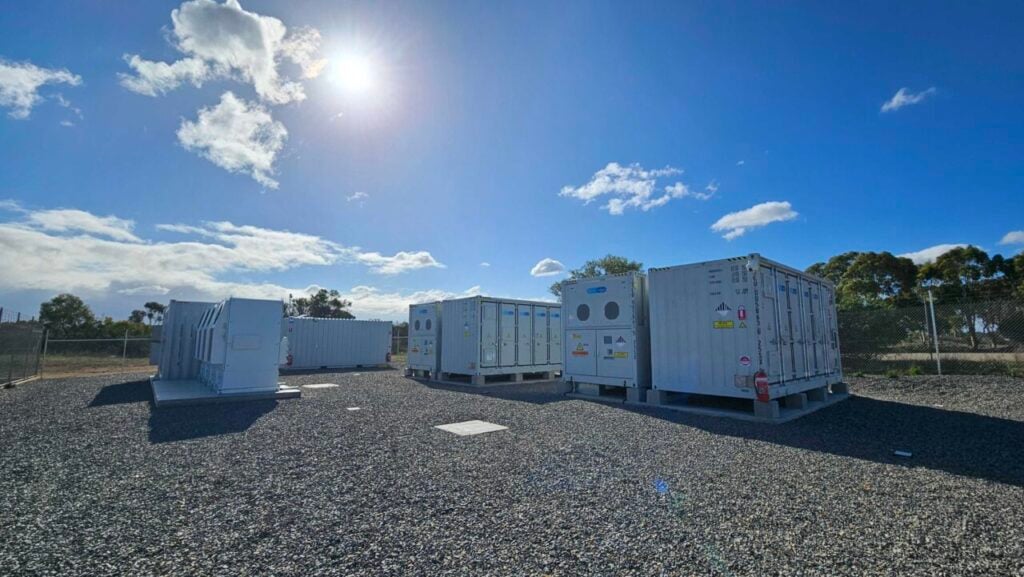
The 5MW/20MWh Strathalbyn BESS, located in the Alexandrina Council area approximately 60km south of Adelaide, is now responding to real-time market signals, storing energy when prices are low and discharging when prices rise.
Participation in frequency control ancillary services (FCAS) markets is planned for the future.
Try Premium for just $1
- Full premium access for the first month at only $1
- Converts to an annual rate after 30 days unless cancelled
- Cancel anytime during the trial period
Premium Benefits
- Expert industry analysis and interviews
- Digital access to PV Tech Power journal
- Exclusive event discounts
Or get the full Premium subscription right away
Or continue reading this article for free
The project is the first operating asset for Lunio Energy, which is part of Lunio Group, an Australian technology and infrastructure group whose other products include Canopy, an AI-powered vegetation monitoring tool for electricity utilities, and Streamline, a dynamic pricing platform for transport and logistics operators.
OptiGrid’s OptiBidder platform, which uses AI-powered forecasting and optimisation algorithms, determines charge and discharge decisions and submits bids across energy and contingency FCAS markets.
The platform currently manages a portfolio of more than 170MW of assets across hybrid and standalone BESS projects in Australia. OptiGrid’s investors include the Clean Energy Finance Corporation, IP Group, Hostplus, UNSW, Adelaide University and EnergyLab.
Lunio Energy CEO Seth Thuraisingham said the choice of optimiser was based on demonstrated performance.
“We selected OptiGrid to optimise trading of the Strathalbyn battery after OptiBidder showed strong results on the capture rate through our evaluation. Their team also brought real depth on the NEM and how batteries operate in South Australia, which gave us confidence through the investment decision.”
OptiGrid CEO Sahand Karimi said the South Australian market presents both opportunities and challenges for operators.
“The high penetration of renewable energy in South Australia, while bringing many benefits, creates price volatility that is difficult to accurately forecast and respond to. Our forecasting models and optimisation algorithms have been developed through years of research, and they’re built to turn that complexity into revenue.”
Karimi also noted that the battery storage system had already performed through the June price cap events, ahead of full FCAS participation.
An established but demanding market
Accoridng to the companies, South Australia holds more operational battery storage capacity per unit of demand than any other NEM region and is also the region most prone to extreme pricing events.
As previously noted, in June, the SA1 trading region hit the AU$20,300/MWh (US$14,198/MWh) market price cap twice in a single evening, with the fleet generating an estimated AU$324,000 across the event, though the outcome was uneven.
Four battery storage systems discharged, two were charging at the price peak, and several with available capacity remained idle.
The divergence in outcomes during that event showcased the commercial stakes of optimisation quality in a market where a handful of five-minute dispatch intervals can determine a month’s revenue.
In a subsequent analysis on ESN Premium, OptiGrid’s Karimi examined why state of charge management and algorithm quality drove such different results across the South Australia fleet that evening, arguing that decisions which appear obvious in hindsight are rarely clear-cut in real time when a battery storage operator is committing a bid hours before a price spike materialises.
The Strathalbyn project enters a South Australian battery fleet that has grown substantially in the past two years.
Wärtsilä recently completed the 150MW/300MWh Bungama BESS for Revera Energy in South Australia in 2025, while the Waratah Super Battery in NSW and the Melbourne Renewable Energy Hub have pushed total NEM battery storage capacity past 10GWh.
Readers of Energy-Storage.news will likely be aware that the Finnish power solutions company announced last month it would wrap its energy storage business into a 50:50 joint venture with German solar manufacturer RCT Solutions, effectively divesting a 50% stake in the unit.
RCT Solutions CEO Peter Fath will head up the JV entity, taking over from Tamara de Gruyter, who led it since the company parted ways with industry veteran Andy Tang in 2025 (Tang then joined Chinese lithium-ion OEM and BESS integrator Rept Battero).
Back in Australia, the country added 9.1GW of new generation and storage in FY26, more than double the FY25 result, with battery storage systems dominating both the connections pipeline and the volume of capacity reaching full output.
Against that backdrop, understanding how normalised revenue and percentage of perfect foresight metrics work has become a practical necessity for battery asset owners evaluating optimiser performance, as the gap between theoretical maximum revenue and actual capture rate determines the commercial case for each project.
Lunio Energy said it has further battery storage projects under development across South Australia, with Strathalbyn serving as the first operating asset in that pipeline.
Never miss an Australian energy storage story. Sign up for our Australia newsletter and get the latest project announcements, policy updates and market analysis delivered directly to you.
Our publisher, Solar Media (part of Informa Group), will host the Battery Asset Management Summit Australia 2026 on 25-26 August at Amora Hotel Jamison in Sydney. You can find out more about the Summit on the official website.