
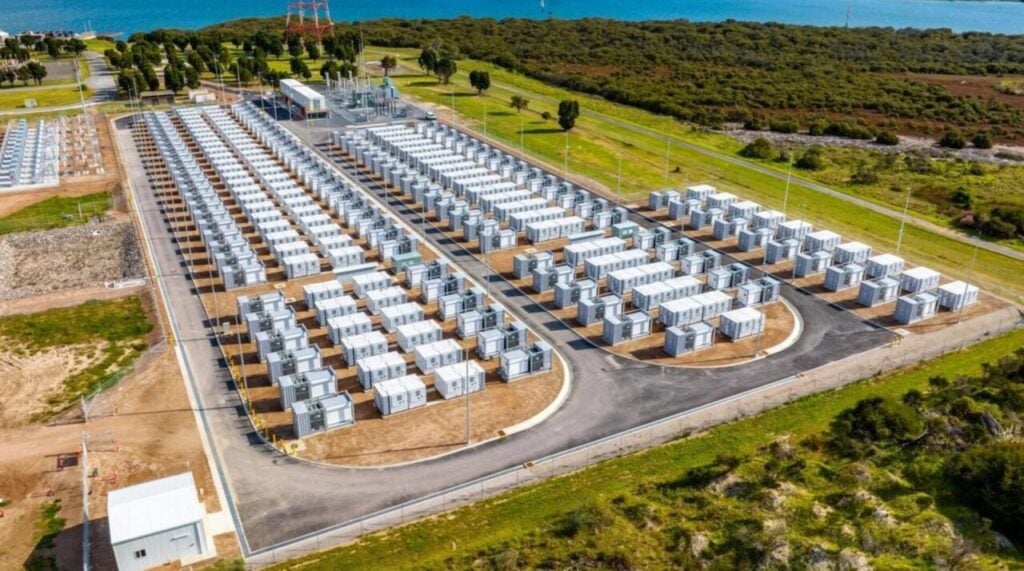
Sahand Karimi, CEO of battery optimisation specialist OptiGrid, examines the dispatch decisions that separated winners from losers during SA1’s AU$20,300/MWh (US$13,994/MWh) price cap event and what the fleet’s collective behaviour reveals about market dynamics in a region increasingly shaped by battery storage.
When South Australia’s SA1 region hit the National Electricity Market (NEM’s) AU$20,300/MWh price cap twice in a single evening on 21 June 2026, the NEMPulse data that followed told a story of sharply divergent outcomes across a fleet of 15 grid-scale battery storage systems.
Mannum captured AU$151,740 in estimated revenue. Templers lost AU$35,410. Two battery storage systems were charging into the cap itself, one at 95MW. The spread of outcomes raised as many questions about dispatch strategy as the headline revenue figure answered about the fleet’s commercial performance.
Sahand Karimi, CEO of OptiGrid, a battery optimisation platform operating in the NEM, says the event illustrates precisely the kind of scenario where the quality of forecasting, bid structure, and risk management strategy separates strong performance from poor outcomes.
Try Premium for just $1
- Full premium access for the first month at only $1
- Converts to an annual rate after 30 days unless cancelled
- Cancel anytime during the trial period
Premium Benefits
- Expert industry analysis and interviews
- Digital access to PV Tech Power journal
- Exclusive event discounts
Or get the full Premium subscription right away
Or continue reading this article for free
“Some decisions look obvious after the event. They rarely are in real time,” Karimi says.
NEMPulse is an independent, open-data dashboard that tracks the dispatch, revenue, and bidding behaviour of every grid-scale battery storage system in the NEM.
Why battery storage systems charge into price caps
The two batteries recorded charging during the AU$20,300/MWh cap event: Lake Bonney BESS1 at an average rate of 1.4MW and Templers at 3.5MW, producing the evening’s most counterintuitive result.
Karimi says there are several legitimate explanations for why a battery storage system might find itself in a charging position during a price cap interval, but not all of them represent sound decision-making.
“There are a few reasons a battery may be charging during a price cap event. It may have been due to market directions or asset health requirements,” Karimi explains.
“But in many cases, it is the result of the battery’s bids and forecast. For example, if a battery is trying to charge ‘at almost any cost’ to prepare for a later price spike, it may submit charge bids at very high prices. If prices then unexpectedly reach the cap during that period, the battery can end up being dispatched to charge at AU$20,300/MWh.”
A related scenario involves the timing of dispatch intervals.
“An asset may still be ramping down from a charging target set in the previous dispatch interval when prices suddenly move to the cap,” Karimi notes.
In a five-minute dispatch environment, transitions between operating states can create windows where an asset’s physical behaviour lags its intended position.
The distinction between a sound decision and a costly one comes down to context.
“Whether that is a sound decision depends on the broader context, as well as risk management strategy,” Karimi says.
“If the battery is charging because it is preserving asset health, that can be a rational decision. But if it is caused by a poor forecast or a bid structure that does not consider dynamic market conditions, then it can leave significant value on the table.”
State of charge versus algorithm quality
The spread of outcomes across the fifteen batteries tracked during the event raises the question of how much is explained by where each battery storage system started the event and how much by how it was operated throughout the event.
Karimi is direct: state of charge at the start of the price cap period was a major driver of outcomes, but that state of charge itself is not independent of earlier algorithmic decisions.
“The state of charge (SoC) at the start of the event was a major driver of the outcome, simply because a battery can only capture extreme prices if it still has energy available,” he says.
OptiGrid’s own OpenBESS data (below) showed a large South Australian battery storage system running out of charge just before the price spikes arrived, having discharged heavily through the earlier evening period when prices were elevated but had not yet hit the cap.
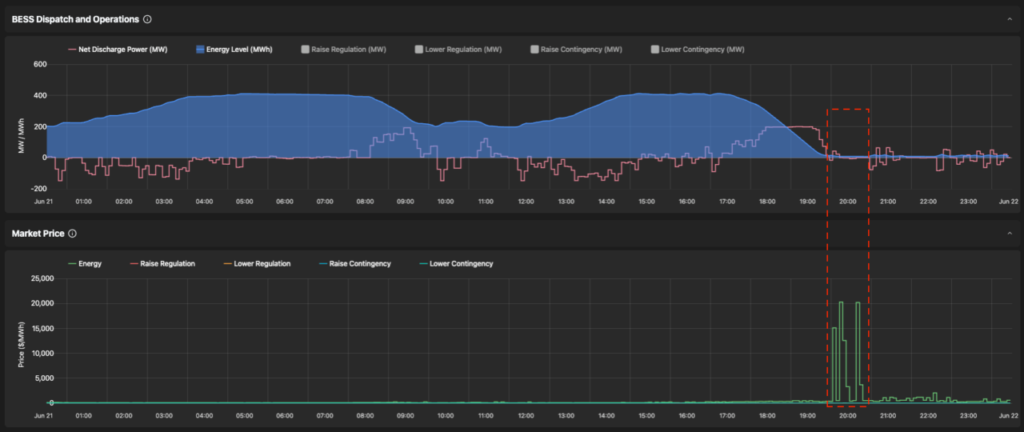
“The small group of batteries that had preserved some energy were able to capture part of the market cap event,” Karimi explains.
“Others had already discharged heavily through the earlier evening period and had little energy left when the highest-value intervals arrived.”
The chart above illustrates the full range of outcomes across the fleet. Four grid-scale battery storage systems, Mannum, Torrens Island, Hornsdale Power Reserve and Dalrymple North, actively discharged and captured positive revenue, with Mannum’s AU$151,740 reflecting both its available state of charge and an average output of 15MW sustained across the event.
Seven battery storage systems were idle despite holding available capacity, generating marginal revenue through FCAS and market position.
Two, Lake Bonney and Templers, were charging during the cap intervals, recording losses of AU$14,160 and AU$35,410, respectively, as a direct cost of their position at the wrong moment. Lincoln Gap and Clements Gap were offline throughout.
The decision that separates the discharging battery storage systems from the idle and charging ones, whether to capture value during the AU$300 to AU$500/MWh periods earlier in the evening, or hold energy in anticipation of a later spike, is exactly where algorithm quality becomes the critical variable.
“Operators had to decide whether to capture value during the earlier periods, or hold energy for a later event that might never arrive. That is a difficult trade-off, and it is exactly where the quality of the bidding and risk strategy matters,” Karimi says.
This dynamic directly connects to the framework for evaluating battery trading performance previously explored by Energy-Storage.news.
Indeed, in a recent op-ed, Karimi and Henry Swisher, the director of market strategy at OptiGrid, highlighted that metrics such as normalised revenue and the percentage of perfect foresight do not only indicate whether a battery discharged during high-price periods.
They also assessed whether the battery storage system made the correct state-of-charge decisions throughout the entire event window to be in a position to discharge effectively.
The 21 June event provides a live case study in why those metrics matter: the battery systems that captured the most value were not necessarily those with the most power output and capacity, but those that had managed their energy reserves through the preceding hours with sufficient discipline to have something left when the cap arrived.
Fleet behaviour as a market-shaping force
One of the more consequential observations from the event is that the growing South Australian battery storage fleet is beginning to shape market outcomes rather than respond to them.
Karimi flags this as an underappreciated dynamic that will become more prominent as the fleet grows.
“Over time, yes, a larger battery fleet can compress some of these opportunities, particularly if many assets start holding charge in anticipation of scarcity events,” he says.
“But the outcome is not always straightforward. If the system needs more energy over a sustained period than the available flexible supply can provide, market cap prices can still occur.”
The specific risk in South Australia, where most of the battery storage fleet is sized for 1–2-hour durations, is a collective action problem that can amplify rather than dampen volatility under some conditions.
“If they discharge too early, they can run out of energy before the highest price intervals arrive. If they all hold back, prices can remain higher for longer during the earlier part of the evening,” Karimi explains.
“For example, if batteries had been more conservative on Sunday evening, we may have seen much higher prices earlier in the event, but potentially less extreme pricing later on.”
The two days after the 21 June event illustrated this dynamic playing out in real time. OptiGrid’s data showed that South Australia battery storage systems adopted a more conservative state-of-charge profile in the aftermath, holding more energy in reserve than they had on Sunday.
“Batteries appeared more conservative with their state of charge, reflecting the previous evening’s volatility,” Karimi notes.
The conclusion Karimi draws from the event is not that any individual battery storage systems necessarily made the wrong call, but that the industry is still in the early stages of understanding how large fleets behave collectively when market stress materialises.
“We are still at the start of learning how large battery fleets behave in these conditions,” he says.
“Good battery trading is about more than reacting to the final price spike. It is about managing uncertainty and state of charge across the whole event.”
Our publisher, Solar Media (part of Informa Group), will host the Battery Asset Management Summit Australia 2026 on 25-26 August at Amora Hotel Jamison in Sydney. You can find out more about the Summit on the official website.
