Redflow has reported a significant rise in revenues from its zinc-bromide flow batteries but the Australian company noted that it expects to remain “cash-flow negative for some time”.
In reporting financial results for the half-year ending 31 December 2021 to the Australian Securities Exchange (ASX), Redflow said revenues for the period were AU$1,174,242 (US$853,000), a 172.3% increase on the same period for 2020, when they stood at AU$431,228.
However it registered a post-income tax loss of AU$6.5 million — an increase on a AU$2.9 million loss for the first half of the year — and noted that it will need additional working capital during this year. It did however raise a total AU$10.8 million for growth initiatives including money from institutional investors.
Redflow said much of the increased loss could be attributed to higher raw materials and consumables costs, which stood at AU$2,226,725 for the half-year, while other big expenses included more than AU$3.6 million for payroll expenses and AU$477,882 for administrative expenses.
Try Premium for just $1
- Full premium access for the first month at only $1
- Converts to an annual rate after 30 days unless cancelled
- Cancel anytime during the trial period
Premium Benefits
- Expert industry analysis and interviews
- Digital access to PV Tech Power journal
- Exclusive event discounts
Or get the full Premium subscription right away
Or continue reading this article for free
At the same time it held more than AU$20 million in total assets at the end of the calendar year, which minus just over AU$8 million of current liabilities leaves the company with AU$13.58 million in net assets and equity. It had just under AU$14.5 million in cash and cash equivalents at the end of the period.
The company completed its single biggest deployment to date recently, a 2MWh project at a bioenergy plant in California as it seeks to continue its international expansion. Earlier in the year, the company, which has largely focused on the medium-sized commercial and large off-grid market to date, launched Energy Pod Z, the larger-scale format battery energy storage system (BESS) it would package up its units into for the project and other larger deployments in future.
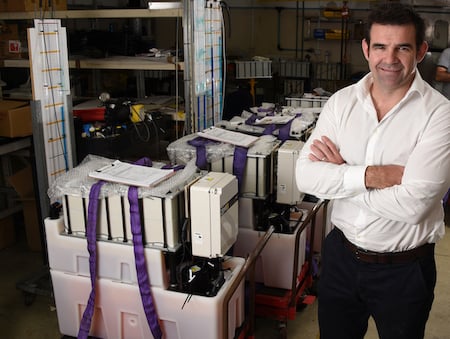
Redflow CEO and managing director Tim Harris said the project will serve as a reference installation for growth in the US and other global markets.
“Given the substantial opportunities for us to leverage the accelerating demand for energy storage, we have been focused on building additional capabilities, such as our safety credentials, and made selected capital investments to deliver on the large market opportunity,” Harris said.
A new president of Americas and chief commercial officer, Mark Higgins has joined the company, Harris announced yesterday.
The California project, for bioenergy generator Anaergia, has generated significant interest in the zinc-bromide flow battery technology. Redflow has claimed interest from a “large listed US corporate” which approved it as a supplier of flow batteries, while Singapore venture capital fund FUND4SE assisted with the manufacturer’s US activities, investing AU$500,000 in shares and options and offering other support.
Its next generation Gen3 battery is on track for launch in the fourth quarter of Redflow’s 2022 financial year, although pandemic impacts on the company’s manufacturing operations, based in Thailand, included staff absences and COVID-19 infections as well as materials supply delays.
Gen3 will be improved from previous models in terms of stack technology, electrolyte tank architecture, improved cooling and a new electronics control system that it is claimed will enable a 30% cost reduction.
Energy-Storage.news reported yesterday that accreditation and standards group UL has selected Redflow’s systems for a testing programme to assess and understand key technical attributes of flow batteries.
Redflow said 2GWh of energy has passed through the systems it has sold into the market to date and it completed a delivery of battery systems for supporting mobile networks in Australia for telecoms provider Optus in a government-supported programme.
The flow battery maker is also one of the members of the international CEO-led Long Duration Energy Storage Council, which was recently joined by Microsoft and Google.