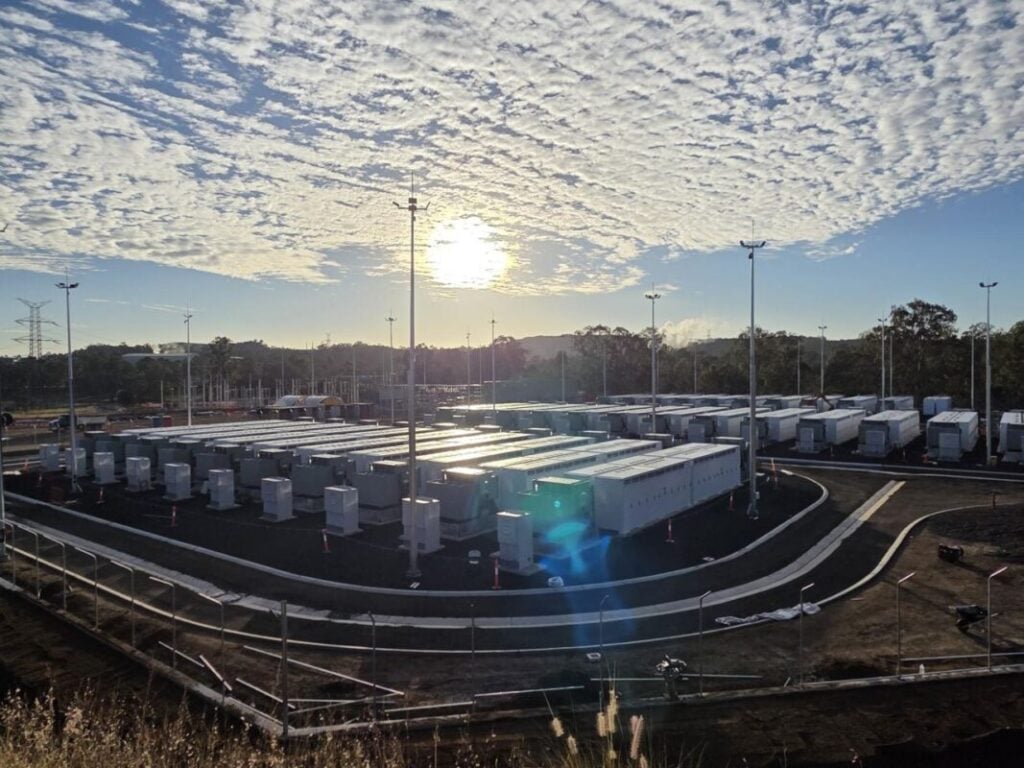
Queensland’s average wholesale electricity price fell by 40% in the 2025-26 financial year, a drop the state’s government-owned generator, CleanCo Queensland, attributes directly to the rapid build-out of utility-scale battery storage across the state.
In its FY26 annual report, tabled in the Queensland parliament in late September, CleanCo stated that wholesale prices in the Queensland market fell to AU$65.47 (US$43.60) per megawatt-hour for the year ended 30 June 2026, down from AU$109.54 per megawatt-hour in the prior year.
The company said the fall was “due to a significant influx of utility-scale batteries during the year, along with favourable conditions for wind and solar generation, and improved reliability of thermal generation assets.”
It added that “evening peak prices were significantly lower and price volatility was limited even during periods of higher demand.”
Try Premium for just $1
- Full premium access for the first month at only $1
- Converts to an annual rate after 30 days unless cancelled
- Cancel anytime during the trial period
Premium Benefits
- Expert industry analysis and interviews
- Digital access to PV Tech Power journal
- Exclusive event discounts
Or get the full Premium subscription right away
Or continue reading this article for free
CleanCo is a Queensland government-owned corporation established in 2018 to operate a portfolio of lower-emissions generation assets, including hydro, gas and, since this year, battery storage, while also holding offtake agreements with third-party wind and solar farms.
The price fall had a direct effect on its own bottom line. The company swung from an AU$17.8 million profit in FY25 to an AU$22.9 million loss in FY26, even as gross margin improved to AU$342.1 million from AU$283.1 million, and total generation across its owned and contracted portfolio rose to a record 4,407 GWh.
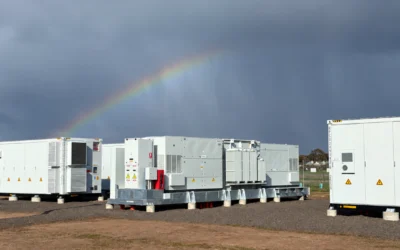
CleanCo’s own battery asset sits at the centre of that market shift. The company opened its 250MW/500MWh Swanbank Battery in February 2026, built on the site of the former Swanbank coal power station in Ipswich, roughly 45km southwest of Brisbane.
Tesla supplied the Megapack technology for the AU$330 million project, funded through the Queensland Renewable Energy and Hydrogen Jobs Fund, with infrastructure and installation delivered by Yurika.
At the opening, Queensland treasurer and minister for energy David Janetzki said the battery storage system was “exactly the kind of modern infrastructure our Energy Roadmap is designed to deliver,” adding that “at Swanbank, we can see how batteries and gas generation work together to support system reliability, particularly during peak demand periods.”
The FY26 annual report shows the asset, now formally named Swanbank F, generated 43.2GWh over the year at a capacity factor of just 8.7%, with CleanCo noting the battery storage system was excluded from its portfolio-wide availability and outage calculations while commissioning was underway and supporting systems were still being embedded.
Operational control of the battery storage system was transferred to CleanCo in April 2026, with the report describing full commissioning as completed the following month.
Storage advances as pumped hydro and a sodium-based project are shelved
While Swanbank F moved into operation, CleanCo used the same report to confirm it would not proceed with several other storage and renewable energy projects it had previously been developing.
“With Queensland’s energy landscape changing significantly over the past year, in FY26 we made the decision not to pursue several proposed projects including the sodium-sulfur (NAS) battery at Swanbank and Moah Creek Wind Farm project,” the company said.
It added that the Mount Rawdon Pumped Hydro Project, developed in partnership with Evolution Mining and ICA Partners, “has not been prioritised for further State investment” following an assessment by Queensland Investment Corporation (QIC), and that CleanCo’s involvement in the project had concluded.
That decision follows on from earlier reporting. Energy-Storage.news reported in July 2026 that the Queensland government had reportedly shelved the AU$6 billion Mt Rawdon pumped hydro project, a 2GW/20GWh scheme that would have repurposed the open-cut pit of a disused gold mine, in favour of continued state backing for the more expensive 2GW/48GWh Borumba pumped hydro project.
CleanCo had committed AU$50 million to Mt Rawdon before the state’s review process concluded.
The FY26 report attributes part of the increase in CleanCo’s operating expenses, which rose to AU$234.2 million from AU$203.2 million, to one-off costs from exiting both the Moah Creek and Mount Rawdon developments.
The cancelled NAS Battery would have added sodium-based long-duration storage alongside Swanbank F at the same site. Elsewhere in Queensland, that technology has still found a way onto the grid. The proprietary NAS technology developed by the Japanese firm NGK Insulators remains the world’s second-most-deployed electrochemical energy storage technology after lithium-ion, but NGK exited the business in mid-2025.
Advanced materials company Lava Blue commissioned Australia’s first grid-connected NAS battery storage system earlier this month, a considerably smaller 250kW/1.45MWh unit at its Centre for Predictive Research into Specialty Materials facility in Brisbane, paired with 200kW of existing rooftop solar.
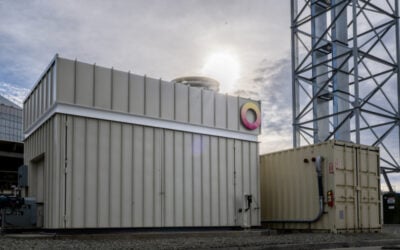
CleanCo’s FY26 report also confirmed the company has begun assessing whether to extend the operating life of its 385MW Swanbank E gas-fired power station beyond its currently scheduled 2036 closure, by up to 20 years, and has separately completed pre-feasibility studies into building an entirely new fast-start gas peaking plant at the same site.
The company said work to increase Swanbank E’s fast-ramp rate capability, from 17.5MW per minute to 25MW per minute, was underway to improve the asset’s ability to respond to demand swings and support ancillary services.
In its newly introduced climate disclosures, prepared under the Australian Sustainability Reporting Standard AASB S2, CleanCo cited CSIRO modelling indicating more than 48GW of battery storage is needed nationally to support the broader energy transition, with the report stating that under a higher-warming, slower-transition scenario, “BESS may displace or out-compete gas depending on spot prices, increasing demand for battery dispatch.”
CleanCo’s dividend recommendation for FY26 was nil, and the company holds AU$576.8 million in borrowings from Queensland Treasury Corporation, down from AU$699.5 million a year earlier.
Never miss an Australian energy storage story. Sign up for our Australia newsletter and get the latest project announcements, policy updates and market analysis delivered directly to you.