The Port of Newcastle has become the first port in New South Wales, Australia, to be approved to safely store grid-scale lithium-ion battery storage systems.
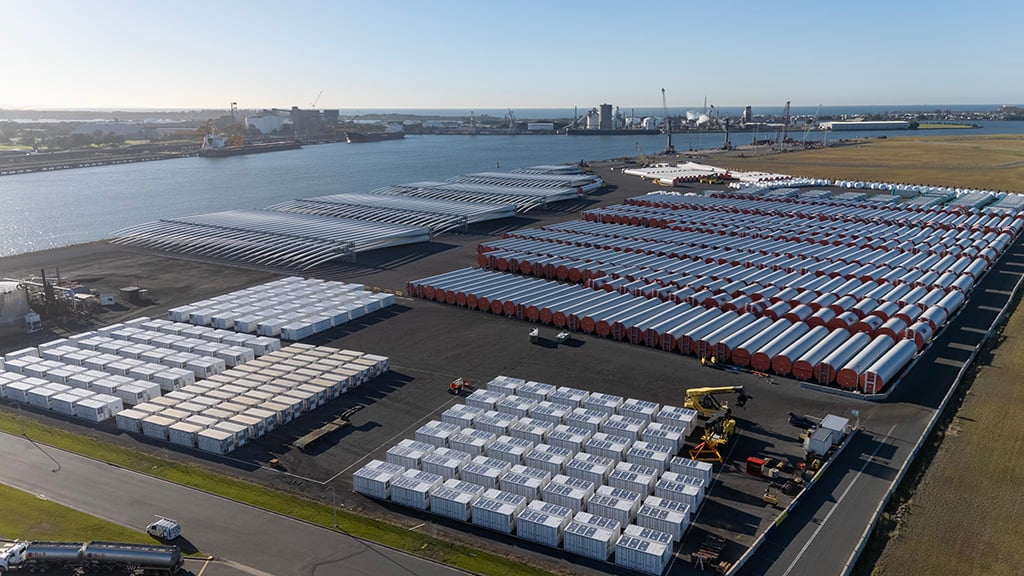
The state government granted approval in late 2025 for the facility to receive and stage battery storage systems at its Mayfield Multipurpose Terminal before they are transported to project sites across the state.
Since then, the port has received and stored batteries for three large-scale projects currently under construction. This includes AGL’s 500MW/2,000MWh Tomago Battery, Origin Energy’s 1,770MWh Eraring battery storage system and Vena Energy’s 510MWh Bellambi Heights battery energy storage system (BESS).
Port of Newcastle chief executive Craig Carmody said the capability required dedicated investment.
Try Premium for just $1
- Full premium access for the first month at only $1
- Converts to an annual rate after 30 days unless cancelled
- Cancel anytime during the trial period
Premium Benefits
- Expert industry analysis and interviews
- Digital access to PV Tech Power journal
- Exclusive event discounts
Or get the full Premium subscription right away
Or continue reading this article for free
“These are complex cargoes that require specialist handling, purpose-built infrastructure and the right safety systems. We’ve invested in that capability because we see where the market is heading and what our customers will need,” Carmody said.
“Whether it’s wind turbine components, grid-scale batteries or other major project cargo, Port of Newcastle has built a reputation for handling complex logistics safely, efficiently and reliably. That’s why project owners continue choosing to bring this cargo through Newcastle.”
AGL chief operations and construction officer Matthew Currie described the port’s role as operationally important for the Tomago project.
“As we prepare for the installation of more than 400 lithium-ion battery units to form the Tomago Battery, the ability to safely receive and temporarily store battery units and other components at the Port of Newcastle is providing important flexibility for our project team,” he said.
The Tomago Battery is expected to reach commercial operation in the second half of 2027.
Supply chain capacity for a growing pipeline
The approval reflects a logistics challenge that is becoming more acute as Australia’s battery storage pipeline moves from planning into construction at scale.
Earlier this year, the trade association Clean Energy Council said that Australia became the world’s third-largest utility-scale battery storage market in 2026, with 4.3GW of large-scale battery storage systems reaching financial close as of its most recent industry report.
Each gigawatt-hour of battery storage requires dozens of large battery enclosures to be shipped, unloaded, staged and transported to project sites, a supply chain task that demands port infrastructure capable of safely handling oversized, hazardous cargo at scale.
The federal government’s updated National Renewable Energy Priority List, published on 15 July 2026, added 11 new projects, including over 4GWh of battery storage, to the list of priority developments receiving coordinated planning and regulatory support.
The projects on that list, many of which are in New South Wales, will require the same port logistics capabilities as those used by the Tomago and Eraring battery storage systems.
The Port of Newcastle’s approval gives project developers confidence that a staging facility exists within the state’s primary renewable energy supply corridor.
Ports playing an active role in the battery storage supply chain is not unique to Australia. A New Zealand port demonstrated the potential for battery storage to generate revenue from grid services while managing the complex tariff structures that affect large industrial electricity users, showcasing the dual role ports can play as both users of battery storage and enablers of its deployment elsewhere.
The battery storage approval forms part of a broader strategic shift at Newcastle, which remains Australia’s largest coal export port while simultaneously positioning itself as the primary logistics gateway for the state’s renewable energy build-out.
The port is investing AU$36 million (US$25 million) in a berth extension at the Multipurpose Terminal to accommodate larger vessels and is exploring further capacity increases for project cargo and battery storage handling.
The announcement was made on the same day the New South Wales government approved the AU$1.8 billion 3.6GWh Stratford Pumped Hydro and Solar Project in the Gloucester Valley, reinforcing Newcastle’s role as the logistical hub for the Hunter region’s energy transition.
The Stratford project will require turbine and generator components to be delivered through the region as it moves toward construction, adding further demand on the port’s project cargo capability alongside the battery storage volumes already flowing through the Mayfield terminal.
Never miss an Australian energy storage story. Sign up for our Australia newsletter and get the latest project announcements, policy updates and market analysis delivered directly to you.
Our publisher, Solar Media (part of Informa Group), will host the Battery Asset Management Summit Australia 2026 on 25-26 August at Amora Hotel Jamison in Sydney. You can find out more about the Summit on the official website.