
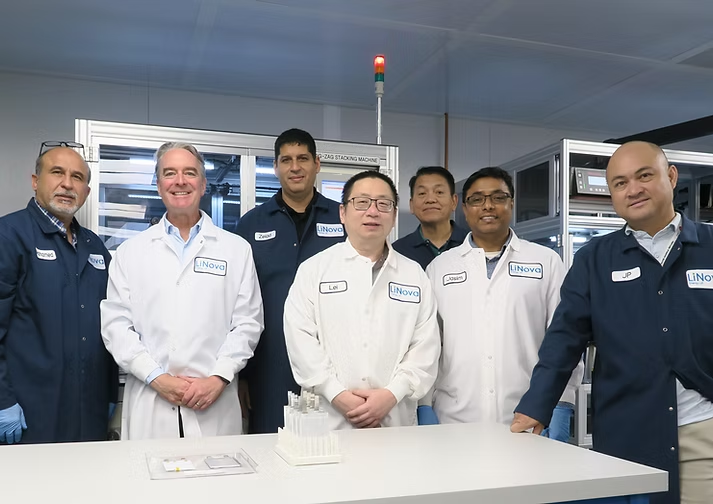
Energy-Storage.news Premium speaks with Mike Nagus, CEO of LiNova Energy, about the company’s recently launched “metal-free polymer cathode” battery.
LiNova Energy, manufacturer of a polymer-based battery cathode technology, is positioning itself at the intersection of two critical infrastructure needs: the explosive growth of data centres powered by artificial intelligence and the demand for domestically-sourced battery technology that eliminates fire risks.
The California-based company recently announced a high-power lithium-ion (Li-ion) cell specifically designed for battery backup units (BBUs) in hyperscale data centres—a product that Nagus says delivers unprecedented power density while addressing the thermal runaway concerns that have plagued traditional chemistries.
Power density
The development emerged from a December request by a hyperscaler partner facing a fundamental constraint—next-generation data centre designs require significantly more power than existing battery chemistries can deliver within the same footprint.
Try Premium for just $1
- Full premium access for the first month at only $1
- Converts to an annual rate after 30 days unless cancelled
- Cancel anytime during the trial period
Premium Benefits
- Expert industry analysis and interviews
- Digital access to PV Tech Power journal
- Exclusive event discounts
Or get the full Premium subscription right away
Or continue reading this article for free
“They came to us and said, ‘We’re moving towards a new design in our data centres that requires significantly more power than anything we’ve done before, and we’re right up against basically maxing out the performance of existing chemistries,'” Nagus explains.
LiNova’s responded by creating a cell capable of 15C continuous discharge and 50C pulse rates at the cell level, with the ability to sustain over 20C for two-minute duration pulses—the typical backup window required for data centre applications.
The performance specifications represent what Nagus believes may be unprecedented territory, particularly for an intrinsically safe cell chemistry.
Eliminating thermal runaway
What distinguishes LiNova’s approach is its proprietary polymer cathode material, which the company has been developing since before its 2022 formation through the combination of two predecessor companies.
Unlike nickel manganese cobalt (NMC) or nickel cobalt aluminum (NCA) chemistries commonly used in high-power applications, LiNova’s cathode material does not emit oxygen when heated—the fundamental mechanism that enables thermal runaway propagation.
“Even if something did happen in the BBU, something else in the system caught fire, our cell is not going to allow that to propagate,” Nagus says. “As the cell actually degrades at temperature, it’s not going to emit oxygen. So, no thermal runaway at the cell level.”
Third-party testing conducted by commercialisation partner Saft using calorimeter and nail penetration tests demonstrated that cells containing LiNova’s cathode did not exhibit thermal runaway even at extreme temperatures, with the cathode material itself not contributing to fire propagation or energy release.
The intrinsic safety characteristic could eliminate the need for extensive fire suppression systems typically required when deploying NMC or NCA cells in data centre environments, which consume valuable rack space and add complexity to system design.
Space for compute
For hyperscalers racing to deploy GPU-intensive AI infrastructure, the value proposition extends beyond safety to spatial efficiency.
By delivering higher power density in an intrinsically safe package, LiNova’s cells could enable data centre operators to reduce the physical footprint dedicated to battery backup, freeing rack space for additional GPUs.
“You increase the power density, you increase the available power in the backup system, and you can reduce the overall footprint of your BBUs, therefore giving you more space for more GPUs,” Nagus says.
The company’s PolyPower cells achieve 265 watt-hours-per-litre energy density at the cell level while maintaining the high discharge rates required for short-duration, high-power applications.
Domestic supply chain
LiNova manufactures its polymer cathode material domestically, with all precursors currently sourced within the US. The company performs roll-to-roll coating at partner Saft’s facility using standard manufacturing processes, though the cathode chemistry itself remains proprietary.
“No matter what kind of trade relationship we might have with our battery partners around the world, we’re going to be able to do this independent of those relationships,” Nagus emphasises. “You’re going to have security of supply.”
The domestic manufacturing capability positions LiNova to serve applications where supply chain security is paramount, including military and aerospace markets that the company identifies as key targets beyond the data centre sector.
Unlike metal oxide cathodes that rely on materials predominantly mined and processed in specific geographic regions, with China controlling much of the upgrading capacity, LiNova’s polymer-based approach can theoretically be replicated anywhere precursor materials are available.
Nagus says LiNova is currently in discussions with multiple parties to deploy pilot systems, working within both the Open Compute Project (OCP) specification for BBUs and proprietary designs used by hyperscalers that don’t adhere to OCP standards.
The company is scaling its cell design to accommodate different form factors, with the initial commercial product likely to be a prismatic cell around three amp-hours capacity suitable for integration into BBU packs.
Most BBU applications require only two to five minutes of backup duration, cycling approximately 20 times per year for testing with replacement every three to five years. LiNova’s PolyPower cells exceed 1,000 cycles, which is well beyond the requirements for this use case.
Once the final commercial cell package is determined, LiNova plans to pursue UL 9540A certification through third-party testing.
While BBUs represent what Nagus calls a “beachhead application,” LiNova is developing a parallel product line for longer-duration applications.
The company’s PolyEnergy cell uses the same cathode and anode materials in a different electrode structure, delivering 250-270 watt-hours-per-kilogram at the cell level with 10C continuous and 20C pulse capability.
This variant targets uninterruptible power supply (UPS) systems, stationary energy storage, and military applications, with a cycle life trajectory exceeding 3,000 cycles and a target of 5,000 cycles.
“There’s a lot of applications for this cell, and the rate capability of our cathode is allowing us to get traction in some of these other markets,” Nagus explains.
The safety and domestic sourcing characteristics that make the technology attractive for data centres apply equally to defense and aerospace applications, where Nagus suggests domestically-manufactured high-power cathode solutions may be virtually nonexistent.
Beyond performance and safety advantages, LiNova claims its cost structure is “significantly lower than the incumbents”—a combination that Nagus believes will simplify adoption for applications requiring high power density.
The company’s near-term focus remains on scaling production and validating performance through pilot deployments, with results expected to inform broader commercialisation strategies across its target markets.
