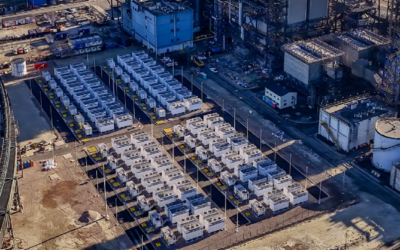
Although the government in Poland has taken steps to open up its energy storage market, regulatory challenges remain.
That is according to speakers at yesterday’s ‘Opening Markets Through Regulation’ panel discussion on Day Two of Solar Media’s Energy Storage Summit Central and Eastern Europe (CEE) 2025, which concluded yesterday (25 September).
Aleksandra Radwanska, Poland country manager for optimiser Entrix, said that two big regulations had made the Polish energy storage market easier to invest in: the capacity market (CM) and the creation of the country’s ancillary services market in June 2024.
“Before that, we didn’t have anything like a market for frequency control reserve (FCR) or automatic frequency restoration reserve (aFRR), which is right now, in theory, the most lucrative revenue stream, although there is no operational storage at scale yet. If you were to have invested in BESS a few years ago, you wouldn’t have been able to participate,” she said.
Try Premium for just $1
- Full premium access for the first month at only $1
- Converts to an annual rate after 30 days unless cancelled
- Cancel anytime during the trial period
Premium Benefits
- Expert industry analysis and interviews
- Digital access to PV Tech Power journal
- Exclusive event discounts
Or get the full Premium subscription right away
Or continue reading this article for free
However, challenges remain. Jan Sakławski, head legal advisor in Poland for developer and IPP Grenergy, highlighted challenges in the area of battery energy storage system (BESS) development.
“There is some talk in the industry about deregulating everything, but that would be wrong. What we need is wise regulation, and currently storage is under-regulated in Poland. When developing storage, you could say it is a warehouse, because there is a semantic similarity in Polish, so a spatial plan that permits for a warehouse automatically permits for storage too, which is of course ridiculous,” he said.
What is needed is precise regulations at every stage of development that pinpoint where storage can be located, he added.
Similarly discussing challenges, Radwanska said that Poland lacks a long-term plan for system flexibility needs and ways to remunerate those services.
Radwanska: “This is another kind of regulation that is very much needed to give a sense of security for our investors, because everyone is asking: how much storage do we really need in Poland? And no one really knows that. Maybe the TSOs have the ability to quantify it in an expert way, but if this knowledge is not published, it’s not useful to open the market, to really bring a solid basis for doing business.”
Moderator Phoebe O’Hara, senior associate at consultancy Systemiq and clean power lead at think tank Energy Transitions Commission, agreed and said that often it was those TSO numbers and statements that drive a market.
“I think it can’t ever be underestimated how vital it is to get clear market signals from either TSOs or governments. A lot of the work that we’ve done (at the Commission) has looked at how vital system planning now is to know what’s going to be on your grid and to communicate that to the market, to give a clear signal of what’s needed,” she said.
Radwanska also pointed out that dialogue around storage and flexibility within the energy industry is too fragmented, pointing to the example of a distribution network operator (DNO) which recently held a webinar on procuring flexibility, but made it an invite-only event.
Another panel at the event, on Day One, looked at emerging opportunities in the Baltic region.