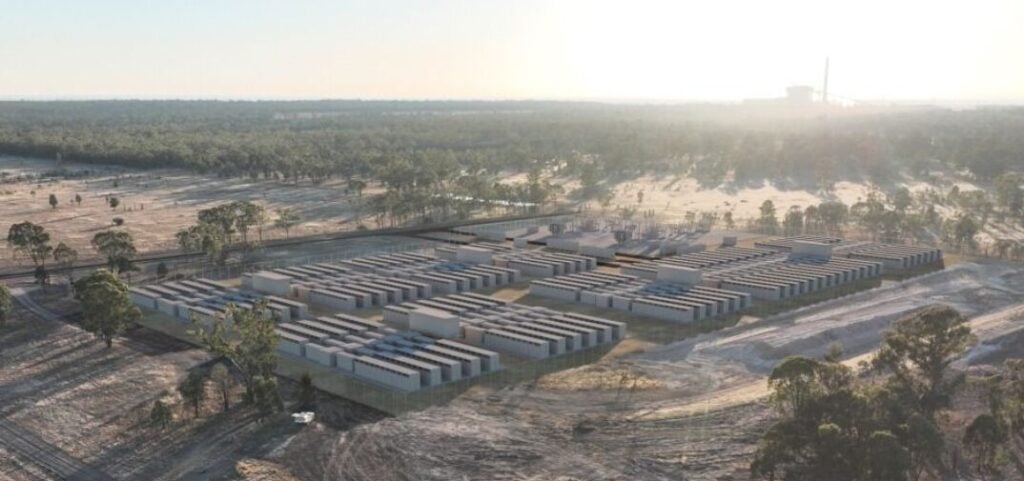
Australia’s Capacity Investment Scheme (CIS) has awarded 4.13GW/15.37GWh of battery storage capacity in its third tender round, after attracting around 135GWh of bids.
The third CIS tender, which targeted 4GW/16GWh of dispatchable capacity in the National Electricity Market (NEM), drew 124 bids totalling approximately 34GW/135GWh, demonstrating an oversubscription ratio exceeding 8:1.
Australia’s minister for climate change and energy, Chris Bowen, said the tender results represented “another massive boost to the nation’s dispatchable, clean energy capability” and would deliver substantial economic benefits beyond the energy sector.
“These projects will create thousands of jobs in regional communities while providing the flexible capacity needed to support our transition to renewables,” Bowen said.
Try Premium for just $1
- Full premium access for the first month at only $1
- Converts to an annual rate after 30 days unless cancelled
- Cancel anytime during the trial period
Premium Benefits
- Expert industry analysis and interviews
- Digital access to PV Tech Power journal
- Exclusive event discounts
Or get the full Premium subscription right away
Or continue reading this article for free
The successful projects will enter into a Capacity Investment Scheme Agreement (CISA), which provides a revenue safety net through an underwriting approach.
This financial structure provides successful projects with a floor price for capacity while capping potential windfall profits during high-price events. It reduces investment risk while protecting consumers from excessive costs during market volatility.
An average storage duration of 3.72 hours
The 16 successful projects feature an average duration of 3.72 hours. The winning bids include several battery energy storage systems (BESS) exceeding 500MWh in capacity, with at least two projects reaching the 1GWh threshold.
The government has released the complete list of 16 successful projects (below). The projects range from 100MW to 450MW, with storage durations between 2 and 4 hours.
| Project | Proponent | Technology | Capacity | State/Location |
|---|---|---|---|---|
| Bulabul 2 BESS | AMPYR Australia | 100MW (4-hour) battery | 406MWh | NSW – Wuuluman |
| Calala BESS | Equis | 150MW (2-hour) battery | 300MWh | NSW – Calala |
| Capricorn BESS | Potentia Energy | 300MW (4-hour) battery | 1,200MWh | QLD – Bouldercombe |
| Deer Park | Akaysha Energy | 275MW (4-hour) battery | 1,100MWh | VIC – Ravenhall |
| Goulburn River Standalone BESS | Lightsource bp | 450MW (3-hour) battery | 1,370MWh | NSW – Merriwa |
| Joel Joel BESS | ACEnergy Pty Ltd | 250MW (4-hour) battery | 1,000MWh | VIC – Joel Joel |
| Kiamal BESS | TotalEnergies Renewables Australia | 220MW (3.9-hour) battery | 810MWh | VIC – Ouyen |
| Koolunga BESS | Equis | 200MW (4-hour) battery | 800MWh | SA – Koolunga |
| Little River BESS | ACEnergy Pty Ltd | 350MW (4-hour) battery | 1,400MWh | VIC – Little River |
| Lower Wonga BESS | Equis | 200MW (4-hour) battery | 800MWh | QLD – Lower Wonga |
| Mornington BESS | Valent Energy Developments | 240MW (2-hour) battery | 587MWh | VIC – Tyabb |
| Mount Piper BESS Stage 1 | Energy Australia | 250MW (4-hour) | 1,000MWh | NSW – Blackmans Flat |
| Reeves Plains | Alinta Energy | 250MW (4-hour) battery | 1,000MWh | SA – Reeves Plains |
| Swallow Tail BESS | AMPYR Australia | 300MW (4-hour) battery | 1,218MWh | NSW – Bannaby |
| Teebar BESS | Atmos Renewables | 400MW (4-hour) battery | 1,600MWh | QLD- Gigoomgan |
| Ulinda Park Expansion | Akaysha Energy | 195MW (4-hour) battery | 780MWh | QLD – Hopeland |
The geographical distribution of successful projects spans all mainland NEM states, with concentrations in areas experiencing network constraints and high renewable energy penetration. New South Wales secured approximately 40% of the awarded capacity, followed by Victoria (25%), Queensland (20%), and South Australia (15%).
Specifically, New South Wales secured five projects totalling 4,294MWh, whilst Victoria secured five projects totalling 4,897MWh. Queensland secured four projects with 4,380MWh, while South Australia rounds out the list with two projects totalling 1,800MWh.
This distribution aligns with AEMO’s Integrated System Plan, which identified these regions as priority areas for dispatchable capacity deployment to support renewable energy integration and system security.
Maximising community benefits
The successful projects have committed to delivering economic benefits beyond their primary energy storage function. According to government figures, these projects will create approximately 5,800 direct jobs during construction and 420 ongoing operational positions.
The 16 projects are estimated to comprise AU$3.8 billion (US$2.54 billion) in local content, AU$218.8 million in First Nations benefits, AU$36 million in shared community benefits and AU$33.6 million of local steel.
Two of the successful projects have established First Nations equity sharing agreements, while several others have pledged to subcontract with First Nations-owned businesses and provide access to training and workforce development opportunities.
These arrangements build on precedents established in earlier renewable energy projects and reflect growing recognition of the importance of inclusive development models.
The government highlighted that partnerships with local technical and further education (TAFE) and scholarship programmes will help upskill local workforces. In contrast, local schools’ science, technology, engineering and mathematics (STEM) education initiatives aim to increase education in the energy transition.
The road ahead for the Capacity Investment Scheme
While the eastern states celebrate the success of the third CIS tender, attention is now shifting west with two new tenders currently open for Western Australia’s Wholesale Electricity Market (WEM).
Launched on 26 August 2025, Tender 5 targets 1.6GW of renewable energy generation capacity, while Tender 6 seeks 2.4GWh of dispatchable capacity, including battery storage with a minimum 2-hour duration.
Both tenders will be the first to implement a streamlined single-stage bidding process, consolidating technical and financial proposals, intended to shorten the tender duration from nine months to approximately six. This approach is designed to increase efficiency and support the timely signing of CISAs.
In an interview with ESN Premium, Nick Hawke, director of Australia’s Clean Energy Finance Corporation (CEFC), recently said this move was a positive shift for the CIS scheme.
Potential proponents are advised to register before 10 October 2025 for both tenders, with bids to close on 7 November. Successful bids into Tenders 5 and 6 are expected to be announced in March 2026. You can find out more about registering via the official website.
‘CISAs enhance revenue certainty,’ says Akaysha Energy
One of the successful bidders in the CIS Tender 3, Australian battery storage developer Akaysha Energy, took to LinkedIn to celebrate the CIS scheme. The developer secured support for two BESS projects with a combined capacity of 470MW/1,880MWh.
The successful projects include the 275MW/1,100MWh Deer Park BESS in Victoria’s Ravenhall area, previously under development by Lumea, and the 195MW/780MWh expansion of the Ulinda Park BESS in Queensland’s Hopeland region.
The Ulinda Park expansion will bring the total project capacity to 350MW/1,078MWh, with the first phase (150MW/300MWh) already nearing completion and expected to be operational in Q3 2025.
Paul Curnow, managing director and chief commercial officer at Akaysha Energy, emphasised the significance of the CIS scheme.
“These awards don’t just underline the critical role of big batteries in Australia’s energy future; they enhance revenue certainty, unlock investment, and enable us to deliver faster,” Curnow said.
Meanwhile, Atmos Renewables said that the selection of its Teebar BESS project will provide a clear pathway for constructing this 400MW/1,600MWh energy asset in Queensland.
Located near Maryborough, Queensland, the Teebar BESS will deliver four hours of energy storage, representing one of the largest battery systems awarded in the latest tender round.
“We’re proud to be playing our part in Australia’s clean energy transition – strengthening critical infrastructure, boosting grid stability, and supporting energy security,” Atmos announced on LinkedIn.
Our publisher, Solar Media, will host the Energy Storage Summit Asia 2025 on 7-8 October 2025 in Manila, the Philippines. You can receive 20% off your ticket using the code ESN20 at checkout.