Revera Energy, a Carlyle-backed energy infrastructure platform, has doubled its holding company (holdco) credit facility from US$150 million to US$300 million to fund its battery energy storage system (BESS) pipeline in the UK and Australia.
Banco Santander and Barclays led the upsize. They join Japanese investment bank Nomura, which acted as sole bookrunner and lead arranger on the original facility in February 2026.
A holdco facility is a loan made to the parent company rather than to an individual project. Revera can use it across its portfolio, typically to fund development and equity commitments, while each project raises its own debt secured against its future revenues.
Revera said the added capacity will allow it to move late-stage battery storage projects in Australia’s National Electricity Market (NEM) and the UK into construction.
Try Premium for just $1
- Full premium access for the first month at only $1
- Converts to an annual rate after 30 days unless cancelled
- Cancel anytime during the trial period
Premium Benefits
- Expert industry analysis and interviews
- Digital access to PV Tech Power journal
- Exclusive event discounts
Or get the full Premium subscription right away
Or continue reading this article for free
When Revera secured the US$150 million facility in February to support 3.4GWh of battery storage across Australia and the UK, it said the facility was expected to be upsized further in the near term.
Revera’s chief financial officer, Andy Hoffman, described the deal at the time as “a transformational step in Revera’s growth”.
Carlyle launched Revera in May 2025 as a platform for renewable energy, battery storage and green hydrogen projects in Australia and the UK, beginning with assets carved out of Amp Energy, another Carlyle-backed renewables developer. Besides BESS, it operates 158MW of solar PV plants in New South Wales and lists green hydrogen among its focus areas.
“Santander and Barclays joining Nomura reflects the track record we’ve built this year, from bringing Bungama into operation to taking Windyhill and Hunterston into construction,” Hoffman said.
“With our holdco facility now doubled, we have the capital to move our next wave of battery storage projects in Australia and the UK into construction.”
A&O Shearman acted as borrower’s counsel and Norton Rose Fulbright as lender’s counsel.
Projects in operation and under construction
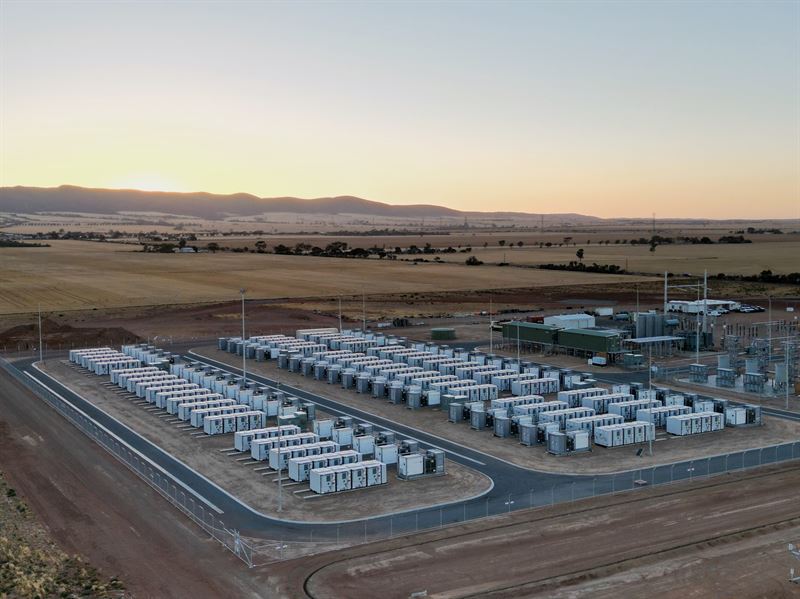
In Australia, the 150MW/300MWh Bungama BESS Stage 1 in South Australia began commercial operations in May, according to the release. The 2-hour system near Port Pirie, in the state’s Mid North region, connects to transmission network operator ElectraNet’s grid.
Finnish technology group Wärtsilä supplied its Quantum High Energy BESS, which uses 306Ah lithium iron phosphate (LFP) cells, run through its GEMS energy management software.
Construction began under Amp Energy, which closed non-recourse debt for Bungama’s first stage with Commonwealth Bank of Australia, Westpac Institutional Bank and Export Development Canada before the project moved to Revera.
After Wärtsilä, now Valo Energy, completed the 300MWh Bungama BESS as the first stage of a multi-stage programme, Revera did not disclose the full scale of later stages.
In February, the company said it had at least a further 600MW/2,400MWh of BESS in development in the NEM, with its next 250MW project expected to reach notice to proceed in the third quarter of 2026.
Revera’s Australian projects join a growing fleet in the NEM. According to analytics platform NEMPulse, 59 grid-scale BESS earned a combined AU$88.91 million (US$62.59 million) in the third quarter of 2026, with five days delivering 15% of that revenue.
In the UK, Revera reached financial close and issued notice to proceed on the 200MW/400MWh Windyhill BESS, just outside Glasgow, in February.
US power equipment company GE Vernova is supplying the BESS for Windyhill, with energy trader Danske Commodities providing a 10-year revenue floor covering all of the project’s capacity.
Under a floor, the offtaker guarantees a minimum revenue and shares in earnings above it, a structure that Danske Commodities described as “pretty well understood” in the UK, where tolling deals remain less common. Commercial operations are expected in the first quarter of 2028.
The 400MW/800MWh Hunterston BESS in North Ayrshire followed in September. Santander and Barclays, the banks leading the holdco upsize, were also among the lenders, alongside Commonwealth Bank of Australia and NatWest, that provided non-recourse senior debt for Hunterston, where Sungrow is supplying the BESS. Non-recourse debt is repaid from the project’s own revenues, not from the parent company.
A third Scottish project, the 400MW/800MWh Kincardine BESS in Fife, is progressing towards a final investment decision. Hunterston and Kincardine were first consented in 2022 as Amp Energy’s Scottish Green Battery Complex, when operations were targeted for 2024.
Together, Revera’s three Scottish projects total 1GW/2GWh and around £500 million (US$670 million) of investment, with construction at Kincardine expected to begin in the first quarter of 2027.