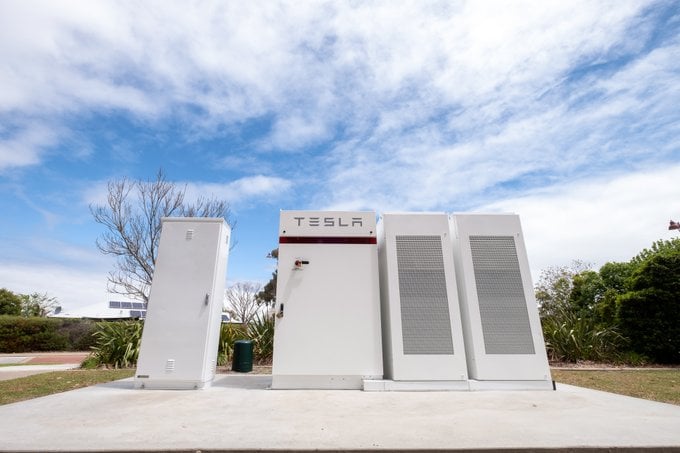
Western Australia’s state-owned electricity network operator is tendering for a “disconnected microgrid” project which could be replicated if successful, to cost-effectively give rural communities reliable and safe power supplies.
State minister for mines, petroleum, energy and corrective services Bill Johnston announced the pilot yesterday, saying disconnected microgrids “could play a crucial role in improving reliability for regional businesses and homeowners”.
Network operator Western Power is now seeking registrations of interest from companies that could help deliver a microgrid capable of operating independently from the rest of the grid. Battery storage would provide control over power, paired with renewable energy generation and with diesel generators for back up.
Western Power said preliminary feasibility assessments had shown that rebuilding its ageing 415v to 33kV distribution network could be more costly than using a distributed microgrid (DMG) to supply the same load. The distribution network is already also somewhat stretched to reach small rural towns on the grid’s edge, which already suffer reliability issues and frequent power outages.
Try Premium for just $1
- Full premium access for the first month at only $1
- Converts to an annual rate after 30 days unless cancelled
- Cancel anytime during the trial period
Premium Benefits
- Expert industry analysis and interviews
- Digital access to PV Tech Power journal
- Exclusive event discounts
Or get the full Premium subscription right away
Or continue reading this article for free
“Stand-alone power systems and microgrids remove the risk of outages caused by power supplies travelling long distances, which are exposed to plant and animal impacts, lightning, high winds, and bushfires,” Minister Bill Johnston said.
While Australia’s federal government has pushed back hard against the idea of introducing the sort of net zero emissions policy target already adopted by more than 120 national governments around the world, the country’s state governments have been more proactive.
Western Australia’s state policy targets net zero by 2050 and Johnston said DMGs can support that goal with the low-carbon emission benefits they would bring. Johnston also said his government is “committed to creating new jobs for Western Australians and exploring technological innovations that will help shape our State’s future power supply”.
In July last year the state government put solar and energy storage at the heart of its post-pandemic recovery plans, and in October 2020 said it was considering a 100MW / 200MWh battery energy storage project at the site of a decommissioned power station. Western Power is also conducting a number of community-scale battery storage trials.
Western Australia, and other regions of Australia, have already also been trying out so-called standalone power systems for remote residents, which are a similar concept to distributed microgrids, but generally are sized to only feed about five electricity customers’ loads. DMGs would offer an islanded, renewables-based power supply for entire towns.
The pilot is expected to be built in either the Mid-West, Wheatbelt or Great Southern region of the state. According to the network operator, towns in the area have a few hundred kilowatts of peak load and a few hundred kilowatt-hours of average energy usage for the majority of the year, rising to about 1,000kWh per day in weekdays during the agricultural region’s grain receival season in November and December.
Western Power is seeking third parties that could provide either a capex solution, which Western Power would own, operate and maintain; an opex solution that would be vendor owner, operated and maintained; or a combination of the two.
If the tender goes well and a provider is found, the DMG must be deliverable by June 2023. The solutions must be broadly replicable to other towns in the area.
Western Power offered more technical specifications and provider requirements, as well as answering some FAQs on its website.
Earlier this year, one Western Australian town went 100% renewable, albeit only for an 80 minute demonstration period. Nonetheless the reliance of the town of Onslow on diesel generators and natural gas has been greatly reduced since solar PV, energy storage and smart controls were installed in an ongoing project which begain in 2019.