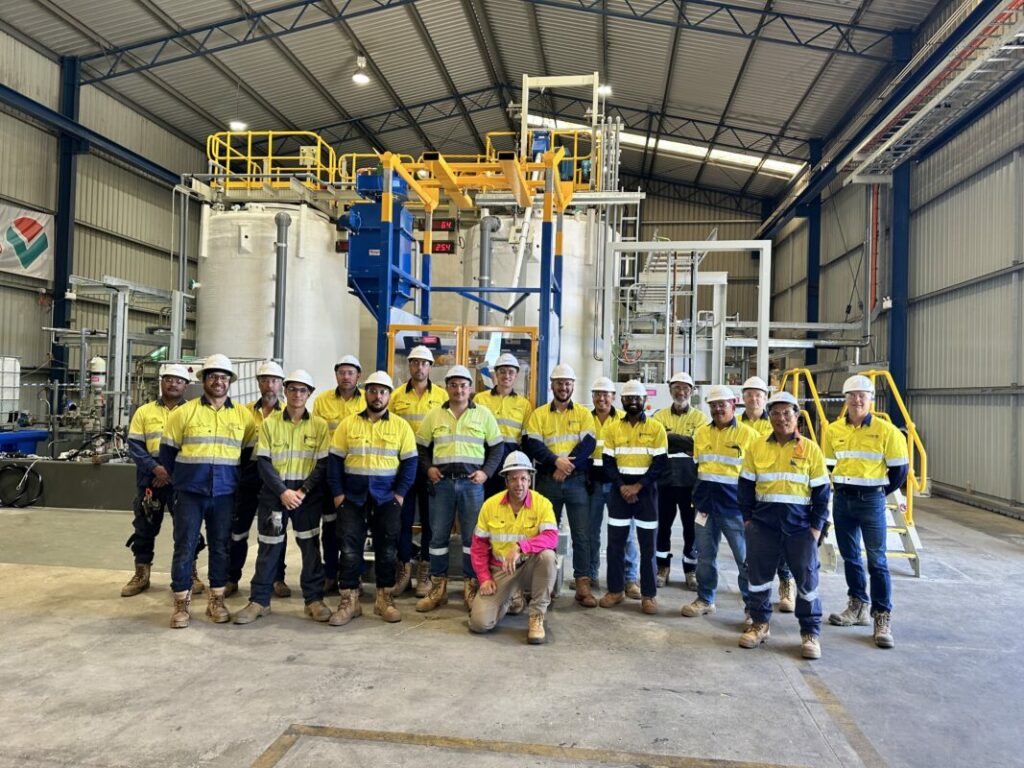
The Western Australia (WA) government has awarded AU$15 million (US$10.4 million) to Australian Vanadium Limited (AVL) for a relocatable vanadium electrolyte manufacturing facility.
The funding comes from the state’s Investment Attraction Fund (IAF) New Energies Industries Round 2. The facility will expand AVL’s electrolyte production and increase local content in the vanadium redox flow battery (VRFB) supply chain.
According to the government, the facility will be “high-capacity” and its modular, relocatable design will allow deployment across regional and industrial centres in WA.
The statement did not give the facility’s location, production capacity, total cost or construction timeline.
Try Premium for just $1
- Full premium access for the first month at only $1
- Converts to an annual rate after 30 days unless cancelled
- Cancel anytime during the trial period
Premium Benefits
- Expert industry analysis and interviews
- Digital access to PV Tech Power journal
- Exclusive event discounts
Or get the full Premium subscription right away
Or continue reading this article for free
In a VRFB, the vanadium electrolyte is the storage medium. It is held in liquid form in separate tanks and pumped through the system to store and release electricity, so a project’s energy capacity depends on the volume of electrolyte supplied.
AVL, a Perth-based vanadium developer, already operates an electrolyte plant in Perth. It completed that plant in December 2023, with support from a federal Modern Manufacturing Initiative grant, as Energy-Storage.news reported when its subsidiary VSUN Energy supplied a 78kW/220kWh VRFB for a long-duration energy storage (LDES) pilot in Kununurra with state-owned utility Horizon Power.
David Michael, WA’s minister for state development, said the IAF continues to attract projects that strengthen the state’s industrial capabilities.
“By supporting AVL’s electrolyte manufacturing capability, we’re creating new opportunities in advanced manufacturing while helping position WA at the forefront of long-duration energy storage technologies,” Michael said.
Amber-Jade Sanderson, WA’s minister for energy and decarbonisation and manufacturing, tied the award to the state’s local manufacturing policy. “Our Made in WA plan is working, with new data showing manufacturing jobs have risen 13 per cent over the past year,” she said.
The government said the IAF has supported 47 projects since it launched in 2022, awarding more than AU$215.2 million.
James Costello, CEO of Australian VRFB developer EORA Energy, said in an interview with ESN Premium in October that vanadium electrolyte is still mostly produced in China, which he put down to state subsidies and market scale.
“There’s plenty of electrolyte, but it’s just the cost of getting it,” Costello said, adding that EORA plans to source raw material from outside China for future projects.
Electrolyte supply for WA’s 500MWh Kalgoorlie VBESS
The award follows WA’s move to build a long-duration VRFB market around local supply. In November 2025, the state government launched an expression-of-interest process for a 50MW/500MWh vanadium flow battery energy storage system (VBESS) in Kalgoorlie, backed by AU$150 million in state funding.
That project has a 10-hour duration and requires WA-manufactured VRFB technology using locally sourced and processed vanadium. The state also halved royalties on vanadium products from 5% to 2.5%. Completion is targeted for 2029.
AVL has formed an exclusive partnership with Japan’s Sumitomo Electric Industries to bid for the Kalgoorlie project, and submitted its Stage Two proposal in late July. The 500MWh system alone would need more than 30 million litres of electrolyte.
The company is also studying a larger industrial application. In August, AVL signed a non-binding memorandum of understanding (MoU) with Alcoa to evaluate a 50-80MW VRFB at the miner’s WA alumina refineries, with 6-8 hours of duration and total storage of 400-640MWh. Electrolyte supply is one of the areas the scoping study will cover.
These projects remain small next to the lithium-ion BESS fleet in the National Electricity Market (NEM), which covers Australia’s eastern and southern states but not WA. Energy held in BESS across the NEM reached a record 20.17GWh on 6 November, up 203% in a year.
Never miss an Australian energy storage story. Sign up for our Australia newsletter and get the latest project announcements, policy updates and market analysis delivered directly to you.