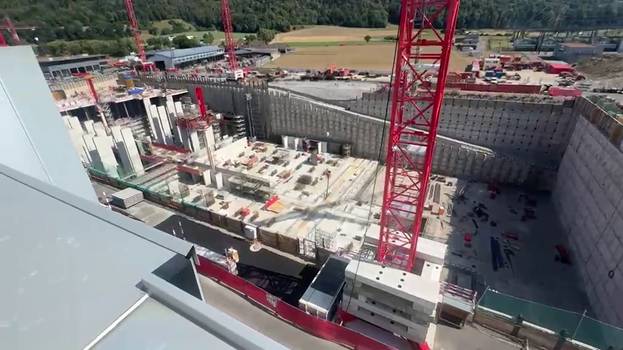
Invinity Energy Systems has hired an engineering, procurement and construction (EPC) partner for its gigawatt-hour-scale vanadium redox flow battery (VRFB) energy storage project in Laufenberg, Switzerland.
UK-Canadian flow battery tech company Invinity announced to the London Stock Exchange earlier this month (11 August), the signing of an EPC contract with buildings, infrastructure and energy services provider Equans Switzerland.
The project, planned as an initial 1.5GWh system based on Invinity’s modular VRFB solution, expandable to 2.1GWh, will be part of Laufenberg Technology Center (TZL), a large data centre campus in development by energy and digital infrastructure company FlexBase.
The VRFB installation would be the world’s largest when completed, based on current public announcements. FlexBase revealed its plan to site a 500MW VRFB in Laufenberg back in 2024, receiving construction approval from local authorities a year later.
Try Premium for just $1
- Full premium access for the first month at only $1
- Converts to an annual rate after 30 days unless cancelled
- Cancel anytime during the trial period
Premium Benefits
- Expert industry analysis and interviews
- Digital access to PV Tech Power journal
- Exclusive event discounts
Or get the full Premium subscription right away
Or continue reading this article for free
A FlexBase spokesperson told Energy-Storage.news in May 2025 that the drivers for selecting flow battery technology for TZL included its low levelised cost of storage (LCOS) when deployed at scale, non-flammable characteristics and expected durability.
The spokesperson said then that, having seen flow batteries perform at scale in Asia, it was “about time we introduce them at a bigger scale to Europe”.
Invinity said in early August that its systems deployed to date have recently surpassed 10GWh of cumulative dispatch for customers globally, with the cumulative volume of energy dispatched increasing by 85% year-on-year since 2025.
According to Invinity, engineering and detailed design activities are “well advanced” and proceeding as planned, with key construction milestones achieved to schedule.
The flow battery provider has worked with Equans before, including partnering on the delivery of a project in Belgium and Invinity CEO Jonathan Marren said the EPC demonstrated “exceptional technical capabilities, a strong safety culture and deep local expertise” through a “demanding evaluation process”.
In fact, Equans had already been named previously as working on the flow battery project when Invinity landed its contract with FlexBase in May.
However, the most recent announcement came as Marren officially signed the contracts with Equans head of building services, Daniel Zbindnen. Equans will provide mechanical, electrical and plumbing (MEP) and other technical services.
Equans Switzerland CEO Claudio Picech called the VRFB installation a “landmark project”, describing partner Invinity as a “a market leader in high quality, flexible, high-throughput BESS”. Equans said in a separate press release that the flow battery will support renewable energy integration, enhance grid stability and enable the development of sustainable power supplies for next-generation digital infrastructure.
Lithium batteries ‘could not do the job that is needed in Laufenberg’
As detailed in ESN Premium analysis piece, vanadium redox flow batteries store energy in tanks filled with liquid electrolyte based on vanadium pentoxide. Unlike lithium-ion (Li-ion) batteries, the power and energy are decoupled, with the power component in the battery stack, pumps and control systems.
This decoupling allows flow batteries to be scaled up to hold much larger capacities of energy by increasing the size of the tanks and adding more electrolyte. Conversely, adding duration to a Li-ion battery energy storage system (BESS) project requires adding more battery enclosures, complete with power electronics and other balance of plant (BOP).
This is why, although flow batteries come in at a higher Capex cost than Li-ion, their LCOS over a lifetime of ownership can be lower, and the technology could be better suited to long-duration energy storage (LDES) applications exceeding 8-hour or more.
Flow batteries also do not have cells that can enter thermal runaway or degrade, which could give them a competitive advantage in fire safety and durability.
Invinity president Matt Harper spoke with ESN Premium about the Laufenberg project in June. Harper said that not only was the project’s scale significant, but the applications it would provide to the TZL data centre would also serve as a proof point for the global energy industry.
While the world’s largest flow batteries to date have all been built in China, Harper noted that their development was driven by government policy aimed at supporting a diversified energy storage supply chain and supply security.
“Lithium batteries could do the job that those vanadium flow batteries in China are being deployed against,” Harper said.
“Lithium batteries cannot do the job that is needed in Laufenburg. And so, in terms of carving out a niche for flow batteries where they are definitively the right technology for the job, this is going to be a world first at this scale.”
It is perhaps worth noting that the CEO of another flow battery manufacturer, ESS Inc., just told ESN Premium in an interview last week that his company is basically suspending sales of new flow battery systems for a year or two.
ESS Inc. CEO Drew Buckley said that the company will focus R&D and business development efforts ahead of rolling out more products commercially. Instead, ESS Inc. is pivoting its short-term revenue generation goals to sodium-ion (Na-ion).
It is important to note, however, that ESS Inc.’s proprietary flow battery is based on an iron and saltwater electrolyte, not the more mature vanadium electrolyte tech that Invinity—and most other companies in the space—are focused on.