
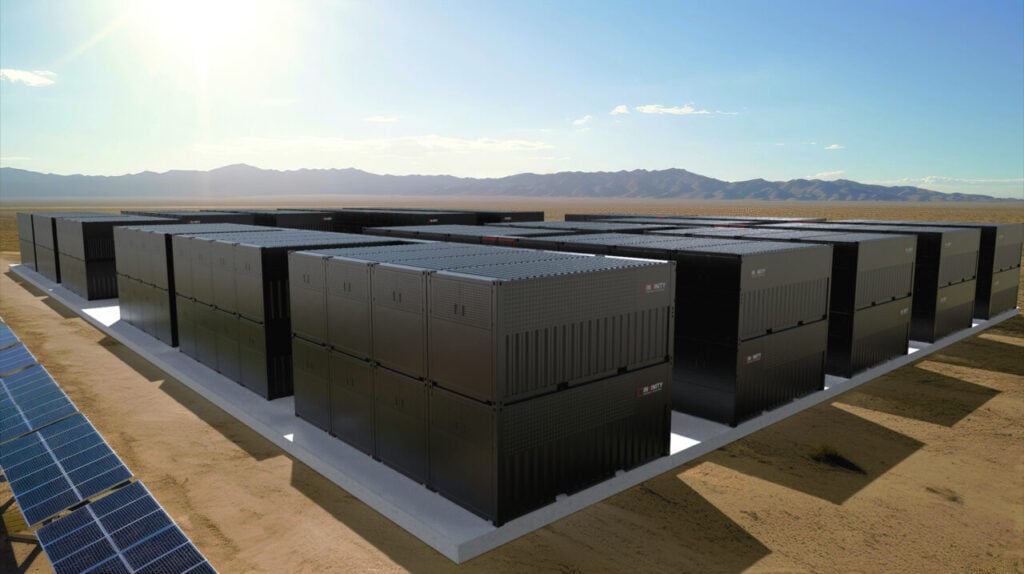
We look at the potential of flow batteries for LDES and compare the leading providers’ offerings and trajectories.
Flow batteries have a lot of potential battery energy storage systems (BESS) because they are very safe and have a practically unlimited number of cycles because the energy is stored in the electrolyte rather than the electrode. This means that while conventional battery electrodes degrade over time, the electrolyte in flow batteries can just be changed and the battery can continue running without any (or very little) capacity degradation.
Long duration energy storage (LDES) could become a 85-140TWh market by 2040, according to the LDES Council. Li-ion is still the preferred battery chemistry, but they are most effective in durations up to 4-8 hours. Flow batteries have the potential to be a more cost-effective solution for 8+ hour durations but have struggled to gain market acceptance over Li-ion despite their advantages on paper.
Flow batteries also have a lot of potential to compliment other LDES systems in the future such as pumped hydro energy storage (PHES). While PHES is one of the biggest and most efficient LDES storage systems today, they can only be used in certain geographical locations with elevation and water reservoirs, and they take a long time to construct. Flow batteries can be deployed much quicker and could be used in regions where PHES is not suitable. So, while Li-ion remains the dominant battery chemistry, multiple companies are starting to deploy flow BESS for LDES to try and disrupt the status quo.
Try Premium for just $1
- Full premium access for the first month at only $1
- Converts to an annual rate after 30 days unless cancelled
- Cancel anytime during the trial period
Premium Benefits
- Expert industry analysis and interviews
- Digital access to PV Tech Power journal
- Exclusive event discounts
Or get the full Premium subscription right away
Or continue reading this article for free
When it makes sense to use flow batteries over Li-ion for LDES BESS
While Li-ion batteries, especially lithium iron phosphate (LFP), are favoured for a lot of BESS, there comes a point where flow batteries become the more economically viable choice. For LDES, where the discharge times are a lot longer (8 hours and above) and require heavier cycling, flow batteries tend to be a lot better suited than Li-ion.
Over short duration, i.e. 4 hours and below, Li-ion technology wins for its energy density and $/kWh cost per kWh. Theoretically, Li-ion cells can discharge at slower rates to achieve longer durations, but this is not where they excel. More Li-ion containers can also be added to build scale, but there comes a point where this is not a cost-effective option.
The reason is because each Li-ion cell and container has a fixed power-to-capacity ratio. For example, this could be 200W/kg for up to 4 hours. Larger Li-ion systems are constructed by simply adding more cells and containers to the stack, which means the cost of a BESS installation scales linearly with $/kWh cost of the individual Li-ion cells.
Flow batteries are different. The power and energy are decoupled, so each of the components scale independently. The power component is the stacks, pumps and control systems, but the energy component is the electrolyte housed in electrolyte tanks. Electrolytes in flow batteries tend to be very cheap, so once the infrastructure is built, scaling up the energy part (i.e. the electrolyte) is much cheaper than scaling up Li-ion containers. So, as these systems scale, their $/kWh cost decreases whereas Li-ion remains linear.
At about 8-hour duration, flow batteries start to be a lot more cost competitive than Li-ion, and for longer LDES durations, the cost gap between the two technologies becomes even more favourable. Measuring the economics from a net present value (NPV) and levelised cost of storage (LCOS), both metrics improve the longer the system is in use and the less it degrades. So, for shorter duration storage, Li-ion is favourable, but as we get into LDES duration territory, the NPV and LCOS both become favourable for flow batteries as well.
Aside from these costs, flow batteries get more favourable in high cycling environments, such as peak shaving, grid balancing, and supporting renewable plants. This is because the degradation of flow cells is negligible compared to Li-ion batteries. Li-ion batteries are good for up to several thousand cycles (and it varies by Li-ion architecture and charge/discharge environments) before they lose enough capacity that they need to be replaced.
On the other hand, flow batteries can last well beyond 20,000 cycles, and if the electrolyte is replaced regularly and the infrastructure maintained, they could in theory just continue cycling until decommissioned, so are ideal for frequent cycling. Many flow batteries come with at least a 25-year guaranteed life span and degrade very little over this time.
While a lot of the considerations are purely economic, there are other factors that make flow batteries a compelling option for LDES. On one hand, they are much safer than Li-ion, which can suffer from thermal runaway. This can increase the insurance, siting and permit costs of Li-ion installations. Flow batteries don’t undergo thermal runaway because they use non-flammable, water-based liquid electrolytes. At the end-of-life (EoL), there is still a lack of recycling options for lithium-based BESS, however, a lot of EoL value is retained in flow batteries because the electrolyte is reusable, as are some of the components.
Who benefits the most from using flow batteries for LDES?
Flow batteries make economic sense for LDES over Li-ion, especially in high cycling environments, such as renewable energy plants, island grids, data centres, C&I sites and grid-scale LDES. Capital expenditure (Capex) is often used to directly compare Li-ion batteries to see which will be the most cost-effective. This doesn’t work when compared Li-ion against flow batteries as they improve economically as duration increases, don’t degrade, and have a much longer lifetime that is often ignored by Capex metrics. That’s why NPV and LCOS metrics tend to be used, and for LDES, flow batteries outperform Li-ion in both metrics.
According to The Faraday Institution LDES flow batteries will benefit developing economies the most and could help to improve grid stability and reliability in countries with unstable grids, as well as remote and off-grid locations. A lot of these grids could combine flow LDES with solar power to provide a reliable back up. Of all countries, it’s been proffered that South Africa, Indonesia, Thailand and India are the most promising developing markets for flow battery LDES. While smaller duration is not typically favoured, the exception is island communities that are disconnected from the grid, as many small islands rely on fossil fuel generators and flow batteries offer a more cost-effective option than these generators in the long-term.
Indonesia has been highlighted at the most promising Southeast Asia country for flow battery development because their mining and industrial sectors could benefit from flow batteries as the industries scale further. The potential in South Africa is also being driven by the mining industry, but also the increase in data centres coupled with an energy grid that has a poor reliability—and could benefit from resilient energy storage systems. In India, the combination of a large population with growing mining, industrial, and high technology sectors will help the grid to expand in line with both population and economic growth.
Both India and Thailand, along with other ASEAN nations such as Vietnam, could utilise flow batteries to improve the resilience of the grid with the increased number of electric two and three wheelers hitting the road—as many ASEAN nations are trying to shift to electric scooters (and some countries have a lot on the road) to battle constant pollution issues. So, flow batteries could help with the rollout of new charging infrastructure and stabilising the variable load demands that come when multiple EVs are connected intermittently to the grid.
The companies who have deployed LDES flow batteries at scale
There are different flow batteries available, with different companies developing them for a range of grid-scale, residential-scale, and commercial and industrial (C&I) storage applications. Out of all the flow cells, vanadium redox flow cells (VRFBs) are the most popular because the ability for vanadium ions to adopt 4 valence states (V4+/V5+ on one side of the flow cell and V2+/V3 on the other side) reduces potential cross-contamination of electrolytes and provides a longer usable life. However, other options are being commercially accepted, including iron flow and organic flow cells, and we look at how these are all being implemented in commercial LDES projects.
Rongke Power: vanadium redox flow batteries (VRFBs)
Rongke Power is one of the biggest companies in the flow battery space, with large-scale installations in China. Rongke Power has three different VRFB products: UPower, Spower, and flow battery stacks.
The Upower series is a 10kW/40kWh unit with a 4-24 hour duration, and over 20,000 cycle life. The Spower series is a 240kWh unit with a 25,000+ cycle life, while the battery stacks come as 10kW, 30 kw, 42kW units with over 20,000 cycle life. The different VRFBs are all designed to work within a storage temperature range of 15-50°C, have a 100% depth of discharge (DOD) without degradation, with a rated power charge/discharge efficiency of at least 80%. Over a 25-year lifespan, Rongke has claimed that its VRFBs show a lower LCOS than lithium batteries. At 8- and 12-hour durations, the gap gets even bigger due to the overbuild required in lithium batteries.
Rongke Power currently has a number of large-scale installations with over 3.5GWh globally installed capacity. These include the CTG Jimusaer ESS, which was the first GWh-scale VRFB and currently thought to be the largest operational VRFB system in the world at 200MW/1,000MWh. It has been designed to support large-scale renewable energy integration.
Rongke also has the largest grid-forming energy storage system using a VRFB in the Xinhua Ushi ESS project, which has an installed capacity of 175MW/700MWh and a 4-hour duration. Rongke also has the largest city centre VRFB project in the Dalian ConCurrent Energy Storage Project. This is being installed in two phases to enhance grid stability and deliver a total capacity of 200MW/800MWh, with 100MW/400MWh being installed in each phase.
However, VRFBs have been able to scale in China because of the cost of labour is much lower, allowing companies to build projects on site. Companies outside China have on the other hand had to build modular solutions that can be manufactured at scale in a factory and shipped to site with relatively simple installation processes (as lithium-ion BESS are).
Stryten Energy: vanadium redox flow batteries (VRFBs)
Stryten Energy is a US company that has partnered with Largo Inc to launch Storion Energy, which is making modular VRFBs and is also focused on developing more robust US supply chains for vanadium and vanadium electrolytes. Not many specifics have been given on the VRFBs other than they have a cycle life stable in temperatures up to 50°C, the potential for an unlimited cycle life with proper maintenance, are scalable from kWh to MWh, and have a cost-effective discharge time greater than 6 hours.
Their VRFBs have been designed for medium to long duration energy storage, typically 4-12 hours, with cited uses across microgrids, utility-scale storage, data centres, military base applications, and managing renewable energy generation in remote and isolated areas. The company uses a vertical supply chain strategy called ‘Earth to Energy’ and has stated that this will help bring the LCOS of their VRFB LDES to below US$0.05/kWh to meet the US Department of Energy’s (DOE) LDES goals.
On the projects side, the biggest one to note so far is a joint project with Terraflow. This is a 9.6MW/48MWh, 5-hour duration VRFB project in Bellville, Texas. This installation is one of the largest LDES installations in Texas today.
Invinity Energy Systems: vanadium redox flow batteries (VRFBs)
Invinity Energy Systems is the biggest non-Chinese company in the VRFB space and creates modular systems for grid-scale, C&I, and data centre LDES applications. Invinity has two key systems, Endurium and Endurium Enterprise. These batteries have been designed to deliver a low LCOS and Invinity have stated that it can deliver power at 25-30% less cost than Li-ion systems with 3.8x lifetime energy throughput.
Endurium has been designed for large-scale utility projects with a rated power between 3-100+MW, 12-500+MWh energy storage, and a 4-18 hour discharge duration without cycle limits. On the other hand, Endurium Enterprise has been designed for C&I applications with a rated power of 1-20MW, 4-80MWh energy storage and 3-18 hour discharge duration without cycle limits. Both the systems have been designed for over 25 years constant cycling and can undergo 100% DOD.
The following table compares the more detailed specifications of the two Invinity products:
| Specification | Endurium™ | Endurium Enterprise™. |
| Rated Power | 3-100+MW | 1-20MW |
| Discharge Duration | 4-18 hour | 3-18 hour |
| DC voltage range | 800-1240 VDC | 400-650 VDC |
| Capacity | 1200kWh | 640-700kWh |
| Max DC power (2 power blocks) | 200kW | 150kW |
| Max DC power (3 power blocks) | 200kW | 188kW |
| Energy Density | 104MWh/Acre | 85MWh/Acre |
| Round Trip Efficiency (RTE) Rated Power | 75% | 68-69% |
| RTE maximum | 80% | 74% |
| Annual Energy Degradation | Less than 0.5% | Less than 0.2% |
Invinity is involved in over 90 projects across 17 countries on five continents and has so far deployed or contracted over 190MWh of storage capacity. The biggest ones currently include the biggest VRFB deployment in Europe at Copwood, East Sussex, UK. This 20.7MWh system is being installed alongside 2MW solar, with the aim of 3 to 18 hours of energy dispatch. It is expected to begin commercial operations in the latter part of 2026.
Invinity has also delivered a 5MWh VRFB to Energy Superhub Oxford in England. This is an EDF-owned project that is providing 2-10 hour durations for bolstering local grid services and energy trading, as well as for supporting the UK’s largest public EV charging hub. Invinity’s VRFBs have also been paired with a tidal power and a green hydrogen electrolyser in conjunction with the European Marine Energy Centre (EMEC). A 1.8MWh system has been deployed alongside a tidal turbine and a 670kW ITM power electrolyser on the island of Eday, Scotland. In 2025, a 30MWh system was also deployed to a confidential partner in conjunction with UK Department of Energy Security & Net Zero.
As we’ve moved in 2026, Invinity has stated that it has achieved a 36% cost reduction since Endurium’s launch and is continuing to deploy its systems in more projects. Current projects for the year so far include 14MWh utility pilot project with Taiwanese company Everdura, and several confidential projects, including a 72MWh project in conjunction with the US DOE Office of Clean Energy Demonstrations, a 14MWh project with the US DOE, and a 11MWh project in Hungary.
ESS Tech Inc: Iron-flow batteries
The US company ESS Tech Inc manufactures modular iron flow batteries based on proprietary tech and design, but has shown laggard financial performance with low revenues and continuous losses.
Like other flow batteries, they have a potentially unlimited cycle life if maintained correctly, and ESS systems offer a discharge duration of 8-22 hours and a design life of at least 25 years. Like many other flow battery manufacturers, ESS has stated that it is on track to meet the DOE’s LDES target of $0.05/kWh by 2030.
ESS flow systems can deliver up to 300 MWh/acre energy density and gigawatt-scale capacities and have been developed for a range of utility-scale and C&I projects. Below is a list of some of the main large-scale projects being implemented by ESS and its partners:
- A single 75 kW/500 kWh system installed at Schiphol Airport, Amsterdam, that is seen as a key facilitator for phasing out diesel ground power units. The flow system is used to charge their electric ground power units.
- Microgrid project in Pennsylvania that has integrated a 115kW solar array with a flow battery
It also announced a 50MW/500MWh at Boxberg Power Station—a coal-fired generator in Eastern Germany—in conjunction with LEAG in June 2023, although no project updates have been provided since it was announced.
The company initially built its offering around its Energy Warehouse and Energy Center products but in the last year or two has pivoted to promote its Energy Base, which is aimed at much larger projects than the previous two and is targeting renewables and data centre applications.
It had largely failed to scale with the previous two products, with quarterly revenues rarely going above a few million despite raising hundreds of millions of dollars in a SPAC listing in 2021. This culminated in August 2025 with a warning to investors regarding its ability to survive another financial year. Its future now hinges on the Energy Base.
CMBlu: organic flow battery
CMBlu is developing organic flow batteries that use carbon-based molecules for the electrolytes instead of metal ions. Like metal-based flow batteries, there is the potential for an unlimited cycle life with correct maintenance, and the company has stated that its systems go up to GWh range, have DC-to-DC round-trip efficiencies up to 90%, can store 200kWh of energy, and have an output power of 40kW.
CMBlu is involved with a number of different projects, including:
- A 5MW, 10-hour pilot project to maintain grid stability in the Phoenix area
- A 1-2MWh, 5-10 hour project at the WEC Energy Group’s Valley Power Plant in Milwaukee. This is a cogeneration plant that can sometimes generate too much electricity, so flow batteries are being used to store the excess energy for later use.
- The delivery of 5GWh flow systems to Uniper in Germany
- Supplying Mercedes Benz in Rastatt, Germany with an 11MWh installation for pairing with their solar arrays.
- A partnership with SRP and Google for analysing CMBlu’s 5MW/50MWh project—it’s first large-scale commercial project—that will come online in 2027.
Final thoughts
Overall, flow batteries are being deployed at scale around the world for a range of utility, industrial and C&I energy storage applications. While VRFBs are the main flow battery technology being deployed today, a number of other flow battery systems are also helping to establish flow batteries as a competitive LDES technology today.
