A 2.1GWh, data centre-paired vanadium redox flow battery (VRFB) project in Switzerland will be among the first of its scale that represents a specific use case for the technology, the president of design partner Invinity Energy Systems told Energy-Storage.news.
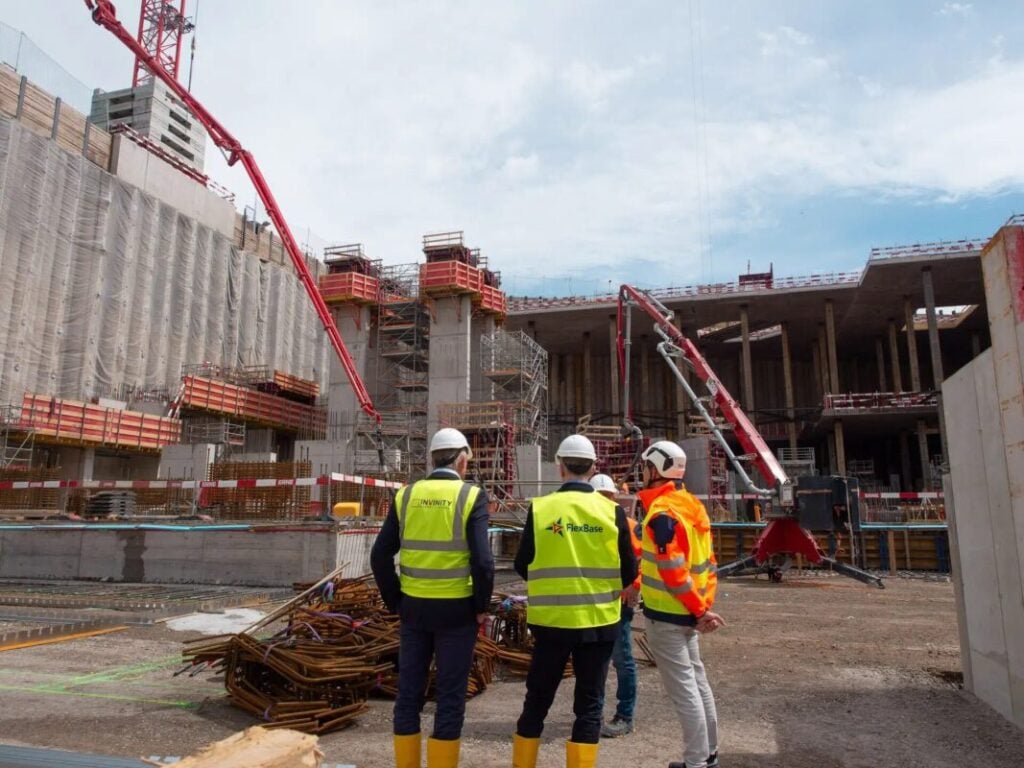
Invinity recently won a contract for the design of the 1.5GW/2.1GWh flow battery project being deployed along with a data centre being developed by Swiss company FlexBase. FlexBase got construction approval for the 800MW phase 1 in January.
There is no contract for the supply of the VRFB modules yet, Invinity president Matt Harper told us, but it should hopefully move quickly to module construction later this year. Ground works are underway and the design stage involves working out how Invinity’s product will be configured on site. Its initial agreement is for 1.5GWh of capacity, possibly relating to the first phase only.
The project is by far the largest VRFB system under development in the world, even including China. But even those projects in China that precede it don’t really reflect the niche use case for flow batteries in the way that this Switzerland project does, Harper claimed.
Try Premium for just $1
- Full premium access for the first month at only $1
- Converts to an annual rate after 30 days unless cancelled
- Cancel anytime during the trial period
Premium Benefits
- Expert industry analysis and interviews
- Digital access to PV Tech Power journal
- Exclusive event discounts
Or get the full Premium subscription right away
Or continue reading this article for free
“Obviously the scale is significant. We’re going to be able to deliver a vanadium flow battery for one of the largest battery installations in the world, that’s really remarkable,” Harper said.
“And if you look at the vanadium flow batteries that are being installed in China, they’re being installed because of a policy trying to focus on the security of supply. Lithium batteries could do the job that those vanadium flow batteries in China are being deployed against.”
“Lithium batteries cannot do the job that is needed in Laufenburg. And so, and so in terms of carving out a niche for flow batteries where they are definitively the right technology for the job, this is going to be a world first at this scale.”
Why a flow battery
Considering that the planned system is short-duration, the choice of flow battery technology for it is an interesting one. We asked Harper why Flexbase opted for it rather than lithium-ion.
“The number one reason is fire safety. If you’re going to install billions of dollars worth of GPUs on the floors above a battery system, you need to make sure that you’ve got a very, very high degree of battery fire safety. They looked at lithium options, they did not see that as something that was available in that space,” he explained.
But the other aspect that makes flow batteries applicable here is the use case, which relates to his earlier point about this project being the first of its scale.
Harper: “The other aspect of it is the sort of operational flexibility needed of the battery itself. If you look at data centres in general, there’s a huge breadth of load. Hundreds of times a day, you might be going from zero load to 100% load and you need a battery that can manage those massive fluctuations in load over the course of the day, for 20 years, without degrading.”
Manufacturing and fitting this in with other potential projects
There is also the question of how the company will have to ramp up its manufacturing capacity, if the design phase is successfully concluded and Invinity gets the supply contract. Its biggest project to-date has been 20.7MWh, in the UK.
The firm currently has 500MWh of annual manufacturing capacity across various sites, but that is around its standard product, which is longer in duration.
So the constraint in this case will be in the power stacks, which determine the megawatt (MW) power output, and not the electrolyte tanks which determine the megawatt-hour (MWh) energy storage capacity.
“The nice thing about this project is that it’s big enough that it opens some of the more conventional forms of capital equipment financing to us, so we’re not necessarily going to be beholden to new funds into the company. There’s a lot of different ways that you can finance manufacturing capacity at this scale,” Harper explained.
There are also projects currently being assessed for the UK’s long-duration energy storage (LDES) cap and floor scheme which aim to use Invinity’s tech, potentially also totalling in the gigawatt-hours. When asked if the firm could feasibly deliver on both these and Flexbase’, Harper pointed out that the latter will be completed much sooner.
We recently published a feature looking at the key flow battery technologies commercialised worldwide and why, despite various benefits, the technology has not yet taken off for LDES. Projects like this one may well mark an inflection point for it.