India Grid Trust (IndiGrid) and development finance institutions from Great Britain and Norway have launched a transmission and battery storage development platform.
IndiGrid is India’s first publicly listed infrastructure investment trust focused on the power sector, established in 2016. It is backed by US investor Kohlberg Kravis Roberts & Co (KKR) and Indian power transmission company Sterlite Power.
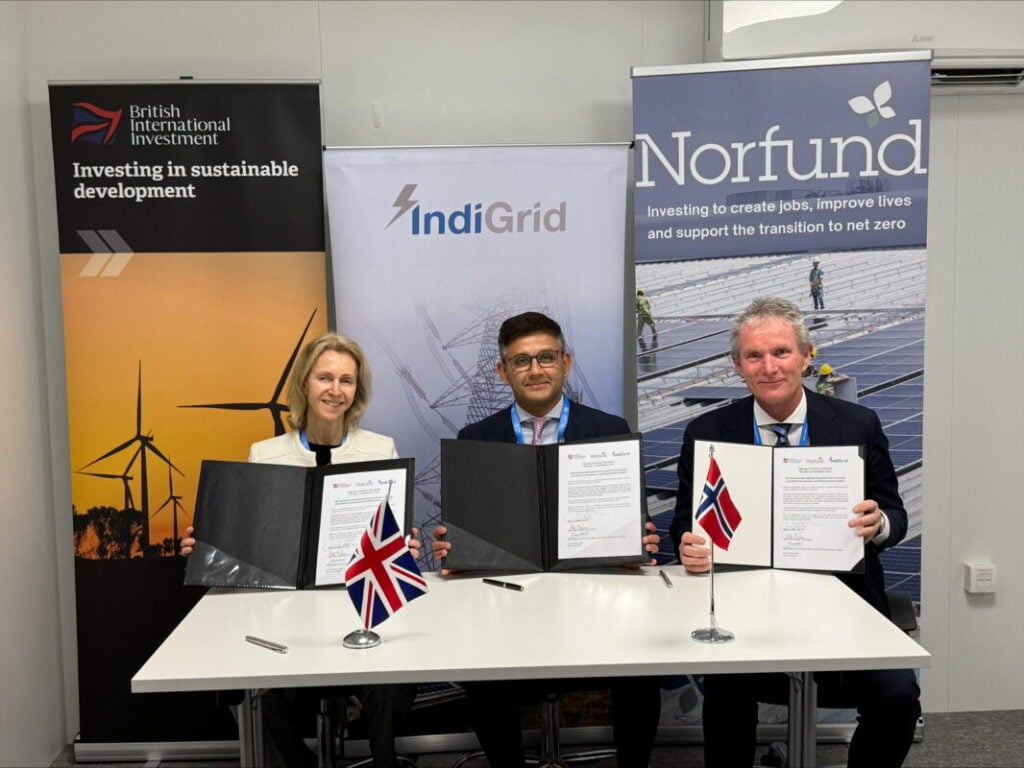
The New Delhi-headquartered trust said today that it has partnered with British International Investment (BII) and the Norwegian Climate Investment Fund to launch the new platform, EnerGrid.
The new company will develop greenfield transmission and standalone battery energy storage system (BESS) projects in India.
Try Premium for just $1
- Full premium access for the first month at only $1
- Converts to an annual rate after 30 days unless cancelled
- Cancel anytime during the trial period
Premium Benefits
- Expert industry analysis and interviews
- Digital access to PV Tech Power journal
- Exclusive event discounts
Or get the full Premium subscription right away
Or continue reading this article for free
CEO Harsh Shah said that while IndiGrid itself will continue to pursue the acquisition of “synergistic brownfield projects,” the new platform can chase other opportunities, including unprecedented growth in the transmission development pipeline and India’s urgent need for energy storage to support its renewable energy policy goals.
Each of the three partners has committed to investing around US$100 million for a total of US$300 million, which IndiGrid claimed gives EnerGrid the capability to pursue US$1.2 billion worth of projects ‘over the next few years’.
BII is the UK government’s development finance institution, while the Norwegian Climate Investment Fund is managed by Norfund, the Nordic European country’s development finance institution owned by its government Ministry of Foreign Affairs.
The deal was signed at the COP29 United Nations (UN) climate talks in Baku, Azerbaijan. The conference’s Azerbaijani presidency is encouraging governments to sign up to a pledge to enable the deployment of 1.5TW of energy storage by 2030.
The presidency said this would make the shared goal of tripling the world’s renewable energy capacity by then much more feasible.
Meanwhile, a new series of reports from the International Renewable Energy Agency (IRENA) Coalition for Action is being published with non-governmental stakeholder recommendations for promoting investment in solar PV, grids and energy storage.
India needs 74GW of energy storage, 170,000km of new transmission by 2032
IndiGrid, listed on the Securities and Exchange Board of India (SEBI), is one of the developers of what was claimed to be the country’s first-ever commercial standalone BESS project when it won regulatory approval in May.
That project is a distribution system-connected 20MW/40MWh BESS asset that will help electricity distribution company (‘discom’) BSES Rajdhani Power Limited (BRPL) increase the uptake of variable renewable energy (VRE) on its network in Delhi.
IndiGrid, BRPL, and the Global Energy Alliance for People and Planet (GEAPP) are co-developing the project.
At last year’s COP28, GEAPP launched the Battery Energy Storage System Consortium (BESS Consortium), through which 11 countries, including India, have pledged to promote the deployment of 5GW of storage in low- and middle-income countries by the end of 2027. Within India, the BESS Consortium is targeting a 1GW pipeline of projects, with the jointly developed project marking the first in that endeavour.
From a big-picture perspective, India is targeting net zero emissions by 2070 and the deployment of over 500GW of energy from non-fossil fuel sources—primarily solar PV and wind—by the end of this decade.
To that end, the national Central Electricity Authority (CEA) projected a requirement for 82.37GWh of energy storage by the 2026-2027 financial year. This would then scale up to 74GW/411.4GWh of energy storage by the 2031-2032 financial year, including 175.18GWh of pumped hydro energy storage (PHES) and 236.22GWh of battery storage.
At the same time, as noted by IndiGrid in its release today, the CEA has estimated that more than 170,000km of transmission lines will need to be built within the next eight years to accommodate new renewables and strengthen the grid while extending electricity access to rural populations.
To date, national and regional authorities such as the Ministry of Power’s Solar Energy Corporation of India (SECI) and state-owned power producer National Thermal Power Corporation (NTPC), along with regional discoms, have tendered for multiple gigawatts of storage, including standalone and renewable energy hybrid projects, while many gigawatts of pumped hydro developments have been fast-tracked in recent months.